
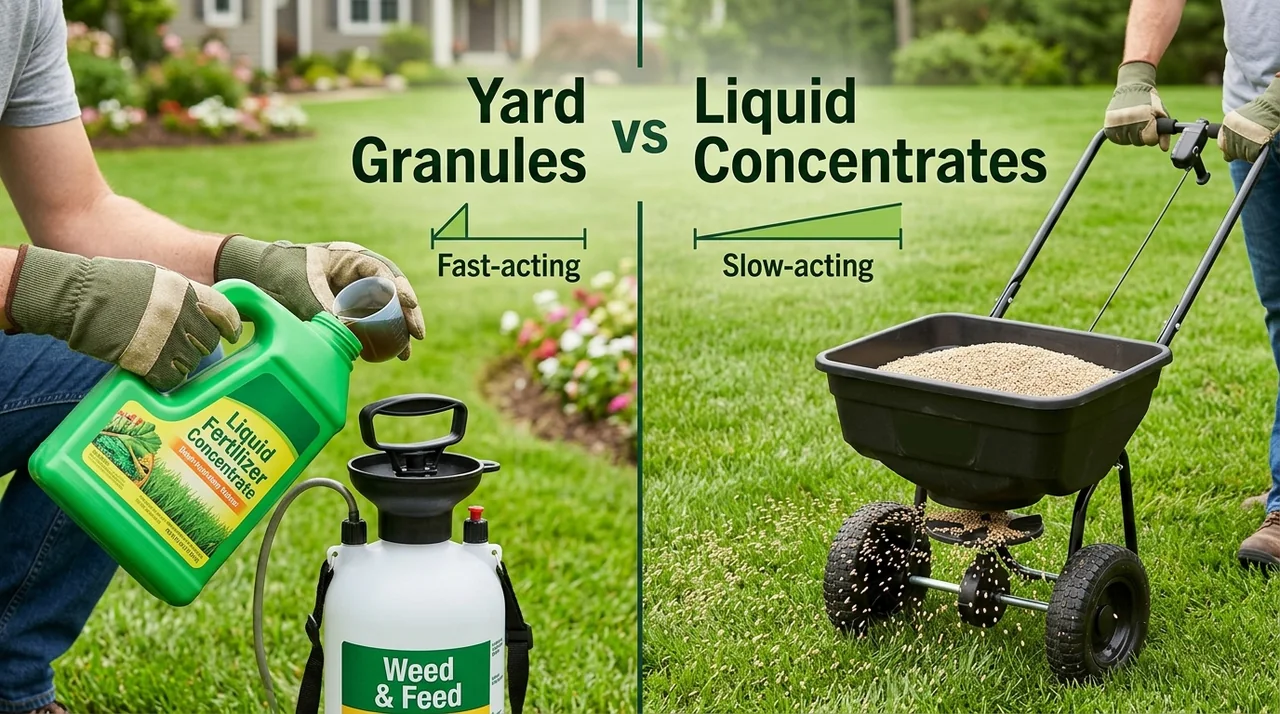


When you shop for yard pest control you'll face the same fork every time: granules or a liquid concentrate. Both can carry similar active ingredients, but they're built for different jobs. Choosing by where the pest lives — down in the turf and soil, or entering along your foundation — makes the decision straightforward.
Granules
Granules are dry particles spread with a broadcast or drop spreader. They sit on the surface and release their active when watered in by irrigation or rain. Their strengths:
- Excellent for treating soil and turf where pests live in the thatch and ground — fleas, ants nesting in the lawn, mole crickets, and other lawn pests
- Easy to apply evenly over broad areas with no mixing
- Low drift, and simple for beginners with just a spreader
Liquid Concentrates
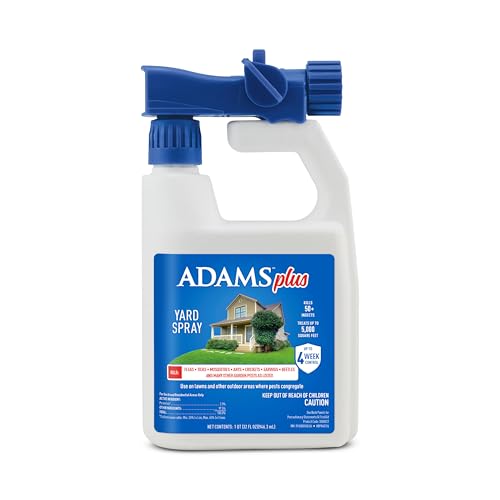
Liquid concentrates are measured, mixed with water, and sprayed through a hose-end or pump sprayer. They coat surfaces on contact and cling to foundations, cracks, and vertical walls — which makes them the natural choice for a perimeter barrier and crack-and-crevice work. Advantages:
- Immediate surface contact and faster action
- Precise placement exactly where insects enter
- Adjustable coverage for spot or band treatment
Which to Use for What
The simple rule: broadcast turf and soil pests with granules; defend the foundation and entry points with a liquid. Fleas, lawn ants, and mole crickets spread across the yard suit granules; a barrier around the base of the house, doorways, and vertical surfaces suits a liquid concentrate. Many complete programs use both — granules over the lawn and a liquid band along the foundation — because each covers a gap the other leaves. Think of granules as treating the "floor" your pests live in and liquid as treating the "walls" they cross to get inside.
Coverage and timing shape the results too. Granules need to be spread evenly at the labeled rate and then watered in reasonably soon, so applying them just before a light rain — but not a downpour that washes them off pavement — is ideal. Liquids should go down on a dry, calm day so the deposit can bind to the surface before rain, and a fresh reapplication is usually needed after heavy storms strip the barrier away. For most homes, a practical rhythm is a granule treatment across the lawn in the warm season when soil pests are active, refreshed as the label allows, plus a liquid perimeter band renewed on the label's schedule to keep invaders from crossing into the house.
Applying Either Safely
One rule applies to both, and especially to concentrates: mix and apply strictly at the labeled rate. More is not better — it's illegal off-label use that wastes product, raises exposure risk for people, pets, and beneficial insects like bees, and can burn your plants. Water granules in as the label directs so they activate, keep everyone off treated areas until dry or settled, and store products sealed and away from food. Follow the EPA-registered label, and call Poison Control at 1-800-222-1222 for any accidental exposure.


