Squash Vine Borer
Melittia cucurbitae · also called squash vine borers, vine borer
Quick answer
The squash vine borer (Melittia cucurbitae) is a fat white grub that tunnels inside squash, zucchini, and pumpkin stems, causing plants to wilt and collapse suddenly. The adult is a wasp-like clearwing moth that flies by day. Common east of the Rockies, it is a frustrating garden pest but is completely harmless to people.
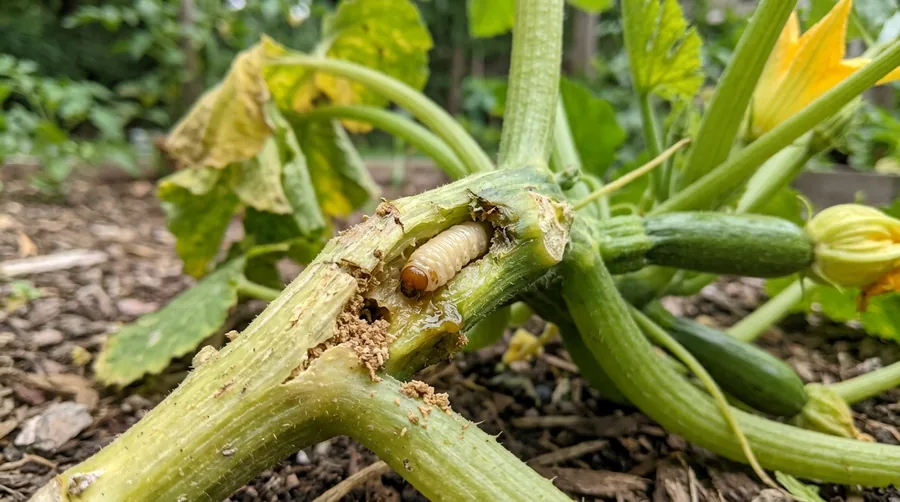
Fat white squash vine borer larva inside a split squash stem with sawdust-like frass
Recommended Products


What it does
The larva bores into the base of a squash-family stem and tunnels inside, feeding on the tissue that carries water to the plant. This cuts off the flow, so the vine wilts and often collapses within days, sometimes after the plant looked perfectly healthy. Wet, sawdust-like frass pushed out of the entry hole is the classic clue.
Where it lives
A pest of squash, zucchini, pumpkin, and gourds, it is common in gardens and small farms east of the Rocky Mountains. The day-flying adult moth appears in early to midsummer. The larva feeds inside the stem, then the mature larva or pupa overwinters in a cocoon a few inches down in the soil.
How it breeds
In early summer the adult moth lays small, flat brown eggs singly on stems near the base of the plant. Larvae hatch, bore in, and feed inside the stem for four to six weeks before dropping to the soil to pupate. There is usually one generation a year in the North and two in the South.
What it eats
Larvae feed inside the stems of cucurbit plants, especially squash, zucchini, pumpkin, and gourds; hard-stemmed varieties like butternut are more resistant.
Identification
The larva is a fat, wrinkled, white grub up to 1 inch with a brown head, found inside the stem. The adult is a striking day-flying clearwing moth that mimics a wasp, with an orange-red and black body and clear hindwings. Wilting vines plus frass at the stem base confirm it.
Signs of an infestation
- Sudden wilting of squash or pumpkin vines in summer
- Sawdust-like frass at holes near the stem base
- A soft, mushy, hollowed-out lower stem
- A fat white grub found when the stem is split open
- Wasp-like orange-and-black moths flying by day
Prevention tips
- Watch for the adult moth in early summer and time defenses to it
- Wrap or mound soil over the lower stem to block egg-laying
- Use floating row covers until plants flower, then remove for pollination
- Plant a second, later crop to escape the main flight
- Remove and destroy infested vines and till soil in fall
Professional solutions
Squash vine borers are hard to control once inside the stem, so prevention matters most; some gardeners slit the stem to remove the larva by hand. For repeated losses, a local extension office can advise on timing insecticide to the adult flight and egg-laying, since sprays cannot reach larvae already tunneling inside.
Health & safety
Squash vine borers do not bite, sting, or spread any disease to people or pets, so they are harmless despite the adult's wasp-like look. The damage is confined to garden plants: infested vines wilt and die, which can wipe out a squash or pumpkin planting.
Relevant Products


Frequently asked questions
Why did my squash plant suddenly wilt and die?
A squash vine borer larva tunneling inside the lower stem is the most common cause of sudden squash wilt. Check the stem base for sawdust-like frass and a soft, hollowed section; splitting the stem often reveals a fat white grub inside.
Can I save a squash plant with a vine borer?
Sometimes. If you catch it early, slit the stem lengthwise, remove the grub, then mound moist soil over the wound so the vine can root and recover. Burying stem nodes along the vine also encourages backup roots.
Fact-checked by Morgan Vance, Editorial Director (editorial review, not a professional pest-control or medical sign-off). Last reviewed June 27, 2026. We correct anything a reader shows us is wrong — see our corrections policy.