
Spruce Budworm
Choristoneura fumiferana · also called eastern spruce budworm, budworm, fir budworm
Quick answer
The spruce budworm (Choristoneura fumiferana) is the reddish-brown caterpillar of a native moth and one of the most destructive defoliators of spruce and fir in North America. Larvae chew opening buds and new needles each spring, browning and thinning conifers. It harms trees, not people, and rarely enters homes.
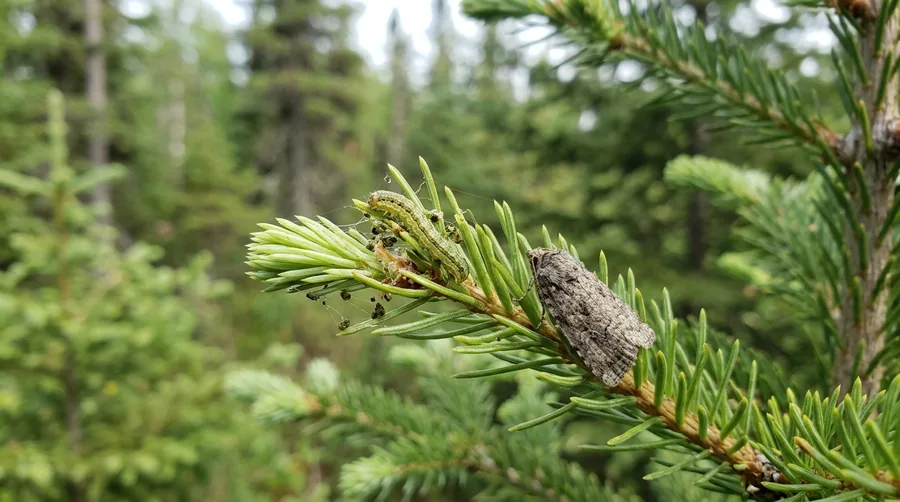
Reddish-brown spruce budworm caterpillar feeding on green spruce needles
Recommended Products


What it does
Larvae feed on the expanding buds and new needles of spruce and fir, webbing shoot tips together with silk as they eat. Feeding concentrates on the current year's growth, so damage shows as reddish-brown, scorched-looking branch tips. Repeated years of defoliation weaken and can eventually kill mature conifers.
Where it lives
This is a forest and landscape pest of balsam fir, white spruce, and related conifers. It is native across the northern US and Canada, with related budworms in the Rockies and Pacific Northwest. On home properties it appears on ornamental and shade spruce and fir, not inside the house.
How it breeds
There is one generation a year. Grayish moths lay egg masses on needles in mid-summer; tiny larvae hatch, then overwinter in silk shelters without feeding. They emerge in spring to mine buds and needles, feed for several weeks, pupate, and emerge as moths. Outbreaks build and collapse over multi-year cycles.
What it eats
Larvae eat conifer buds, developing shoots, and fresh needles, strongly preferring balsam fir and white spruce. Adult moths do not damage foliage.
Identification
Mature larvae are about 20-30 mm, reddish-brown to olive with pale spots along the body and a dark brown to black head. Early feeding leaves shoots webbed with silk and frass. Adult moths are mottled gray-brown with a roughly 20-25 mm wingspan.
Signs of an infestation
- Reddish-brown, scorched-looking new growth at branch tips
- Silk webbing binding needles and shoots together
- Chewed, ragged buds and partial needles in spring
- Frass (droppings) caught in webbed foliage
- Thinning, top-down defoliation over successive years
Prevention tips
- Keep landscape spruce and fir vigorous with proper watering and mulching
- Avoid drought stress, which worsens outbreak damage
- Prune and remove severely weakened or dying conifers
- Encourage birds and natural parasitic wasps that prey on larvae
- Have valuable specimen trees inspected during regional outbreaks
Professional solutions
For prized landscape conifers during an outbreak, a certified arborist can time treatments to early larval feeding, often using a Bacillus thuringiensis (Bt) product or another EPA-registered insecticide labeled for the tree. Large or tall trees generally need professional equipment. Always follow the product label and keep children and pets off treated areas until dry.
Health & safety
The spruce budworm poses no direct risk to people or pets. It does not bite, sting, or carry human disease. The concern is purely to trees, where repeated defoliation can kill spruce and fir. If a licensed applicator treats trees, follow label re-entry times; for any accidental pesticide exposure, call Poison Control at 1-800-222-1222.
Relevant Products


Frequently asked questions
Is the spruce budworm dangerous to people?
No. The spruce budworm does not bite or sting people, and it carries no human disease. It is strictly a tree pest, and its only real harm is defoliating and, over repeated years, killing spruce and fir trees.
Why are the tips of my spruce turning reddish-brown?
Reddish-brown, scorched-looking new growth webbed with silk in spring is a classic sign of spruce budworm feeding on buds and fresh needles. Confirm by looking for small reddish-brown caterpillars and frass in the webbing at branch tips.
Fact-checked by Morgan Vance, Editorial Director (editorial review, not a professional pest-control or medical sign-off). Last reviewed June 3, 2026. We correct anything a reader shows us is wrong — see our corrections policy.