
Walnut Caterpillar
Datana integerrima · also called walnut caterpillars, walnut datana
Quick answer
The walnut caterpillar (Datana integerrima) is a hairy, reddish-brown to black caterpillar that feeds in large groups on walnut, pecan, and hickory. Colonies strip leaves and cluster on trunks to molt, leaving matted hairy patches. They can defoliate whole branches but do not sting and pose no real threat to people.
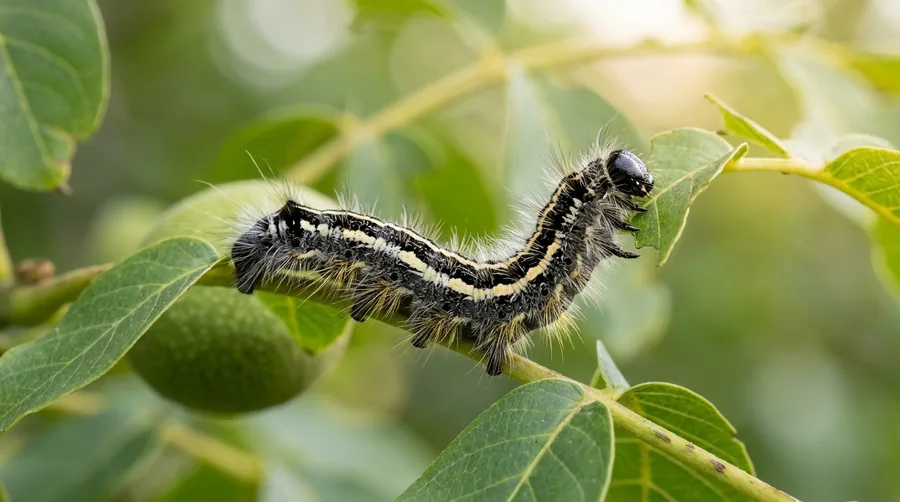
Cluster of hairy black-and-reddish walnut caterpillars arching on a walnut tree branch
Recommended Products


What it does
These caterpillars feed together in dense colonies, and when disturbed they raise both ends in a distinctive arching or J-shaped posture. They eat leaves from the tips inward, often stripping one branch before moving on. To molt, the whole group migrates to the trunk or a large limb, leaving a matted patch of shed hairy skins.
Where it lives
Walnut caterpillars feed on black walnut, English walnut, pecan, hickory, and related trees in yards, orchards, and woodlots. They are most common in the southern and central US. They live on the trees and do not enter homes, though shed-skin masses on trunks are conspicuous.
How it breeds
There are one to two generations a year, with two in the warmer South. Reddish-brown moths lay egg masses on the undersides of leaves; larvae hatch and feed gregariously for several weeks, then pupate in the soil. Second-generation larvae in late summer often cause the heaviest defoliation.
What it eats
Larvae eat the leaves of walnut, pecan, hickory, and related nut trees. Young larvae skeletonize leaves; older ones consume entire leaves except the main veins. Adult moths do not feed on foliage.
Identification
Mature larvae are up to about 50 mm, reddish-brown to nearly black, covered in long soft grayish-white hairs. Younger larvae are reddish with paler stripes. Look for tight clusters on branches and the arching defensive pose, plus matted masses of shed skins on the trunk.
Signs of an infestation
- Dense clusters of hairy caterpillars on branches
- Caterpillars arching both ends when disturbed
- Branches stripped of leaves from the tips inward
- Matted patches of shed hairy skins on the trunk
- Dark droppings accumulating under infested limbs
Prevention tips
- Scout walnut and pecan trees in summer for egg masses and young colonies
- Prune out and destroy branches holding young clustered larvae
- Knock small colonies into soapy water while they are grouped
- Keep trees healthy so they can refoliate after defoliation
- Encourage birds and predatory insects that feed on the larvae
Professional solutions
Small, reachable colonies are easily removed by pruning or a Bacillus thuringiensis (Bt) product applied while larvae are young. Large or tall nut trees, or orchard-scale outbreaks, are best handled by an arborist or licensed applicator with proper equipment. Follow the EPA-registered label, especially near food-bearing nut crops.
Health & safety
Walnut caterpillars do not sting and are not venomous. Their long hairs can cause mild skin irritation in sensitive people who handle them, so it is sensible to avoid direct contact and wear gloves when removing colonies. There is no disease risk, and healthy trees usually recover from defoliation.
Relevant Products


Frequently asked questions
Do walnut caterpillars sting?
No, walnut caterpillars are not stinging caterpillars and are not venomous. Their soft hairs can cause mild skin irritation in some people who handle them directly, so wear gloves when removing colonies, but they cause no serious harm.
Why are the caterpillars clustered on my tree trunk?
Walnut caterpillars migrate together to the trunk or a large limb to molt, then return to feed. The matted patches of shed hairy skins they leave behind are a classic sign. Removing these grouped clusters while they gather is an easy control moment.
Fact-checked by Morgan Vance, Editorial Director (editorial review, not a professional pest-control or medical sign-off). Last reviewed June 25, 2026. We correct anything a reader shows us is wrong — see our corrections policy.