
Mimosa Webworm
Homadaula anisocentra · also called mimosa webworms, honeylocust webworm
Quick answer
The mimosa webworm (Homadaula anisocentra) is a small gray-brown caterpillar that binds mimosa and honeylocust foliage into silk nests and skeletonizes the leaves inside. Heavy webbing turns tree canopies brown and unsightly by late summer. Introduced from Asia, it damages ornamental trees but does not bite, sting, or threaten homes.
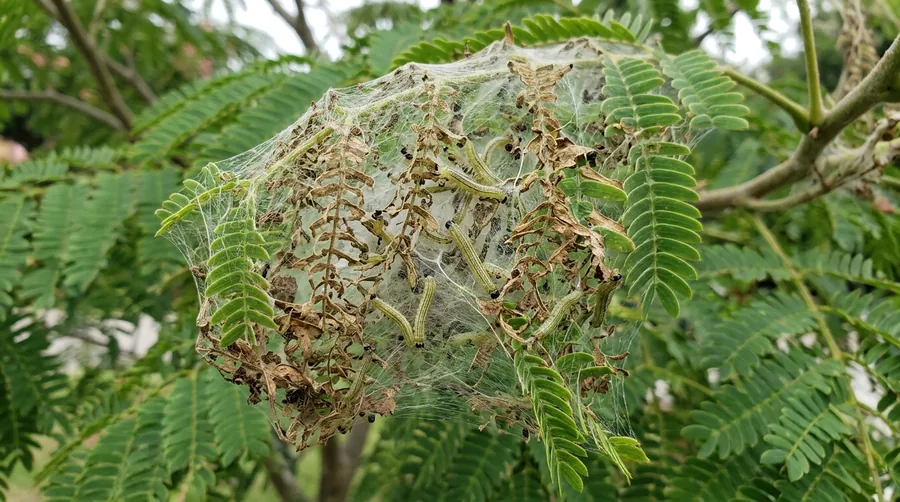
Gray-brown mimosa webworm caterpillar in silk webbing on browned honeylocust foliage
Recommended Products


What it does
Larvae web leaflets together into loose silk nests and feed inside, scraping the leaf surface so foliage turns brown and skeletonized. As colonies grow, the webbing spreads across large sections of the canopy. When disturbed, the caterpillars wriggle backward rapidly or drop on a silk thread to escape.
Where it lives
It attacks mimosa (silktree) and thornless honeylocust, both popular landscape and street trees, across the southern, central, and eastern US. The webbed, browning canopies are a common midsummer eyesore in yards and along streets. The insect stays on the trees and does not enter homes.
How it breeds
There are typically two generations a year, sometimes more in the warm South. Small silvery-gray moths lay eggs on foliage; larvae feed within webbing for several weeks, then pupate in bark crevices or leaf litter. The second, late-summer generation usually causes the most conspicuous webbing and browning.
What it eats
Larvae feed on the leaflets of mimosa and honeylocust, skeletonizing the tissue inside their silk nests. They do not feed on other plant types, and the adult moths do not damage foliage.
Identification
Mature larvae are gray to brown, about 15-18 mm, with lengthwise pink or white stripes, and they wriggle backward when touched. The unmistakable sign is dense silk webbing enclosing browned, skeletonized foliage on mimosa or honeylocust. Adult moths are small and silvery-gray with dark speckles.
Signs of an infestation
- Silk webbing enclosing clumps of foliage
- Brown, skeletonized leaves inside the webs
- Sections of canopy turning brown by late summer
- Caterpillars that wriggle backward or drop on threads
- Webbing and dead leaves persisting on branches
Prevention tips
- Inspect mimosa and honeylocust in early summer for the first webs
- Prune out and destroy small webbed branches promptly
- Rake and remove leaf litter where pupae overwinter
- Keep trees healthy so they tolerate feeding
- Consider resistant honeylocust cultivars for new plantings
Professional solutions
Early, reachable webs can be pruned out or treated with a Bacillus thuringiensis (Bt) product while larvae are young, before heavy webbing forms. Large trees or advanced infestations are best treated by an arborist or licensed applicator. Use only EPA-registered products according to the label, and time applications to young larvae for best results.
Health & safety
The mimosa webworm is harmless to people and pets. It does not bite, sting, or spread disease. Its impact is cosmetic and horticultural: unsightly webbing and browned foliage that can stress mimosa and honeylocust over repeated heavy years, but rarely kills an otherwise healthy tree.
Relevant Products


Frequently asked questions
What is the webbing turning my honeylocust brown?
That silk webbing enclosing browned, skeletonized foliage is the work of mimosa webworm caterpillars feeding inside. It is most obvious on mimosa and thornless honeylocust in late summer. The webworm is a cosmetic pest and does not harm people or your home.
How do I get rid of mimosa webworm?
Prune out and destroy small webbed branches as soon as you see them, and treat young larvae with a Bt product before heavy webbing forms. For large trees, an arborist can apply an EPA-registered treatment timed to early larval feeding.
Fact-checked by Morgan Vance, Editorial Director (editorial review, not a professional pest-control or medical sign-off). Last reviewed June 28, 2026. We correct anything a reader shows us is wrong — see our corrections policy.