
Spotted Cucumber Beetle
Diabrotica undecimpunctata howardi · also called spotted cucumber beetle, southern corn rootworm, 12-spotted cucumber beetle
Quick answer
The spotted cucumber beetle (Diabrotica undecimpunctata howardi) is a yellow-green beetle with twelve black spots that feeds on cucumbers, squash, melons, beans, and corn. Adults chew leaves and flowers, while the larvae (southern corn rootworm) attack roots. It also spreads bacterial wilt and mosaic viruses between plants. It is harmless to people but damaging to crops.
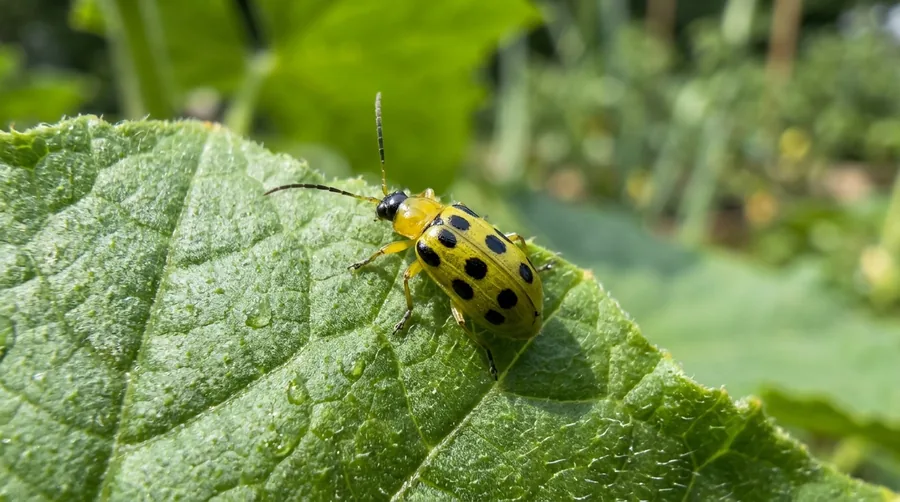
Yellow-green spotted cucumber beetle with twelve black spots on its wing covers on a squash leaf
Recommended Products


What it does
Adult spotted cucumber beetles chew holes in leaves, flowers, and soft fruit and are quick to fly when disturbed. As they feed they transmit plant pathogens, notably the bacteria that cause cucurbit bacterial wilt and cucumber mosaic virus, which can be more damaging than the chewing itself. The soil-dwelling larvae bore into roots, weakening or killing young plants.
Where it lives
This pest lives in vegetable gardens and field crops across the eastern, southern, and central US. Adults are found on cucurbits, beans, corn, and many flowering plants; larvae live in the soil around plant roots, especially corn. Adults overwinter in the South and migrate north each season, so northern gardens see them later in the year.
How it breeds
There are one to three generations a year depending on climate. Adults lay eggs in the soil at the base of host plants. The larvae, known as the southern corn rootworm, feed on roots for a few weeks, then pupate in the soil. New adults emerge to feed on foliage and flowers, continuing the cycle through the growing season.
What it eats
Adults feed on the leaves, flowers, pollen, and fruit of many plants, favoring cucurbits (cucumber, squash, melon, pumpkin), beans, and corn silks. Larvae feed underground on the roots of corn and other hosts. Their broad diet and disease-spreading make them a significant vegetable pest.
Identification
The adult is about a quarter inch, yellow-green, with twelve distinct black spots on the wing covers and a black head, resembling a slender, spotted relative of a ladybug. The striped cucumber beetle is similar but has black stripes instead of spots. The pale larva is thin and worm-like, found in the soil around roots.
Signs of an infestation
- Holes chewed in leaves, flowers, and cucurbit fruit
- Yellow-green, twelve-spotted beetles on plants
- Sudden wilting of cucumber or melon vines from bacterial wilt
- Poor stands and stunted corn from root-feeding larvae
- Scarring on young fruit and chewed corn silks
Prevention tips
- Use floating row covers on young cucurbits, removing them at flowering for pollination
- Choose wilt-tolerant or resistant varieties where available
- Rotate cucurbits and corn away from last year's beds
- Control weeds and clear crop debris that shelter beetles
- Use yellow sticky traps and scout early to catch infestations
Professional solutions
For gardens, cultural methods, row covers, and scouting usually suffice; because these beetles spread bacterial wilt, even modest numbers on seedlings warrant attention. For larger plantings, an advisor or licensed applicator can recommend labeled insecticides timed to protect seedlings and reduce disease spread, applied to avoid harming bees on flowering plants.
Health & safety
Spotted cucumber beetles pose no health risk to people or pets; they do not bite, sting, or spread human disease. Their impact is agricultural: direct feeding plus the plant diseases they transmit, such as bacterial wilt and mosaic viruses, which can devastate cucurbit crops. Their root-feeding larvae also damage corn and other crops.
Relevant Products


Frequently asked questions
Why are my cucumber and squash plants suddenly wilting?
Spotted (and striped) cucumber beetles spread bacterial wilt as they feed. Once a plant is infected, it can wilt and die even though the beetles themselves did little visible chewing. That is why controlling the beetles early, especially on seedlings, matters more than the leaf holes alone suggest.
How do I control spotted cucumber beetles in my garden?
Protect young plants with floating row covers, removing them at flowering so bees can pollinate. Rotate cucurbits and corn, clear weeds and debris, and scout early with yellow sticky traps. Because the beetles spread disease, act promptly on seedlings; labeled insecticides are an option for heavy pressure.
What is the southern corn rootworm?
It is the larval stage of the spotted cucumber beetle. The pale, worm-like larvae live in the soil and feed on the roots of corn and other plants, stunting growth and thinning stands. So the same insect damages crops twice: as a leaf-chewing adult and a root-feeding larva.
Fact-checked by Morgan Vance, Editorial Director (editorial review, not a professional pest-control or medical sign-off). Last reviewed July 10, 2026. We correct anything a reader shows us is wrong — see our corrections policy.