
Corn Rootworm
Diabrotica spp. · also called corn rootworms, western corn rootworm, northern corn rootworm
Quick answer
Corn rootworms (Diabrotica species) are among the costliest US corn pests, often called the 'billion-dollar bug.' The larvae chew corn roots, causing plants to lodge and lean, while adult beetles clip silks and feed on leaves. A field-crop pest of the Corn Belt, it does no harm to people and is managed at the farm scale.
Yellow-green striped western corn rootworm beetle on a corn silk tassel
Recommended Products


What it does
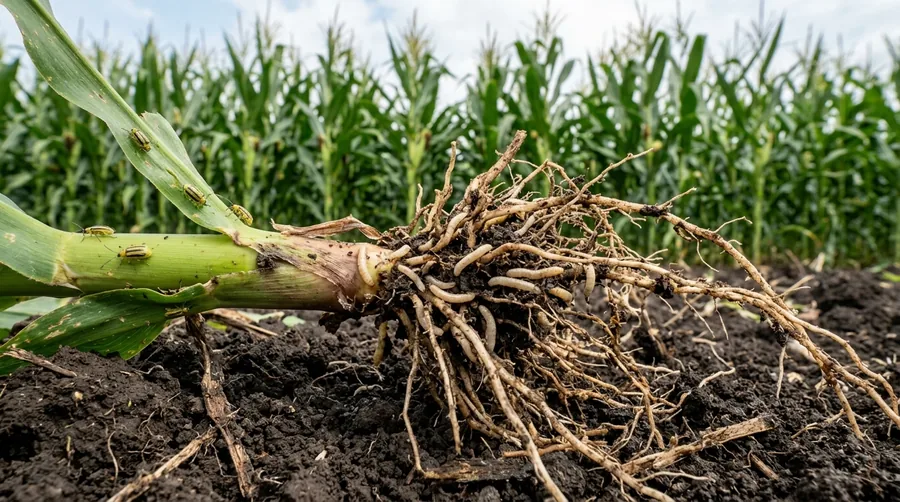
The larvae do the worst damage, tunneling into and chewing corn roots, which weakens the plant's anchorage so it lodges or bends into a 'gooseneck' shape and takes up water poorly. The adult beetles feed on leaves, pollen, and especially silks; heavy silk-clipping during pollination can interfere with kernel set.
Where it lives
A pest of field corn concentrated in the Corn Belt and northern states, it is worst where corn is grown in the same field year after year. Adults live on and around corn plants in summer; the eggs and larvae live in the soil of cornfields. It is strictly an agricultural pest, not found in homes.
How it breeds
Adult beetles lay eggs in the soil of cornfields in late summer. The eggs overwinter and hatch the next spring, and the larvae feed on corn roots before pupating in the soil and emerging as adults in mid-summer. There is one generation a year, timed closely to the corn crop.
What it eats
Larvae feed on corn roots; adults feed on corn silks, pollen, and leaves, and sometimes on the pollen and flowers of other nearby plants.
Identification
Adults are about 1/4 inch. The western corn rootworm is yellow-green with black stripes or a dark patch on the wing covers, while the northern species is solid pale green to tan. The larvae are slender white worms with a brown head, found feeding on and inside corn roots.
Signs of an infestation
- Corn plants leaning, lodged, or bent into a gooseneck shape
- Chewed, pruned, or brown corn roots when dug up
- Yellow-green beetles feeding on silks and leaves
- Heavily clipped silks during pollination
- Poor kernel set from silk feeding
Prevention tips
- Rotate corn with a non-host crop such as soybeans
- Plant Bt corn hybrids that target rootworm larvae
- Scout adults in late summer to predict next year's pressure
- Rotate control tactics to slow resistance
- Avoid continuous corn in problem fields
Professional solutions
Corn rootworm is a field-scale problem managed with a local extension agent or agronomist, who can assess root damage, monitor adult beetle counts to forecast risk, and recommend crop rotation, Bt hybrids, or labeled soil insecticides. Rotating tactics is important because rootworm populations have adapted to some single strategies.
Health & safety
Corn rootworms do not bite, sting, or carry any disease affecting people or pets, so there is no health risk. The damage is entirely agricultural: root-feeding that lodges corn and reduces yield, historically severe enough to earn the pest its 'billion-dollar bug' nickname.
Relevant Products


Frequently asked questions
Why is corn rootworm called the billion-dollar bug?
The nickname reflects the very high combined cost of yield loss and control across US corn each year. Larvae pruning the roots cause plants to lodge and yield poorly, making rootworm one of the most economically damaging corn pests.
Does crop rotation control corn rootworm?
Rotating corn with a non-host crop like soybeans breaks the pest's life cycle and is a core control tactic, since larvae starve without corn roots. However, some rootworm populations have adapted to rotation, so it is best combined with other methods.
Fact-checked by Morgan Vance, Editorial Director (editorial review, not a professional pest-control or medical sign-off). Last reviewed May 13, 2026. We correct anything a reader shows us is wrong — see our corrections policy.