
European Corn Borer
Ostrinia nubilalis · also called corn borer, ECB
Quick answer
The European corn borer (Ostrinia nubilalis) is a pale, spotted caterpillar that tunnels into corn stalks, ears, and other crops. An introduced pest, it weakens stalks so they break, and damages ears and peppers. It is the larva of a tan moth and poses no risk to people. Bt corn has sharply reduced its impact.
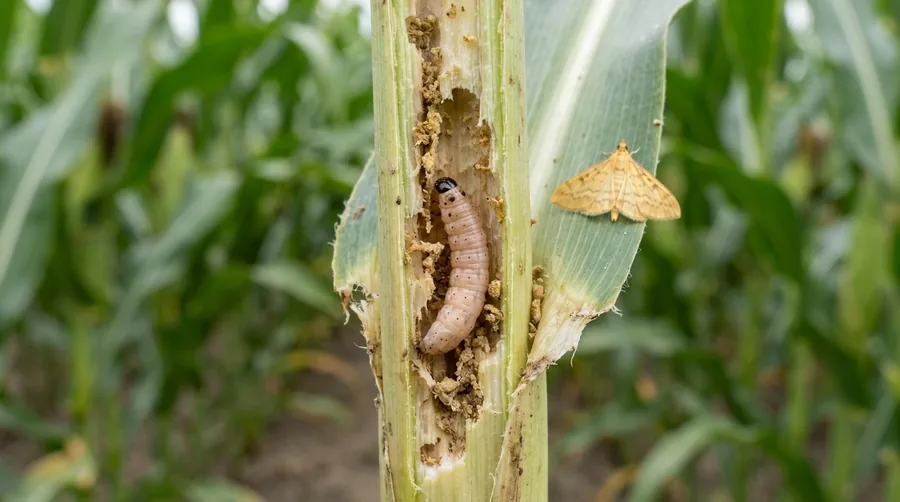
Pale pinkish European corn borer caterpillar tunneling inside a split corn stalk
Recommended Products


What it does
Young larvae first chew on leaves and the corn whorl, then bore into the stalk, ear shank, or ear. Their tunneling disrupts the plant's flow of water and nutrients, weakens stalks so they lodge (fall over), and drops ears. On peppers and other crops, they bore into fruit, letting in rot.
Where it lives
An introduced pest first found in the northeastern US around 1917, it is now established across the Corn Belt, Northeast, and northern states, and less common in the far South and West. Besides corn it attacks peppers, snap beans, potatoes, and many other plants. It overwinters as a full-grown larva inside corn stalks and crop debris.
How it breeds
Overwintering larvae pupate in spring, and the emerging moths lay clustered, overlapping eggs on leaf undersides. Larvae feed and bore for several weeks before pupating. Generations per year range from one in the far north to three or four in the South, tracking the length of the warm season.
What it eats
Larvae feed on corn (leaves, stalks, and ears) and also bore into peppers, snap beans, potatoes, and a wide range of other herbaceous plants.
Identification
Mature larvae are about 1 inch, pale gray to pinkish, with a dark brown head and rows of small dark spots along the body. The adult is a pale yellowish-brown moth (males darker) with wavy dark lines across the wings. Sawdust-like frass at boreholes is a key sign.
Signs of an infestation
- Small 'shot-hole' feeding marks across unfurling corn leaves
- Round boreholes in stalks with sawdust-like frass
- Broken, lodged stalks and dropped ears
- Tunneling and frass inside peppers or bean pods
- Egg masses of overlapping scales on leaf undersides
Prevention tips
- Plant Bt corn hybrids where borer pressure is high
- Shred and plow down corn stalks and debris after harvest
- Scout whorls for young larvae before they bore in
- Time any treatment to egg hatch, before larvae tunnel in
- Rotate crops and manage nearby weedy hosts
Professional solutions
This is a field-crop pest best handled with a local extension agent or agronomist, who can monitor moth flights and egg hatch and recommend Bt hybrids or labeled insecticides applied before larvae bore into the plant. Once inside the stalk or fruit, larvae are shielded from sprays, so timing and prevention are essential.
Health & safety
European corn borers do not bite, sting, or carry any disease affecting people or pets, so they present no health risk. Their impact is purely agricultural: tunneling that weakens corn stalks and damages ears and other crops, historically a major source of yield loss before Bt corn.
Relevant Products


Frequently asked questions
How does the European corn borer damage corn?
Larvae bore into stalks and ear shanks, tunneling through the plant. This weakens stalks so they break and lodge, drops ears to the ground, and interferes with the plant's water and nutrient flow, all reducing harvestable yield.
Has Bt corn reduced the corn borer problem?
Yes. Widespread planting of Bt corn, which produces a protein toxic to the borer, has sharply lowered European corn borer populations across the Corn Belt since the late 1990s, benefiting even non-Bt fields nearby through areawide suppression.
Fact-checked by Morgan Vance, Editorial Director (editorial review, not a professional pest-control or medical sign-off). Last reviewed July 11, 2026. We correct anything a reader shows us is wrong — see our corrections policy.