
Fall Armyworm
Spodoptera frugiperda · also called fall armyworms, armyworm
Quick answer
The fall armyworm (Spodoptera frugiperda) is a striped caterpillar marked by an inverted white 'Y' on its head. Larvae feed in large numbers on corn, grasses, turf, and pasture, sometimes stripping a lawn or field in days. Unable to survive cold winters, it migrates north each year from the Deep South. It does not harm people.
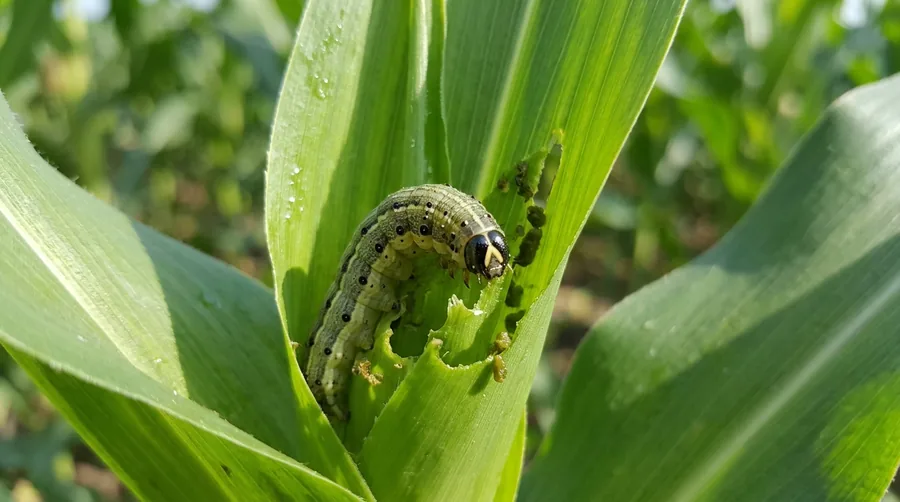
Fall armyworm caterpillar with an inverted white Y on its head feeding on a grass blade
Recommended Products


What it does
Fall armyworms feed as groups of larvae that can move across a field or lawn 'like an army,' consuming leaves, whorls, and grass blades. Large numbers can strip corn whorls or brown out a turf lawn within a few days, often seemingly overnight, which is why late-summer outbreaks catch people by surprise.
Where it lives
This pest favors grasses: field and sweet corn, sorghum, rice, pasture, and turfgrass, plus many vegetables. It cannot survive freezing winters and overwinters only in south Florida and south Texas, spreading northward through the growing season, so it is most damaging across the South and reaches the East and Midwest in outbreak years.
How it breeds
A female moth lays fuzzy egg masses of 100-200 eggs, often on leaves or structures near host plants. Larvae feed for two to three weeks through six stages, then pupate in the soil. Several fast generations occur each season, and the migratory adults ride weather systems far to the north.
What it eats
Larvae feed mostly on grasses, corn, sorghum, rice, turfgrass, and pasture, and will also attack vegetables and other crops during heavy outbreaks.
Identification
Mature larvae are about 1.5 inches, green to brown with lengthwise stripes, and show two key marks: an inverted pale Y on the dark head capsule and four dark spots arranged in a square on the segment near the tail. The adult is a mottled gray-brown moth.
Signs of an infestation
- Ragged, chewed leaves and skeletonized grass blades
- Brown, dying patches spreading across a lawn or field
- Sawdust-like frass in corn whorls
- Clusters of caterpillars of different sizes feeding together
- Fuzzy egg masses on leaves, fences, or walls
Prevention tips
- Scout lawns and fields in late summer, when outbreaks peak
- Catch infestations early, while larvae are small and easier to control
- Keep turf healthy and well-watered to aid recovery
- Use pheromone traps to detect incoming moth flights
- Mow and remove heavy grass thatch that shelters larvae
Professional solutions
For lawns and field crops, a local extension agent or agronomist can confirm an outbreak and recommend labeled insecticides timed to small larvae, which are far easier to control than large ones. Because the pest arrives suddenly in migrating waves, prompt identification is the key to limiting turf or crop loss.
Health & safety
Fall armyworms do not bite, sting, or carry any human disease, so they pose no health risk to people or pets. The damage is to plants, chewed foliage and browned-out lawns, pastures, and crops, sometimes appearing dramatically fast during a late-summer outbreak.
Relevant Products


Frequently asked questions
Why did my lawn turn brown overnight from armyworms?
Fall armyworms feed in large groups and can chew a lawn down to the crowns in a day or two once the caterpillars are big. The damage looks sudden because the small larvae fed unnoticed for a week before their appetite peaked.
Do fall armyworms come back every year?
They cannot survive freezing winters, so they die out in the North each year. New populations migrate up from south Florida and Texas every season, which is why outbreaks vary from year to year and peak in late summer.
Fact-checked by Morgan Vance, Editorial Director (editorial review, not a professional pest-control or medical sign-off). Last reviewed June 10, 2026. We correct anything a reader shows us is wrong — see our corrections policy.