
Spinach Leafminer
Pegomya hyoscyami · also called spinach leafminer, beet leafminer, mangold fly
Quick answer
The spinach leafminer (Pegomya hyoscyami) is the larva of a small fly that tunnels between the upper and lower surfaces of spinach, chard, and beet leaves. Its feeding creates pale winding trails that widen into blotches, ruining leafy greens. Because larvae feed inside the leaf, sprays reach them poorly and prevention matters most.
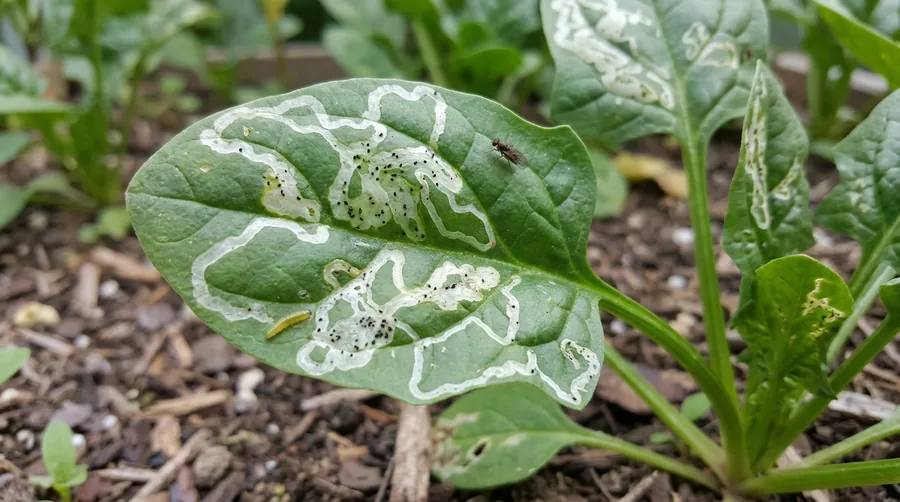
Spinach leaf with pale winding and blotchy mines caused by leafminer larvae tunneling inside
Recommended Products


What it does
The maggots feed inside the leaf, hollowing out the tissue between the two surfaces. Early mines are narrow winding trails that widen into large tan or translucent blotches as the larvae grow. Since they are protected within the leaf, contact sprays reach them poorly, and infested leaves of spinach, chard, and beet are rendered unusable.
Where it lives
The spinach leafminer occurs across the US, and is a notable early-season pest of cool-weather greens in the North, Northeast, and Midwest. It attacks spinach, Swiss chard, and beets in gardens and fields, and persists on weedy hosts such as lambsquarters and nightshade between crops.
How it breeds
Females lay rows of small white cylindrical eggs on the underside of leaves. Larvae hatch and mine within the leaf for one to three weeks, then drop to pupate in the soil. Several generations occur through spring and summer, but the first spring generation usually causes the most conspicuous damage on early greens.
What it eats
Larvae feed inside the leaves of spinach, Swiss chard, and beets, and on related weeds like lambsquarters and nightshade. The adult fly feeds on nectar and other liquids and does not damage the crop.
Identification
Damage is the easiest sign: pale, winding-to-blotchy mines within spinach, chard, or beet leaves, often with a whitish maggot visible inside when held to the light. The larva is a small, legless whitish maggot; the adult is a gray, bristly fly about 6 mm, resembling a small housefly and rarely noticed.
Signs of an infestation
- Pale winding trails that widen into tan or translucent blotches
- Small white maggots visible inside leaves held to the light
- Rows of tiny white cylindrical eggs on leaf undersides
- Blistered, papery patches on spinach, chard, or beet leaves
- Unusable leafy greens with hollowed interiors
Prevention tips
- Cover greens with floating row cover to keep egg-laying flies off
- Inspect leaf undersides and crush rows of white eggs
- Pick off and destroy mined leaves promptly to remove larvae
- Control weedy hosts such as lambsquarters near the garden
- Rotate spinach, chard, and beets and clear crop residue
Professional solutions
Row covers are the most reliable home-garden defense, since larvae feeding inside leaves are hard to reach with sprays; removing mined leaves and egg rows by hand helps too. For persistent problems on larger plantings, your Cooperative Extension office can advise on timing and any leaf-miner-appropriate products for your region.
Health & safety
The spinach leafminer is harmless to people and pets, with no bite, sting, or human-disease risk. Its damage is cosmetic and agricultural: the mines make leafy greens unappetizing and unmarketable, but affected leaves are simply discarded rather than posing any food-safety hazard.
Relevant Products


Frequently asked questions
What makes pale trails and blotches inside my spinach leaves?
Winding pale trails that widen into tan or translucent blotches inside spinach, chard, or beet leaves are made by spinach leafminer maggots tunneling between the leaf surfaces. Hold a leaf to the light and you may see the small white maggot inside the mine.
How do I stop leafminers on spinach and chard?
Because the larvae feed protected inside the leaf, prevention works best: cover greens with floating row cover to keep the flies from laying eggs, crush the rows of white eggs on leaf undersides, and pick off and destroy mined leaves. Control weedy hosts nearby.
Can I eat spinach with leafminer damage?
Leafminers do not carry human disease, so lightly affected leaves are unappetizing rather than unsafe; simply remove and discard the mined areas. Heavily mined leaves are best composted. The pest's real cost is ruined, unusable greens, not any food-safety risk.
Fact-checked by Morgan Vance, Editorial Director (editorial review, not a professional pest-control or medical sign-off). Last reviewed May 13, 2026. We correct anything a reader shows us is wrong — see our corrections policy.