
Onion Thrips
Thrips tabaci · also called onion thrip, potato thrips, cotton seedling thrips
Quick answer
Onion thrips (Thrips tabaci) are tiny, slender pale-yellow to brown insects that rasp onion, garlic, and cabbage leaves and suck the juices, leaving silvery streaks and stunted growth. They hide in leaf folds, breed rapidly, and can spread Iris yellow spot virus. Their small size makes early infestations easy to miss.
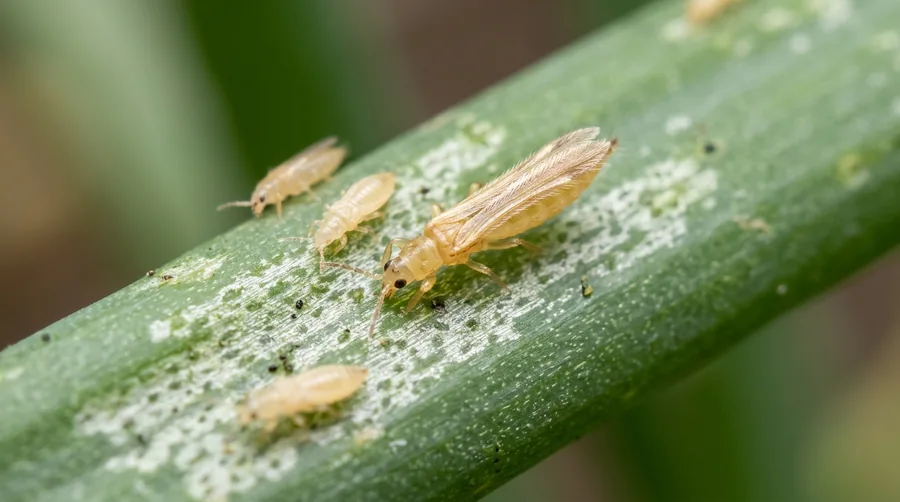
Tiny slender pale-yellow onion thrips clustered in the leaf base of an onion plant
Recommended Products


What it does
Both adults and nymphs use rasping-sucking mouthparts to scrape leaf surfaces and feed on the released sap, producing silvery or whitish streaks and blotches. They wedge into tight leaf folds and the necks of onions, where they are hard to see and hard to reach with sprays. Feeding intensifies in hot, dry weather.
Where it lives
Onion thrips occur nationwide on onions, garlic, leeks, cabbage, and a wide range of vegetables, ornamentals, and weeds. They shelter in the protected leaf axils of host plants and can move readily between crops and weedy hosts, building large populations on dense, well-fertilized plantings.
How it breeds
Females often reproduce without mating, laying eggs inside leaf tissue. Nymphs feed and pass through two active stages, then a non-feeding pre-pupal and pupal stage in the soil or leaf debris, before emerging as adults. Generations can complete in about two to three weeks, so populations explode in warm weather.
What it eats
Onion thrips feed on plant sap from the leaves of onions, garlic, leeks, cabbage and other brassicas, beans, cucurbits, and many ornamentals and weeds, favoring the tender leaf bases of allium crops.
Identification
Adults are only 1-1.5 mm long, slender and pale yellow to light brown, with narrow fringed wings visible only under magnification. Nymphs are smaller, wingless, and paler. The silvery streaking they leave, plus tiny dark fecal specks in the leaf folds, is often easier to spot than the insects themselves.
Signs of an infestation
- Silvery or whitish streaks and blotches on leaves
- Tiny dark fecal specks in leaf folds and onion necks
- Distorted, stunted, or bleached foliage
- Slender pale insects that scatter when a leaf fold is opened
- Reduced bulb size in heavily infested onions
Prevention tips
- Inspect allium crops weekly, checking deep in the leaf folds
- Avoid over-fertilizing with nitrogen, which favors thrips buildup
- Use reflective mulch to deter thrips from settling
- Keep plants watered, since drought stress worsens damage
- Control weedy hosts and remove crop debris after harvest
Professional solutions
Home gardeners can use strong water sprays, insecticidal soap, or spinosad, directing them into the leaf folds where thrips hide. Because thrips resist many products and breed fast, rotate modes of action. For repeated onion losses or suspected virus, your Cooperative Extension office can advise on thresholds and resistance-aware programs.
Health & safety
Onion thrips do not bite people, sting, or carry human disease, so they pose no direct health risk. Their importance is agricultural: heavy feeding streaks and stunts crops, and they transmit Iris yellow spot virus to onions and related plants, which can seriously reduce bulb yield.
Relevant Products


Frequently asked questions
What causes silvery streaks on my onion leaves?
Silvery or whitish streaks and blotches on onion, garlic, or leek leaves are classic onion thrips damage. The insects are only about a millimeter long and hide deep in the leaf folds, so look there for slender pale specks and tiny dark fecal spots.
How do I get rid of onion thrips?
Direct strong water sprays, insecticidal soap, or spinosad into the leaf folds where thrips shelter, and repeat as needed since they breed quickly. Avoid excess nitrogen, keep plants well watered, and rotate products because thrips develop resistance to repeated use of one chemistry.
Do onion thrips spread disease?
They can transmit Iris yellow spot virus to onions and related crops, which is why growers watch them closely. That disease risk is to plants, not people; onion thrips do not bite humans or carry any human illness.
Fact-checked by Morgan Vance, Editorial Director (editorial review, not a professional pest-control or medical sign-off). Last reviewed June 30, 2026. We correct anything a reader shows us is wrong — see our corrections policy.