Potato Psyllid
Bactericera cockerelli · also called potato psyllid, tomato psyllid
Quick answer
The potato psyllid (Bactericera cockerelli) is a tiny cicada-like insect whose nymphs feed on potatoes, tomatoes, peppers, and eggplant. Their feeding injects a toxin that causes 'psyllid yellows,' and they transmit the bacterium behind 'zebra chip' disease in potatoes. Adults hold their clear wings rooflike over a small greenish body.
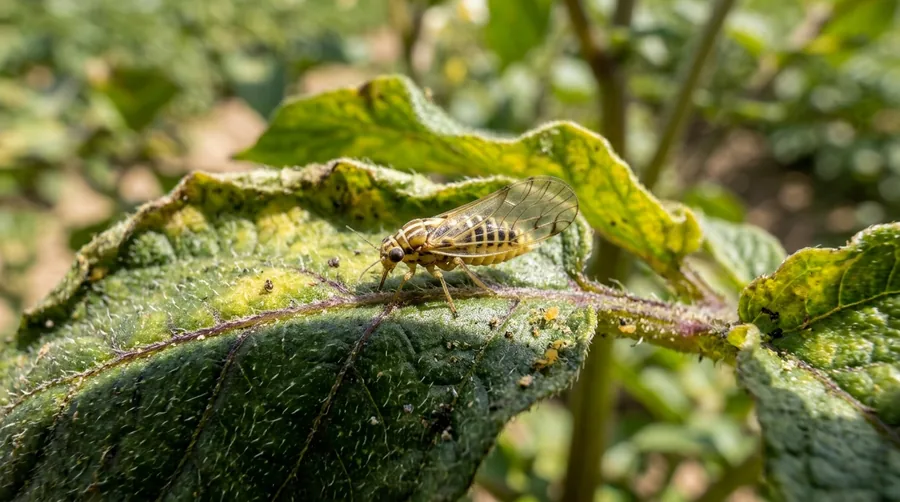
Tiny cicada-like potato psyllid with clear wings held rooflike over its body on a potato leaf
Recommended Products


What it does
Nymphs settle on the underside of leaves and feed on sap, injecting saliva that can trigger 'psyllid yellows,' a disorder of yellowed, curled, and stunted growth. Adults jump and fly readily and migrate long distances on the wind. The insect is significant less for the feeding itself than for the disease it can carry.
Where it lives
Potato psyllids are chiefly a western and south-central US pest, moving seasonally between overwintering hosts and cultivated solanaceous crops. They build up on potatoes, tomatoes, peppers, and eggplant in gardens and fields, and shelter on non-crop nightshades and other host plants between crop seasons.
How it breeds
Females lay tiny yellow eggs on short stalks along leaf edges. Nymphs pass through five flattened, scale-like stages on the leaf underside over two to three weeks before becoming winged adults. Several generations occur per season, and migratory adults can introduce the psyllid into new areas each year.
What it eats
Potato psyllids feed on plant sap from solanaceous crops, mainly potato, tomato, pepper, and eggplant, and also on wild and weedy nightshades that serve as alternate hosts.
Identification
Adults are about 2 mm, resembling a miniature cicada, dark with pale markings and clear wings held rooflike over the body. Nymphs are flat, oval, pale green, and scale-like with a fringe of short spines around the edge, sitting motionless on leaf undersides, and are easily overlooked.
Signs of an infestation
- Yellowing, upward curling, and stunting of new growth (psyllid yellows)
- Flat, scale-like pale nymphs on leaf undersides
- Tiny cicada-like adults that jump when disturbed
- White, sugary waxy specks (psyllid sugars) on leaves
- In potatoes, striped internal discoloration when tubers are cut (zebra chip)
Prevention tips
- Inspect leaf undersides of potatoes and tomatoes for nymphs weekly
- Use yellow sticky cards to detect arriving adults early
- Manage weedy nightshades near the garden
- Use row cover on young solanaceous plants where pressure is high
- Remove and destroy infested plants showing psyllid yellows
Professional solutions
Gardeners can suppress nymphs with insecticidal soap or labeled products aimed at leaf undersides, plus sticky-card monitoring. Because the psyllid vectors zebra chip and migrates, area-wide pressure varies year to year. Your Cooperative Extension office can confirm the pest, interpret disease risk, and recommend regionally appropriate, resistance-aware control.
Health & safety
The potato psyllid does not bite, sting, or carry any human disease, so it is harmless to people and pets. Its significance is entirely to crops: its toxin causes psyllid yellows, and it transmits the bacterium responsible for zebra chip disease in potatoes, which can make tubers unmarketable.
Relevant Products


Frequently asked questions
What is causing my potato or tomato leaves to yellow and curl?
Yellowing, upward-curling, stunted new growth on potatoes or tomatoes can be 'psyllid yellows,' caused by potato psyllid nymphs feeding on the leaf undersides. Check there for flat, pale, scale-like nymphs and tiny cicada-like adults that jump when disturbed.
What is zebra chip disease?
Zebra chip is a potato disease caused by a bacterium the potato psyllid can transmit while feeding. Affected tubers show dark striped discoloration when cut and fry poorly, making them unmarketable. The disease affects plants and food quality, not human health.
How do I control potato psyllids in the garden?
Monitor leaf undersides and use yellow sticky cards to catch arriving adults, treat nymphs with insecticidal soap or a labeled product aimed under the leaves, manage weedy nightshades nearby, and remove badly affected plants. Row cover protects young plants where pressure is high.
Fact-checked by Morgan Vance, Editorial Director (editorial review, not a professional pest-control or medical sign-off). Last reviewed June 3, 2026. We correct anything a reader shows us is wrong — see our corrections policy.