
Beet Leafhopper
Circulifer tenellus · also called beet leafhopper, whitefly of the West (misnomer)
Quick answer
The beet leafhopper (Circulifer tenellus) is a small, pale, wedge-shaped insect of the arid western US that hops and flies readily between weeds and crops. It feeds on sap from beets, tomatoes, beans, and many plants, but its real importance is spreading beet curly top virus, which can devastate susceptible vegetables.
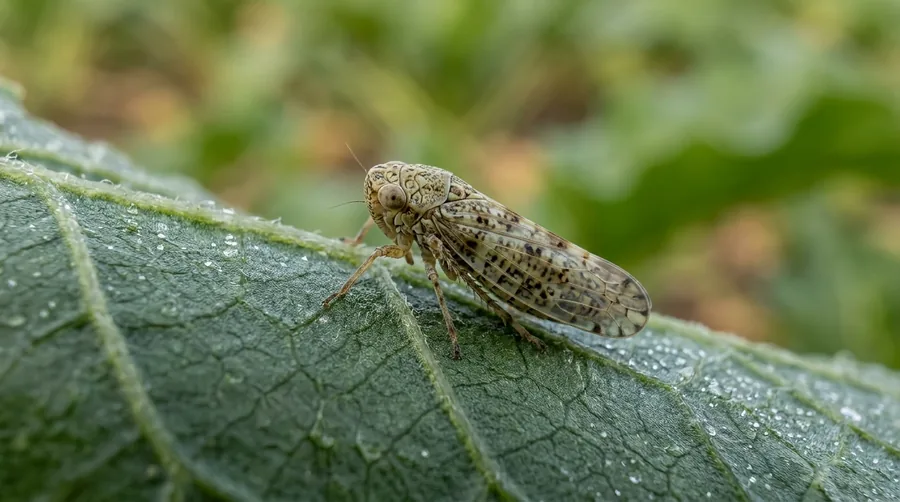
Small pale greenish wedge-shaped beet leafhopper on a beet leaf in bright sun
Recommended Products



What it does
Beet leafhoppers feed on plant sap and are highly mobile, hopping and flying quickly when disturbed and migrating from drying rangeland weeds into irrigated crops and gardens. Their direct feeding causes little harm, but as they probe plant after plant they transmit beet curly top virus, which triggers stunting, leaf curling, and often plant death.
Where it lives
This leafhopper is a pest of the arid and semi-arid West, Southwest, and Mountain regions. It overwinters and builds up on weedy hosts such as Russian thistle and mustards on rangeland and field margins, then moves into beets, tomatoes, beans, peppers, cucurbits, and many garden plants when weeds dry down.
How it breeds
Females insert eggs into leaf and stem tissue of host plants. Nymphs pass through five stages over about three weeks before maturing into winged adults. Several generations develop each year, and mass movement of adults out of drying rangeland can suddenly flood cultivated areas with virus-carrying leafhoppers.
What it eats
Beet leafhoppers feed on sap from a very wide range of plants, including sugar beets, table beets, tomatoes, beans, peppers, cucurbits, and spinach, as well as many rangeland and garden weeds that serve as reservoirs for the virus.
Identification
Adults are about 3 mm, slender and wedge-shaped, and pale green, gray, or tan, sometimes with faint darker markings. They taper toward the rear and jump or fly instantly when disturbed. Nymphs are smaller, wingless, and pale. The insect is easy to overlook until curly top symptoms appear on plants.
Signs of an infestation
- Stunted plants with upward-curled, thickened, crinkled leaves (curly top)
- Yellowing and dwarfing of young beets, tomatoes, or beans
- Small pale wedge-shaped insects that hop away when disturbed
- Sudden appearance of symptoms after weeds nearby dry down
- Plant death in scattered plants across the garden
Prevention tips
- Manage weedy hosts like Russian thistle and mustards near the garden
- Shade or interplant tomatoes, which are less attractive under cover
- Use row covers or fine netting to exclude migrating leafhoppers
- Plant more densely so symptoms fall on fewer key plants
- Remove and destroy plants showing curly top to reduce spread
Professional solutions
Insecticides rarely prevent curly top because leafhoppers infect plants before they can be killed, so gardeners rely on exclusion, shading, and weed management. For recurring curly top losses, your Cooperative Extension office can advise on resistant varieties, timing, and regional leafhopper movement, which drives the disease risk more than local spraying does.
Health & safety
The beet leafhopper does not bite, sting, or transmit any human disease, so it is harmless to people and pets. Its impact is agricultural: as the vector of beet curly top virus, it can cause severe stunting and death in susceptible garden and field crops even at low insect numbers.
Relevant Products


Frequently asked questions
What causes curled, stunted growth on my tomatoes and beets?
Upward-curled, thickened, crinkled leaves with severe stunting are typical of beet curly top virus, spread by the beet leafhopper. The tiny pale wedge-shaped leafhoppers move in from drying rangeland weeds, infect plants quickly, and are often gone before symptoms appear.
Can I spray to stop beet curly top virus?
Usually not effectively. Beet leafhoppers infect plants as they probe, often before an insecticide can kill them, so control focuses on excluding them with row covers or netting, shading tomatoes, managing weedy hosts, and using resistant varieties where available.
Is the beet leafhopper dangerous to people?
No. It does not bite, sting, or carry any human illness. The concern is strictly to plants, since it transmits beet curly top virus, which can severely damage or kill susceptible vegetables even when few leafhoppers are present.
Fact-checked by Morgan Vance, Editorial Director (editorial review, not a professional pest-control or medical sign-off). Last reviewed August 6, 2026. We correct anything a reader shows us is wrong — see our corrections policy.