
Beet Armyworm
Spodoptera exigua · also called beet armyworm, small mottled willow moth
Quick answer
The beet armyworm (Spodoptera exigua) is a smooth green caterpillar with pale side stripes that feeds on a wide range of vegetables and field crops, from beets and lettuce to tomatoes and peppers. Young larvae feed in groups, skeletonizing leaves, while older ones chew ragged holes and bore into fruit. It overwinters in the South and spreads north.
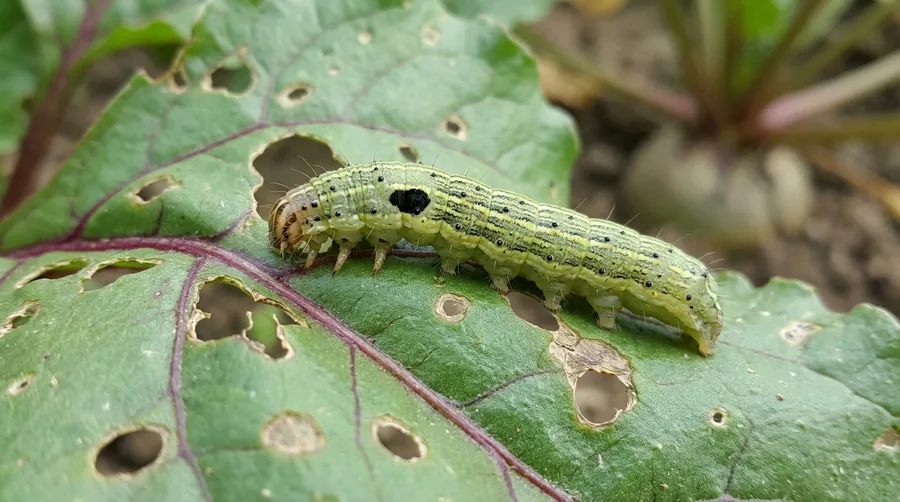
Smooth green beet armyworm caterpillar with pale side stripes on a chewed vegetable leaf
Recommended Products


What it does
Newly hatched larvae feed together in a cluster, skeletonizing the leaf surface and leaving fine webbing. As they grow they spread out and chew ragged holes, and older larvae may bore into buds, heads, or fruit. Large numbers can move across a planting in 'army' fashion, and the moths fly and disperse at night.
Where it lives
Beet armyworms overwinter in the warm far South and Southwest and migrate northward each summer, so they can appear nationwide by late season. They attack a broad range of vegetables and field crops in gardens and fields, thriving in hot weather on beets, lettuce, cole crops, tomatoes, peppers, and cotton.
How it breeds
Females lay masses of eggs covered with pale scales on leaves, often hundreds at a time. Larvae feed through five instars over two to three weeks, then pupate in the soil. Warm conditions allow several generations per season, with populations building rapidly during hot summer months.
What it eats
This highly polyphagous caterpillar feeds on many hosts, including beets, chard, lettuce, cole crops, tomatoes, peppers, beans, onions, and field crops such as cotton and alfalfa, plus numerous weeds.
Identification
Larvae are smooth (nearly hairless), up to about 30 mm, green to olive with wavy pale stripes along the sides and usually a small dark spot on the side above the second pair of true legs. The adult is a mottled gray-brown moth with a small pale spot on each forewing, active at night.
Signs of an infestation
- Clusters of small caterpillars skeletonizing leaves with fine webbing
- Ragged holes chewed through leaves by larger larvae
- Egg masses covered in pale fuzzy scales on foliage
- Boring damage in buds, heads, or fruit
- Green dark-spotted caterpillars scattered across the planting
Prevention tips
- Scout for egg masses and young clustered larvae, which are easiest to control
- Handpick and destroy clusters and egg masses in small gardens
- Use row covers on vulnerable crops during peak flights
- Encourage natural enemies by limiting broad-spectrum sprays
- Remove crop residue and weeds that host larvae
Professional solutions
Bacillus thuringiensis (Bt) or spinosad works best on small larvae before they burrow into plant parts; older beet armyworms are hard to kill and often resist common insecticides. For recurring outbreaks or large plantings, your Cooperative Extension office can advise on threshold-based, resistance-aware timing rather than repeated calendar sprays.
Health & safety
The beet armyworm is not a health risk. It does not bite, sting, or carry human disease, and the caterpillars are safe to handle. Its importance is agricultural, since heavy feeding can defoliate seedlings and damage marketable leaves, heads, and fruit across many vegetable crops.
Relevant Products


Frequently asked questions
What are the small green caterpillars feeding in groups on my vegetables?
Clusters of small green caterpillars skeletonizing leaves with fine webbing are often beet armyworms. As they grow they spread out and chew ragged holes. Look for smooth green larvae with pale side stripes and a small dark spot behind the head, plus fuzzy egg masses.
What kills beet armyworms best?
Bacillus thuringiensis (Bt) or spinosad works well on young larvae, so timing matters: treat while caterpillars are small and still clustered, before they bore into buds or fruit. Older beet armyworms are hard to kill and resist many products, so handpicking and row covers also help.
Are beet armyworms only a Southern pest?
They overwinter in the warm far South and Southwest but migrate northward each summer, so they can turn up nationwide by late season. Northern gardens usually see them later in the year, while southern areas can face them across much of the growing season.
Fact-checked by Morgan Vance, Editorial Director (editorial review, not a professional pest-control or medical sign-off). Last reviewed June 23, 2026. We correct anything a reader shows us is wrong — see our corrections policy.