
Colorado Potato Beetle
Leptinotarsa decemlineata · also called potato bug, potato beetle, ten-striped spearman
Quick answer
The Colorado potato beetle (Leptinotarsa decemlineata) is a round, yellow-orange beetle with ten black stripes that feeds on potato, eggplant, and tomato. Both striped adults and humpbacked red larvae quickly strip the leaves. Notorious for shrugging off insecticides, it is a serious garden and crop pest but harmless to people.
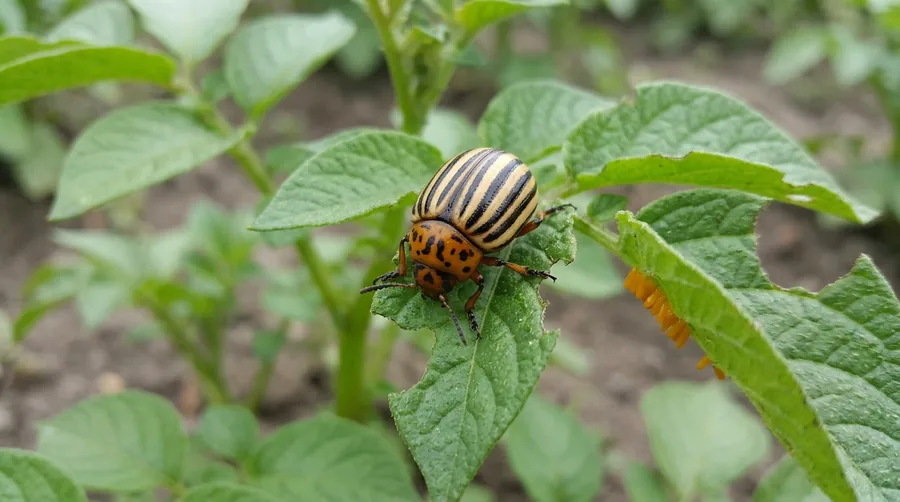
Yellow and black striped Colorado potato beetle on a chewed potato leaf
Recommended Products


What it does
Both the adults and the plump red larvae chew leaves, and a heavy population can completely defoliate potato plants, cutting yield or killing young plants. The beetle is famous for rapidly developing resistance to insecticides, which makes it one of the hardest garden and field pests to control with sprays alone.
Where it lives
A pest of potato and its relatives (eggplant, tomato, pepper, and nightshade weeds), it is found across most of the US wherever these crops grow, in gardens and fields alike. Adults overwinter in the soil and in field margins, emerging in spring to find host plants as they sprout.
How it breeds
Overwintered adults emerge in spring, feed, and lay clusters of bright yellow-orange eggs on leaf undersides. Larvae feed for two to three weeks, drop to pupate in the soil, and emerge as new adults. There are one to three generations a year, so populations can build quickly through the season.
What it eats
Colorado potato beetles feed on plants in the nightshade family, mainly potato, plus eggplant, tomato, pepper, and related weeds.
Identification
Adults are about 3/8 inch, rounded and domed, yellow-orange with ten black lengthwise stripes on the wing covers. Larvae are humpbacked and brick-red with black spots along each side. Egg clusters are bright yellow-orange on leaf undersides.
Signs of an infestation
- Yellow-and-black striped beetles on potato or eggplant
- Red humpbacked larvae feeding in groups
- Clusters of orange eggs on leaf undersides
- Leaves chewed to the stems (defoliation)
- Dark droppings on remaining foliage
Prevention tips
- Handpick adults, larvae, and egg clusters into soapy water
- Rotate potatoes and eggplants far from last year's beds
- Use straw mulch, which hinders adults reaching plants
- Cover young plants with floating row covers
- Encourage predators like stink bugs and lady beetles
Professional solutions
Small plantings are best managed by hand-picking and crop rotation, since the beetle resists many insecticides. For larger infestations, a local extension agent or agronomist can recommend rotating labeled products with different modes of action, or a Bt strain specific to leaf beetles, to slow resistance and protect the crop.
Health & safety
Colorado potato beetles do not bite, sting, or carry any disease affecting people or pets, so they are harmless to handle. Their impact is on plants, rapid defoliation of potato and related crops that can sharply reduce yield or kill young plants if left unchecked.
Relevant Products


Frequently asked questions
Why is the Colorado potato beetle so hard to kill?
It has repeatedly evolved resistance to insecticides, so many sprays that once worked no longer do. Effective control combines hand-picking, crop rotation, mulch, row covers, and rotating chemical modes of action rather than relying on one product.
What do Colorado potato beetle larvae look like?
The larvae are plump, humpbacked, and brick-red to orange with two rows of black spots along each side and a black head. They feed in groups on leaves and often cause more defoliation than the adults.
Fact-checked by Morgan Vance, Editorial Director (editorial review, not a professional pest-control or medical sign-off). Last reviewed May 18, 2026. We correct anything a reader shows us is wrong — see our corrections policy.