
Southern Pine Beetle
Dendroctonus frontalis · also called SPB, southern pine bark beetle
Quick answer
The southern pine beetle (Dendroctonus frontalis) is a tiny bark beetle that is the most destructive pine pest in the southern United States. Beetles mass-attack pines, tunneling S-shaped galleries under the bark and introducing blue-stain fungi that together kill the tree. Outbreaks can wipe out stands of pines quickly, marked by popcorn-like pitch tubes.
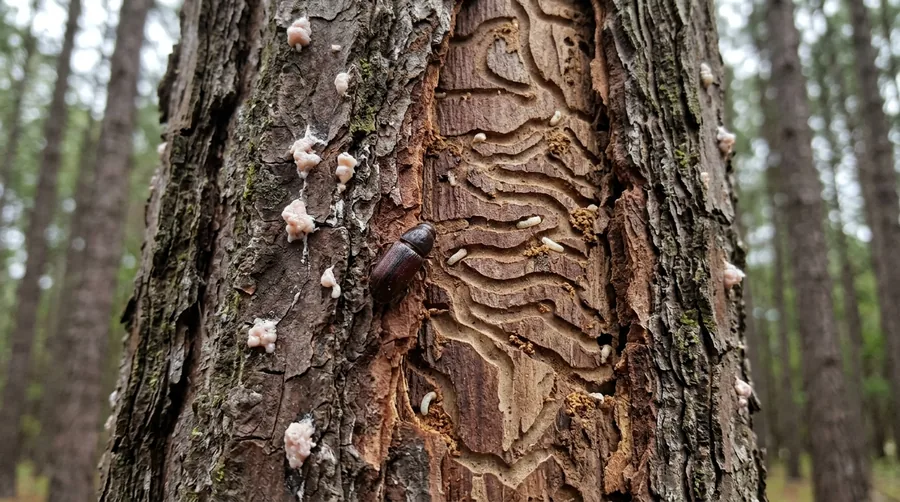
Tiny reddish-brown southern pine beetle beside winding S-shaped galleries etched under pine bark
Recommended Products


What it does
Southern pine beetles attack in huge numbers, overwhelming a tree's defenses through a coordinated 'mass attack' triggered by chemical signals. Adults bore in and excavate winding, S-shaped egg galleries in the inner bark, and they carry blue-stain fungi that clog the tree's water-conducting tissue. The combination of girdling tunnels and fungus kills pines rapidly, often within weeks.
Where it lives
It attacks most southern pines, especially loblolly, shortleaf, Virginia, and pond pine, in forests, plantations, parks, and yards. It ranges across the southeastern and south-central United States and has been expanding northward. Dense, stressed, or overstocked pine stands are especially vulnerable, and infestations spread tree to tree as expanding 'spots.'
How it breeds
The southern pine beetle breeds very fast, completing a generation in about a month in warm weather and producing several generations a year. Females bore in, lay eggs along S-shaped galleries, and larvae feed in the inner bark before pupating. New adults emerge to attack nearby pines, so a small spot can grow explosively during the warm season.
What it eats
Adults and larvae feed on the inner bark (phloem) of pine trees and on the blue-stain fungi they cultivate there. The beetle does not feed on people, animals, or wood products; it depends on living or freshly killed pines to reproduce.
Identification
Adults are tiny, 2 to 4 mm, reddish-brown to black beetles with a rounded (not notched) hind end, distinguishing them from Ips engraver beetles. The best signs are on the tree: small popcorn-shaped pitch tubes on the bark, winding S-shaped galleries under the bark, and fading needles that turn yellow, then red, then brown across a patch of trees.
Signs of an infestation
- Popcorn-shaped pitch tubes (masses of resin) on the trunk
- Winding, S-shaped galleries etched in the inner bark
- Needles fading from green to yellow to red across a group of pines
- Expanding 'spots' of dying trees in a stand
- Blue-gray staining in the sapwood of cut infested wood
- Woodpecker damage and popcorn frass at the tree base
Prevention tips
- Keep pines healthy and avoid overcrowding by thinning dense stands
- Reduce stress from drought, injury, and soil compaction around valued pines
- Remove and destroy infested trees promptly to slow spot growth
- Consult a forester about stand management in high-risk areas
- Report suspected outbreaks to your state forestry agency
Professional solutions
Active southern pine beetle infestations are managed at the stand level by foresters, not with homeowner sprays. Standard responses include cutting and removing infested trees plus a buffer of green trees to stop the spot from spreading. High-value individual yard pines can sometimes be protected with professionally applied preventive insecticides before attack; once a tree is successfully mass-attacked, it usually cannot be saved.
Health & safety
Southern pine beetles do not bite, sting, or transmit disease to people or pets, so there is no health risk. The danger is to trees and property: rapid pine mortality can create stands of dead, hazardous trees near homes and cause significant timber and landscape losses, which is why quick removal and stand management matter.
Relevant Products




Frequently asked questions
How do I know if my pines have southern pine beetle?
Look for popcorn-shaped resin pitch tubes on the bark, S-shaped tunnels under the bark, and needles fading from green to yellow to red across a patch of trees. The dying trees usually form an expanding 'spot.' A forester or your state forestry agency can confirm and advise on next steps.
What is the difference between southern pine beetle and Ips beetles?
Both are bark beetles in pines, but southern pine beetle makes winding S-shaped galleries and has a rounded hind end, while Ips engraver beetles make Y- or I-shaped galleries and have a scooped, spined rear. Southern pine beetle mass-attacks healthy pines; Ips usually targets stressed or injured trees.
Can I treat southern pine beetle myself?
No. Infestations move fast and are managed at the stand level by foresters, typically by cutting and removing infested trees plus a buffer of nearby green trees. Preventive insecticide on a high-value yard pine is a professional job and only works before the tree is attacked.
Fact-checked by Morgan Vance, Editorial Director (editorial review, not a professional pest-control or medical sign-off). Last reviewed June 15, 2026. We correct anything a reader shows us is wrong — see our corrections policy.