Ips Beetle
Ips spp. · also called engraver beetle, ips engraver beetle, pine engraver
Quick answer
Ips beetles (Ips species), also called engraver beetles, are small bark beetles that tunnel Y- or I-shaped galleries under the bark of pines and spruces. They usually attack trees already stressed by drought, injury, or fresh cutting, and can kill weakened pines. A scooped, spined rear end distinguishes them from other pine bark beetles.
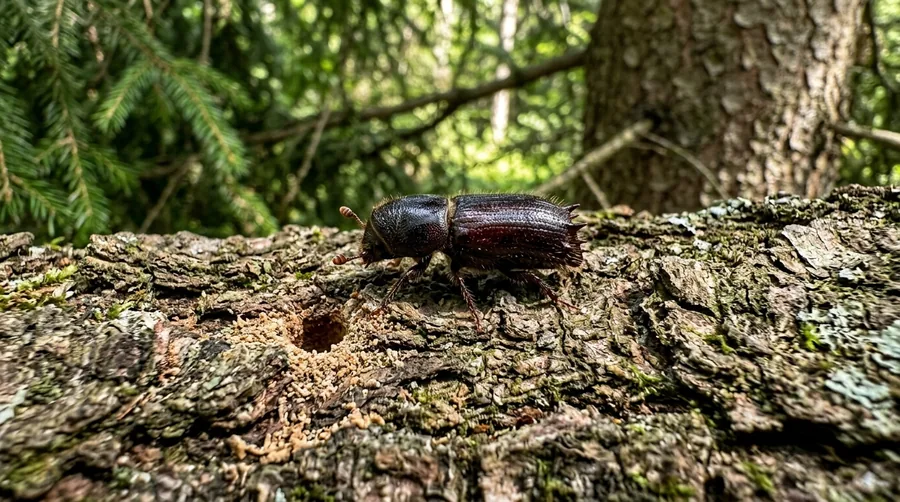
Reddish-brown Ips engraver beetle with a scooped spined rear beside Y-shaped galleries under pine bark
Recommended Products


What it does
Ips beetles bore through the bark and excavate distinctive Y- or H/I-shaped galleries in the inner bark, where they mate and lay eggs. They are drawn to stressed, injured, dying, or freshly cut pines and to slash and logging debris, and they carry blue-stain fungi. In most cases they are secondary invaders, finishing off weakened trees rather than killing vigorous ones, though hot, dry years can trigger heavier attacks.
Where it lives
Ips species attack pines and sometimes spruces throughout their range, from the western mountains to the southern and eastern United States. They infest landscape trees, forests, plantations, storm-damaged trees, and fresh pine logs or slash. Drought-stressed yards, recently thinned stands, and construction-damaged pines are common trouble spots.
How it breeds
Ips beetles reproduce quickly, with several overlapping generations per year in warm regions. A male starts a central 'nuptial chamber,' several females join and radiate egg galleries from it, giving the Y or star shape. Larvae feed in the inner bark, pupate, and emerge as adults that seek out new stressed trees, so populations can build fast after drought or storms.
What it eats
Adults and larvae feed on the inner bark (phloem) of pines and spruces and on associated blue-stain fungi. Ips beetles do not feed on wood products, people, or animals; they need the living or freshly killed inner bark of conifers to breed.
Identification
Adults are small, 3 to 6.5 mm, reddish-brown to black, cylindrical beetles. The diagnostic feature is the rear end: it is scooped out (concave) and lined with several pairs of spines, unlike the rounded rear of Dendroctonus beetles. Under the bark, the Y-, H-, or I-shaped galleries are kept clean of frass, another clue that separates Ips from other bark beetles.
Signs of an infestation
- Y-, H-, or I-shaped galleries cut into the inner bark
- Reddish-brown boring dust in bark crevices and at the tree base
- Pitch tubes that are small or absent, unlike some other bark beetles
- Fading, yellowing, then reddish-brown needles, often starting in the top or one section
- Blue-stain discoloration in the sapwood
- Small round exit holes scattered over the bark
Prevention tips
- Water valued pines during drought to reduce stress
- Avoid wounding trunks and roots during construction or pruning
- Remove or debark fresh pine logs, slash, and storm debris promptly
- Do not pile fresh pine wood near living pines
- Thin overcrowded stands to keep trees vigorous
Professional solutions
Because Ips beetles target stressed trees, the best 'treatment' is keeping trees healthy and removing breeding material like fresh slash. Once needles have faded, the beetles have usually already left and sprays will not help. A certified arborist can assess whether nearby high-value pines warrant a preventive insecticide and can safely remove infested or hazardous trees.
Health & safety
Ips beetles do not bite, sting, or spread disease to people or pets, so they present no health risk. Their impact is on tree health and property: they can kill drought- or storm-stressed pines, leaving dead trees that may need removal, but they rarely overwhelm well-watered, vigorous landscape trees.
Relevant Products




Frequently asked questions
Why did Ips beetles attack my pine?
Ips beetles are drawn to stressed trees, especially pines weakened by drought, root injury, construction damage, or recent storms, as well as fresh-cut logs and slash. Healthy, well-watered pines are far less likely to be successfully attacked, so reducing stress is the best defense.
Can I spray to save a pine with Ips beetles?
Usually not once the needles are fading, because the beetles have often already finished feeding and moved on. Insecticides are mainly preventive, applied by professionals to protect high-value trees before attack. Removing infested trees and fresh pine debris helps keep beetle numbers down.
How are Ips beetles different from southern or mountain pine beetle?
Ips beetles make Y- or I-shaped galleries and have a scooped, spined rear end, and they mostly attack stressed trees. Dendroctonus beetles like the southern and mountain pine beetle have rounded rears, make different gallery patterns, and can mass-attack and kill healthy pines.
Fact-checked by Morgan Vance, Editorial Director (editorial review, not a professional pest-control or medical sign-off). Last reviewed May 23, 2026. We correct anything a reader shows us is wrong — see our corrections policy.