Nantucket Pine Tip Moth
Rhyacionia frustrana · also called pine tip moth, Nantucket pine moth
Quick answer
The Nantucket pine tip moth (Rhyacionia frustrana) is a small moth whose larvae bore into the tips and buds of young pines, killing the shoots. The dead, browned tips (called flagging) stunt and deform seedlings and young plantation or landscape pines. It rarely harms large, established trees, so damage is mainly a concern on young pines.
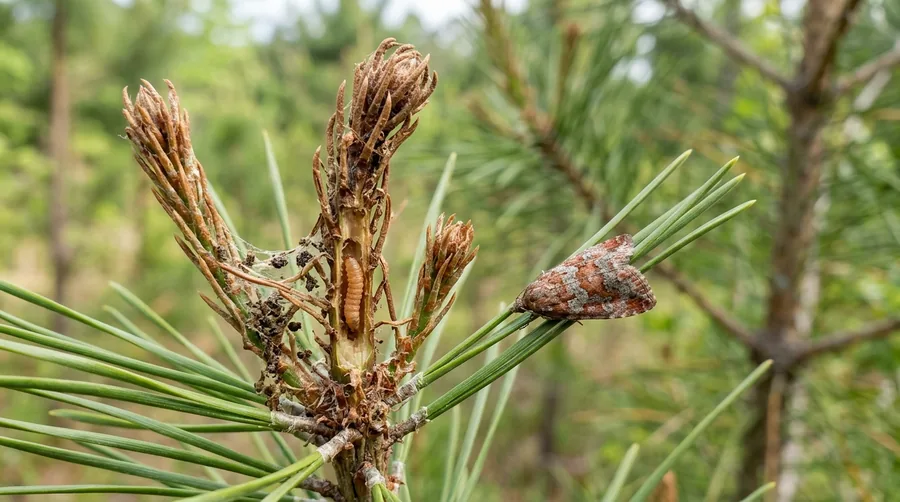
Small reddish-brown Nantucket pine tip moth beside a dead, browned pine shoot tip
Recommended Products


What it does
The larvae are the damaging stage. They tunnel into the buds and new shoot tips of pines, hollowing them out and killing the growing tip. Damaged tips turn brown and die ('flagging'), and repeated attacks stunt the tree, cause crooked or bushy growth, and can kill seedlings. Because the caterpillars feed inside the shoots, protected by webbing and pitch, they are hard to reach once inside.
Where it lives
The Nantucket pine tip moth attacks many pines, especially young loblolly, shortleaf, Virginia, and other hard pines, and is a notable pest of pine plantations, seedlings, Christmas-tree farms, and young landscape pines. It occurs across the eastern, southeastern, and south-central United States. Open-grown young pines are far more affected than large, established forest trees.
How it breeds
There are two to four generations per year, more in the warm South. Adults emerge in spring and lay eggs on new growth, buds, and needles. Larvae bore into buds and shoot tips, feed for several weeks, then pupate inside the damaged tip. New adults emerge to attack later flushes of growth, so successive generations damage the tree through the growing season. It overwinters as a pupa in the tips.
What it eats
Larvae feed inside the buds, new shoots, and shoot tips of young pines, hollowing them out. The adult moths take nectar or do not feed. The insect depends on the tender new growth of pines to develop, which is why young, vigorously flushing trees are the main hosts.
Identification
Adults are small, roughly half-inch-wingspan moths mottled reddish-brown and gray, easy to overlook. The obvious sign is the damage: dead, brown shoot tips and buds, often with silk webbing and pitch at the base, and small cream-colored to brown caterpillars hollowed inside. Cutting open a browned tip usually reveals the larva or its tunnel and frass.
Signs of an infestation
- Dead, browned shoot tips and buds ('flagging') on young pines
- Webbing and pitch (resin) at the base of damaged tips
- Hollowed shoots with a caterpillar or frass inside when cut open
- Stunted, crooked, or bushy growth on young pines
- Multiple flushes of damage through spring and summer
- Small mottled moths near young pines in the growing season
Prevention tips
- Inspect young pines in spring for early tip damage
- Prune off and destroy infested tips before larvae mature
- Avoid planting highly susceptible pines in known problem areas
- Keep young trees vigorous so they outgrow light damage
- Time any control to adult flights, which pheromone traps help monitor
Professional solutions
On a few small landscape pines, pruning out and destroying infested tips is often enough. Because larvae are protected inside shoots, effective spraying must be timed precisely to egg hatch and adult flight, so extension offices and certified arborists use pheromone traps and degree-day models to schedule treatments. In plantations and Christmas-tree farms, professionals manage tip moth with well-timed insecticides.
Health & safety
The Nantucket pine tip moth poses no risk to people or pets; it does not bite, sting, or spread disease. Its impact is on tree form and growth, chiefly on young pines, where repeated tip death can stunt and deform trees or kill seedlings. Large, established pines tolerate it well, so the concern is mainly for young and plantation trees.
Relevant Products


Frequently asked questions
Why are the tips of my young pine turning brown?
Brown, dead shoot tips on a young pine, often with webbing and pitch at the base, are a classic sign of Nantucket pine tip moth larvae boring inside the shoots. Cut open a browned tip and you will usually find the caterpillar or its tunnel. Pruning out infested tips helps on small trees.
Does the pine tip moth kill trees?
It can kill seedlings and badly stunt or deform young pines through repeated tip death, but large, established pines tolerate the damage and are rarely seriously harmed. That is why the moth is mainly a concern in plantations, Christmas-tree farms, and young landscape plantings.
When should I treat for pine tip moth?
Timing is everything, because the larvae are protected inside the shoots. Sprays must line up with adult flight and egg hatch, which pheromone traps and degree-day models help pinpoint. For a few small trees, simply pruning and destroying infested tips is often enough without spraying.
Fact-checked by Morgan Vance, Editorial Director (editorial review, not a professional pest-control or medical sign-off). Last reviewed May 14, 2026. We correct anything a reader shows us is wrong — see our corrections policy.