
Pine Sawfly
Neodiprion spp. · also called conifer sawfly, European pine sawfly, redheaded pine sawfly
Quick answer
Pine sawflies (Neodiprion species) are wasp relatives whose caterpillar-like larvae feed in groups on pine needles, sometimes stripping branches bare. Despite looking like caterpillars, they are not moths and do not sting. Most feeding is unsightly rather than fatal, though repeated defoliation can weaken or, in young pines, occasionally kill trees.
Cluster of green pine sawfly larvae feeding side by side on a pine branch
Recommended Products


What it does
Pine sawfly larvae feed together in colonies, lined up along needles and often rearing back in unison when disturbed, a defensive display. Depending on the species, they eat older needles, new needles, or both, and a colony can quickly strip a branch. Because many species eat only the previous year's needles and leave the new growth, trees frequently survive and recover, though the temporary damage looks dramatic.
Where it lives
Pine sawflies feed on pines and sometimes other conifers in yards, plantations, windbreaks, and forests. Different species dominate different regions, but as a group they occur across the United States. Young, open-grown, and ornamental pines, including landscape and Christmas-tree plantings, are common targets because their branches are easy for colonies to defoliate.
How it breeds
Life cycles vary by species, with one or more generations a year. Females use a saw-like egg-laying organ (the source of the name) to slit needles and insert rows of eggs. Larvae hatch and feed in colonies for several weeks, then drop to pupate in cocoons in the litter or soil. Some species overwinter as eggs in the needles, others as prepupae in cocoons.
What it eats
The larvae feed on pine needles, and some species also on other conifers. Many eat mainly the older, previous-season needles, while others attack new growth. The adult sawflies are short-lived and do little or no feeding on foliage. The insect depends on conifer needles to develop.
Identification
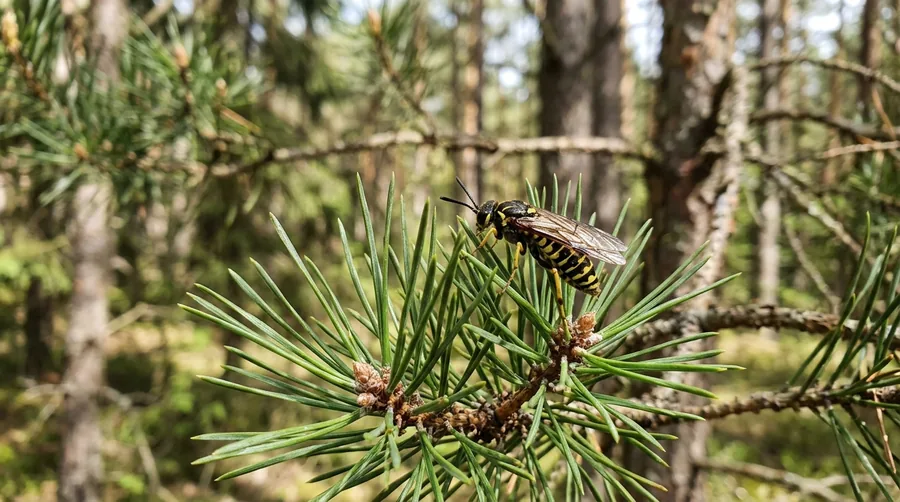
Larvae look like caterpillars but are sawfly larvae, typically green to grayish with darker stripes, and some, like the redheaded pine sawfly, have a reddish head and spotted body. A useful clue is the number of fleshy prolegs: sawfly larvae have more (usually six or more pairs) than moth caterpillars. Adults are small, stout, wasp-like insects that do not sting.
Signs of an infestation
- Groups of caterpillar-like larvae lined up on needles
- Branches stripped of older needles, leaving tufts of new growth
- Larvae rearing back in unison when the branch is jostled
- Brown, dried, partially chewed needles ('strawing')
- Bare, defoliated branches, often lower or on one side
- Small cocoons in the litter or soil beneath the tree
Prevention tips
- Scout pines in spring and early summer for young larval colonies
- Prune off and destroy branches holding feeding colonies
- Knock or handpick colonies into soapy water on small trees
- Encourage birds and natural enemies that feed on sawfly larvae
- Keep trees vigorous so they recover quickly from feeding
Professional solutions
Most pine sawfly problems are easily handled without a professional: colonies are clustered and easy to prune out or knock off small trees, and horticultural products labeled for sawfly larvae work when caterpillar-specific treatments do not. Note that Bacillus thuringiensis (Bt) for caterpillars does NOT kill sawflies, since they are not moths. For large or repeatedly defoliated trees, a certified arborist can treat effectively.
Health & safety
Pine sawflies do not bite, sting, or spread disease, and they pose no risk to people or pets despite their sometimes-startling group displays. The impact is to tree appearance and, with repeated heavy defoliation, tree vigor; young pines can occasionally be killed, but established pines usually recover, so the concern is mainly cosmetic.
Relevant Products


Frequently asked questions
Are the larvae on my pine caterpillars or sawflies?
Count the fleshy prolegs on the abdomen: sawfly larvae have six or more pairs, while moth caterpillars have five or fewer. Pine sawfly larvae also feed in tight colonies and rear back in unison when disturbed. The distinction matters because Bt sprays for caterpillars do not kill sawflies.
Will pine sawflies kill my pine tree?
Usually not. Many species eat only the older needles and leave the new growth, so established pines typically recover. Repeated heavy defoliation can weaken a tree, and young or small pines are occasionally killed, but most damage is temporary and cosmetic.
How do I get rid of pine sawflies?
Because they cluster, you can often prune out infested branches or knock the larvae into soapy water on small trees. Products labeled for sawfly larvae work if needed, but note that Bt, which controls caterpillars, does not affect sawflies. Large trees may warrant a certified arborist.
Fact-checked by Morgan Vance, Editorial Director (editorial review, not a professional pest-control or medical sign-off). Last reviewed July 27, 2026. We correct anything a reader shows us is wrong — see our corrections policy.