
Mountain Pine Beetle
Dendroctonus ponderosae · also called MPB, Black Hills beetle, Rocky Mountain pine beetle
Quick answer
The mountain pine beetle (Dendroctonus ponderosae) is a small bark beetle native to western North America and the region's most damaging pine pest. Beetles mass-attack pines and introduce blue-stain fungi, together killing the tree. Landmark outbreaks have killed pines across millions of acres. Signs include popcorn-like pitch tubes and reddening needles.
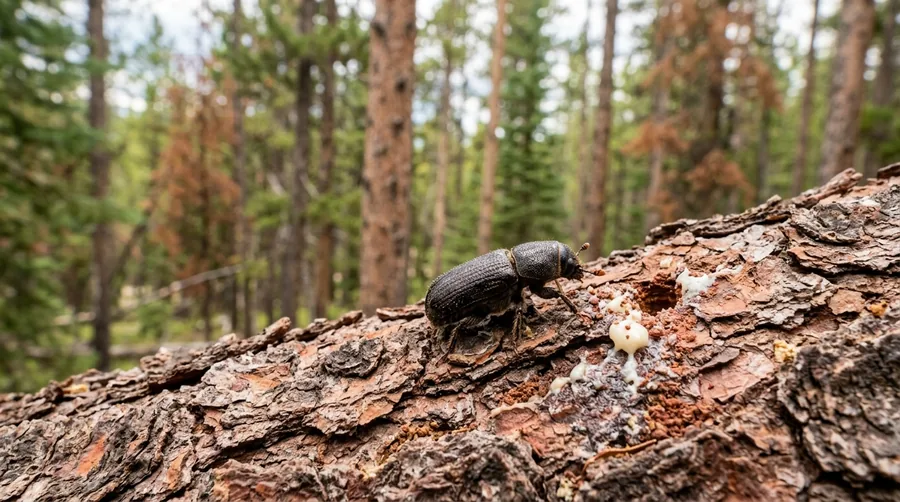
Small black mountain pine beetle on ponderosa pine bark near a cream-colored pitch tube
Recommended Products


What it does
Mountain pine beetles overcome a tree's defenses by attacking in mass, coordinated by chemical signals so hundreds strike at once. They bore in and cut vertical J-shaped egg galleries in the inner bark, and they introduce blue-stain fungi that block the tree's water transport. The tree's pitch defenses are overwhelmed, and the combined feeding and fungus kill it, usually within a year.
Where it lives
It attacks most western pines, including lodgepole, ponderosa, whitebark, and sugar pine, in forests, mountain communities, parks, and yards. It ranges through the western United States and western Canada, from the Rockies to the Pacific. Dense, mature, or drought-stressed pine stands are most at risk, and warmer winters have allowed outbreaks to expand to higher elevations.
How it breeds
There is generally one generation per year. Adults fly in mid to late summer, mass-attack pines, and lay eggs in vertical galleries. Larvae feed under the bark and overwinter there, protected by natural antifreeze compounds, then resume feeding and pupate before emerging the next summer. Mild winters improve larval survival and can fuel larger outbreaks.
What it eats
Adults and larvae feed on the inner bark (phloem) of pine trees and on the blue-stain fungi they introduce. The beetle does not feed on people, animals, or finished wood; it requires living pines to reproduce and complete its life cycle.
Identification
Adults are small, about 5 mm, hard black cylindrical beetles rarely seen because they live under the bark. Diagnosis relies on tree signs: cream to reddish popcorn-shaped pitch tubes on the trunk, reddish boring dust in bark crevices and at the base, J-shaped galleries under the bark, and needles that fade to yellow and then red about a year after attack.
Signs of an infestation
- Popcorn-shaped pitch tubes on the trunk, often cream or pink
- Reddish-brown boring dust in bark crevices and at the tree base
- Vertical J-shaped galleries in the inner bark
- Whole-tree needle fade to yellow, then red, about a year after attack
- Blue-gray stained sapwood in cut wood
- Woodpecker flecking on the bark
Prevention tips
- Keep pines vigorous and thin overcrowded stands to reduce competition
- Water valued landscape pines during drought
- Remove and destroy infested trees before beetles emerge the next summer
- Consider professionally applied preventive sprays or repellents on high-value pines in outbreak areas
- Work with a forester on stand-level management where outbreaks are active
Professional solutions
Managing mountain pine beetle is a job for foresters and certified arborists. In outbreaks, infested trees are removed and destroyed before the next generation emerges. High-value yard pines can sometimes be protected by preventive insecticide sprays or anti-aggregation pheromone (verbenone) applied by professionals before attack. A tree that has been successfully mass-attacked generally cannot be saved.
Health & safety
Mountain pine beetles do not bite, sting, or transmit disease to people or pets, so they pose no direct health risk. The impact is ecological and to property: extensive pine mortality raises wildfire fuel loads and leaves dead, hazardous trees near homes, so removing killed trees and protecting valued ones are the main concerns.
Relevant Products




Frequently asked questions
What are the signs of mountain pine beetle in my pines?
Look for popcorn-shaped pitch tubes on the trunk, reddish boring dust in the bark and at the base, and needles that fade to yellow and then red, usually about a year after attack. J-shaped galleries under the bark and blue-stained wood confirm it. A forester or arborist can verify an infestation.
Can a mountain pine beetle infestation be treated?
Once a pine has been successfully mass-attacked it generally cannot be saved and is removed before beetles emerge. Prevention is the main tool: keeping trees healthy, thinning dense stands, and having professionals apply preventive sprays or verbenone repellent to high-value trees before attack.
Why have mountain pine beetle outbreaks been so severe?
Large areas of mature, densely stocked pines, drought stress, and milder winters that let more larvae survive have combined to fuel major outbreaks across the West. Warmer conditions have also let the beetle expand into higher elevations and hosts like whitebark pine.
Fact-checked by Morgan Vance, Editorial Director (editorial review, not a professional pest-control or medical sign-off). Last reviewed July 8, 2026. We correct anything a reader shows us is wrong — see our corrections policy.