
Rice Weevil
Sitophilus oryzae · also called rice weevils, grain weevil
Quick answer
The rice weevil (Sitophilus oryzae) is a small reddish-brown to black weevil with a long snout and four faint pale spots on its back. Females bore into whole grains to lay eggs, and larvae develop hidden inside the kernel. It infests rice, wheat, corn, and other whole grains in homes and storage.
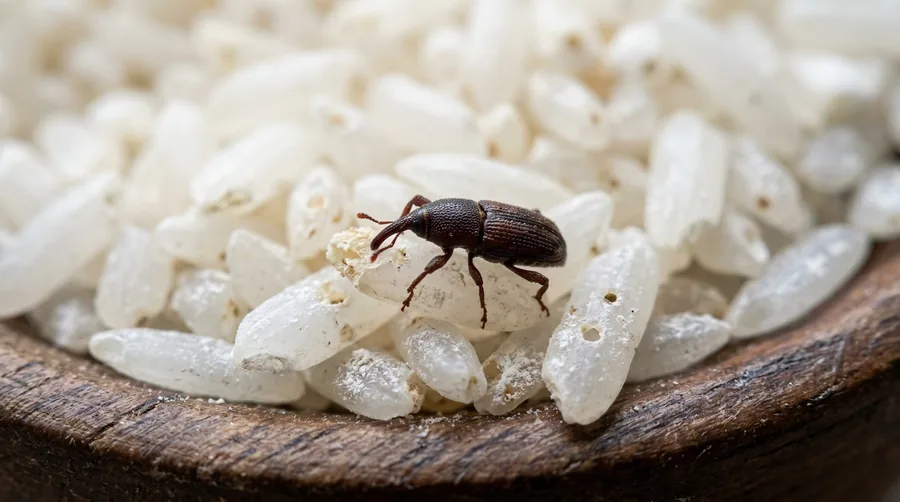
Small reddish-brown rice weevil with a long snout and pale back spots on scattered rice grains
Recommended Products


What it does
The rice weevil is an internal grain feeder: the female chews a tiny hole in a whole kernel, deposits an egg, and seals it, so the larva grows unseen inside. Adults can fly and are attracted to light, helping them disperse. Damaged grain heats and molds, and the emerging adults leave ragged exit holes.
Where it lives
It infests whole grains in home pantries, granaries, mills, and warehouses, favoring stored rice, wheat, corn, barley, and even hard pasta and caked flour. It can also begin infestations in standing grain in the field. It occurs nationwide and is especially troublesome in warmer regions and heated storage.
How it breeds
A female lays several hundred eggs over her life, one per kernel. The legless larva feeds inside the grain, pupates there, and emerges as an adult, completing a generation in about a month under warm conditions. Multiple overlapping generations a year cause populations to build rapidly in stored grain.
What it eats
Larvae develop inside whole kernels of rice, wheat, corn, sorghum, and similar grains, and adults also feed on grain and can attack caked flour and hard pasta. Because larvae need intact kernels, whole-grain products are most at risk.
Identification
Adults are about 1/8 inch, reddish-brown to nearly black, with a long, down-curved snout and four lighter reddish or yellowish spots on the wing covers. The rice weevil closely resembles the maize weevil; both fly and are spotted, while the granary weevil is larger, unspotted, and flightless.
Signs of an infestation
- Whole grains with small round exit holes
- Weevils crawling in rice, pasta, or flour
- Grain that feels warm, damp, or clumped
- Weevils gathering at windows or lights after flying
- Fine flour-like dust from tunneled kernels
Prevention tips
- Store grains and pasta in airtight glass or hard-plastic containers
- Freeze new grain for several days to kill hidden eggs
- Use older stock first and buy amounts you will use soon
- Clean cabinet cracks and vacuum spilled grain
- Inspect bulk grains before storing them
Professional solutions
Most home rice weevil problems are solved by discarding infested grain, cleaning shelves, and switching to airtight storage. A professional is worthwhile for repeated infestations or for granary, mill, and warehouse settings, where inspection, sanitation, and controlled treatment or fumigation may be required.
Health & safety
Rice weevils do not bite, sting, or transmit disease, and they do not damage the home structure. The concern is contamination and loss of stored grain. Eating a few accidentally is not considered harmful, but infested, possibly moldy grain should be discarded rather than salvaged.
Relevant Products


Frequently asked questions
How do rice weevils get into sealed bags of rice?
Infestations usually start inside the grain before you buy it, since larvae develop hidden within whole kernels and adults can chew out of thin packaging. Freezing new grain for several days and storing it in airtight containers stops hidden eggs from developing and spreading.
What is the difference between a rice weevil and a granary weevil?
Rice weevils are smaller, have four pale spots on the back, and can fly, while granary weevils are larger, uniformly dark without spots, and cannot fly. Both bore into whole kernels, but the granary weevil is more common in cooler climates.
Can I still eat grain with rice weevils in it?
Weevils are not known to carry disease, so accidentally eating a few is not considered dangerous. However, infested grain is contaminated, often tunneled and prone to mold, so it is best discarded and the storage area cleaned before restocking.
Fact-checked by Morgan Vance, Editorial Director (editorial review, not a professional pest-control or medical sign-off). Last reviewed May 17, 2026. We correct anything a reader shows us is wrong — see our corrections policy.