
Angoumois Grain Moth
Sitotroga cerealella · also called Angoumois grain moths, grain moth
Quick answer
The Angoumois grain moth (Sitotroga cerealella) is a small buff-yellow moth whose larvae develop entirely inside whole grain kernels, unlike surface-feeding pantry moths. It attacks wheat, corn, rice, and sorghum in both the field and storage. Emerging adults leave a round exit hole in each hollowed kernel.
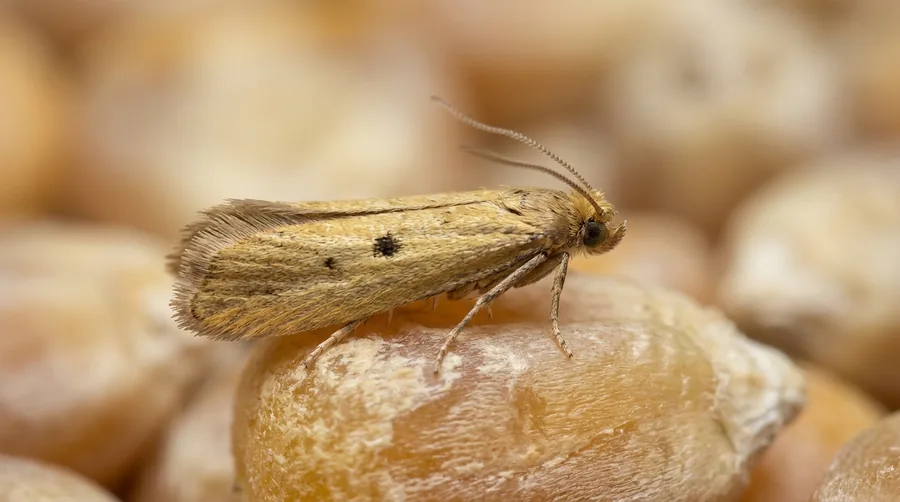
Small buff-yellow Angoumois grain moth beside whole grain kernels with round exit holes
Recommended Products
See the full ranking →

What it does
Unlike the Indianmeal and flour moths, whose larvae feed on the surface of dry foods, the Angoumois grain moth develops inside a single whole kernel. The larva hollows the grain out, pupates within, and the adult emerges through a round hole, leaving a light, empty husk. Adults are weak fliers active around stored and field grain.
Where it lives
It infests whole grains such as wheat, corn, rice, barley, and sorghum in granaries, bins, cribs, and warehouses, and readily attacks maturing grain in the field before harvest. It is a farm and commercial storage pest across the US, especially damaging in warmer regions and in the upper layers of stored grain.
How it breeds
A female lays eggs on or near grain. The tiny larva bores into a kernel and completes its development inside, pupating there before the adult chews its way out. A generation takes about a month in warm conditions, and continued field-to-storage breeding allows several overlapping generations a season.
What it eats
Larvae feed inside whole kernels of wheat, corn, rice, barley, oats, and sorghum, consuming the interior. Because each larva needs an intact kernel, whole grains, not flour or milled products, are the primary target of this internal feeder.
Identification
Adults are small, buff to yellowish-tan, with narrow, pointed, heavily fringed hindwings that bear a small finger-like projection. Larvae are pale and are found within kernels. Round exit holes in otherwise intact grain and light, hollowed kernels distinguish this internal feeder from surface-feeding pantry moths.
Signs of an infestation
- Whole kernels with small round exit holes
- Light, hollow grain that floats or feels empty
- Small buff moths flying around stored or field grain
- Larvae found inside cut-open kernels
- Damage concentrated in the top layer of stored grain
Prevention tips
- Harvest and dry grain promptly and store it clean
- Clean bins and cribs before adding new grain
- Store grain in sealed, insect-proof containers
- Use pheromone traps to monitor grain storage
- Manage the surface layer of stored grain where they concentrate
Professional solutions
Small household quantities are handled by discarding infested grain and cleaning. On farms and in commercial storage, professionals and grain managers use bin sanitation, aeration and temperature control, surface treatments, and fumigation to protect stored grain from this internal feeder that also arrives from the field.
Health & safety
Angoumois grain moths do not bite, sting, or transmit disease and cause no structural damage. Their impact is economic: hollowed, contaminated grain with reduced weight, germination, and quality. Infested grain should be discarded or diverted rather than used for food or seed.
Relevant Products


Frequently asked questions
How is the Angoumois grain moth different from a pantry moth?
Its larvae develop entirely inside a single whole grain kernel, whereas common pantry moths like the Indianmeal moth feed on the surface of dry foods and spin webbing. The Angoumois grain moth leaves round exit holes in otherwise intact kernels and attacks whole grain, not flour.
Can the Angoumois grain moth infest grain in the field?
Yes. It attacks maturing grain such as wheat, corn, and sorghum in the field before harvest, then continues breeding in storage. This field-to-storage carryover is why prompt harvest, drying, clean bins, and sealed storage are important for keeping it in check.
Are pheromone traps useful for the Angoumois grain moth?
Pheromone traps can help monitor adult activity in grain storage and time control measures, but they do not stop larvae developing inside kernels. Sanitation, clean sealed storage, and, for bulk grain, professional grain management remain the core of effective control.
Fact-checked by Morgan Vance, Editorial Director (editorial review, not a professional pest-control or medical sign-off). Last reviewed July 23, 2026. We correct anything a reader shows us is wrong — see our corrections policy.