
Maize Weevil
Sitophilus zeamais · also called maize weevils, greater rice weevil, corn weevil
Quick answer
The maize weevil (Sitophilus zeamais) is a small reddish-brown weevil with a long snout and four orange-red spots on its back, and it is a strong flier. Females lay eggs inside whole kernels, where larvae feed hidden from view. It attacks corn, rice, and other grain both in the field and in storage.
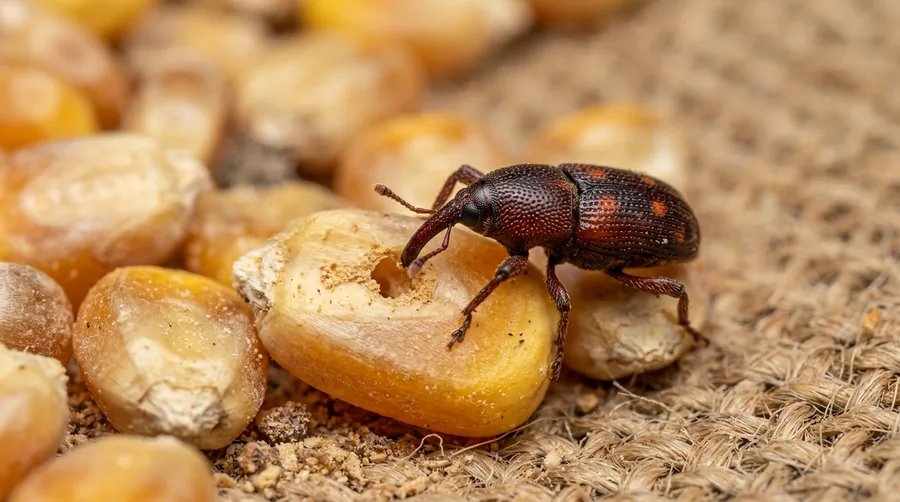
Reddish-brown maize weevil with a long snout and orange back spots on corn kernels
Recommended Products


What it does
The maize weevil is an internal feeder like the rice weevil but is generally larger and a stronger flier, letting it infest grain in the field before harvest as well as in storage. Females hollow kernels to lay eggs, and larvae mature unseen inside. Its flight ability makes it especially good at colonizing new grain.
Where it lives
It is a major pest of stored corn, rice, wheat, and sorghum in granaries, mills, and farms, and readily attacks grain still in the field, particularly in warm climates. Found nationwide, it is most damaging in the warm, humid conditions of the South and in poorly protected farm storage.
How it breeds
A female lays several hundred eggs, one per kernel, sealing each in place. The larva develops and pupates inside the grain, emerging as an adult in roughly a month under warm conditions. Because it breeds in both field and storage and completes generations quickly, populations can escalate rapidly.
What it eats
Larvae feed inside whole kernels of corn, rice, wheat, sorghum, and other grains, and adults also feed on grain. It prefers whole kernels and is a particularly serious pest of stored corn, from which it takes its name.
Identification
Adults are about 1/8 inch, reddish-brown with four orange-red spots on the wing covers and a long curved snout. It looks almost identical to the rice weevil but averages slightly larger; both fly and are spotted, unlike the flightless, unspotted granary weevil. Microscopic features confirm the species.
Signs of an infestation
- Corn and grain kernels with round emergence holes
- Spotted, long-snouted weevils in stored grain
- Weevils flying to lights or windows
- Warm, musty, or clumping grain in storage
- Field corn infested before or at harvest
Prevention tips
- Harvest and dry grain promptly to safe moisture levels
- Store grain in clean, sealed, insect-proof containers or bins
- Clean bins and equipment before adding new grain
- Rotate and use older stored grain first
- Freeze small quantities to kill hidden eggs
Professional solutions
Small household amounts are handled by discarding infested grain and cleaning. On farms and in commercial storage, professionals or grain-management specialists use bin sanitation, moisture and temperature control, protectant treatments, and fumigation to protect large volumes from this fast-breeding, flying pest.
Health & safety
Maize weevils do not bite, sting, or transmit disease and cause no structural harm. Their damage is economic: contaminated and hollowed grain with reduced weight and quality, plus secondary mold. Infested grain should be discarded rather than eaten or fed to livestock.
Relevant Products


Frequently asked questions
How is the maize weevil different from the rice weevil?
They look almost identical, both with a long snout and four spots on the back, and both can fly. The maize weevil averages slightly larger and is an especially strong flier and serious pest of stored corn. Distinguishing them precisely usually requires microscopic examination.
Can maize weevils infest corn in the field?
Yes. Unlike the granary weevil, the maize weevil flies well and can begin infesting grain, especially corn, while it is still in the field before harvest. This is why prompt harvest, drying, and clean storage are important for keeping populations down.
How do I protect stored corn from maize weevils?
Dry grain to a safe moisture level, store it in clean sealed bins or containers, and clean out old grain residue before restocking. Rotating stock and, for small amounts, freezing grain to kill hidden eggs all help. Large farm storage may need professional grain protection.
Fact-checked by Morgan Vance, Editorial Director (editorial review, not a professional pest-control or medical sign-off). Last reviewed June 9, 2026. We correct anything a reader shows us is wrong — see our corrections policy.