
Granary Weevil
Sitophilus granarius · also called granary weevils, grain weevil, wheat weevil
Quick answer
The granary weevil (Sitophilus granarius) is a shiny reddish-brown to black weevil with a long snout and no wing spots, and unlike its relatives it cannot fly. Larvae develop inside whole grain kernels, hollowing them out. Common in cooler climates, it infests wheat, barley, and other stored whole grains.
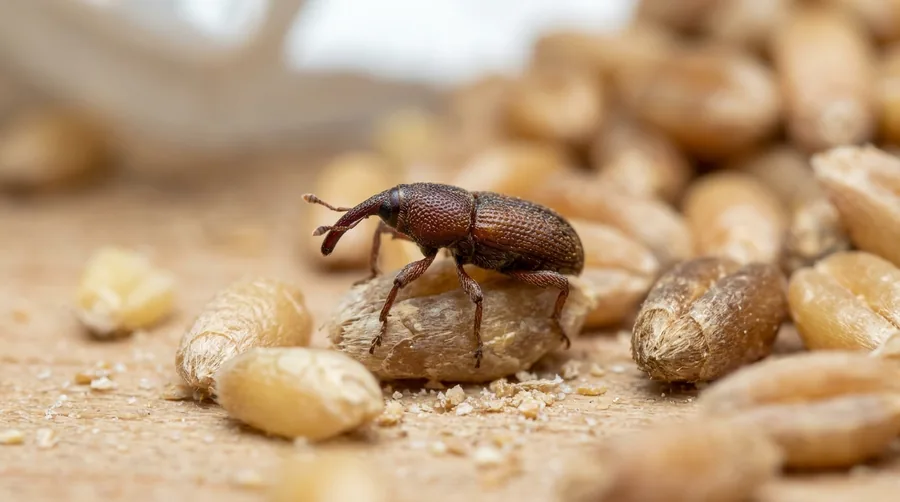
Shiny dark reddish-brown granary weevil with a long snout on wheat kernels
Recommended Products


What it does
The granary weevil is an internal grain feeder that spends most of its life hidden inside kernels. It cannot fly, so it spreads through infested grain and contaminated storage rather than by dispersing on its own. Because it tolerates cool temperatures well, it persists in unheated granaries where other grain pests decline.
Where it lives
It is primarily a pest of stored whole grains in granaries, mills, elevators, and home pantries, and does not infest grain in the field. It favors wheat, barley, oats, rye, and corn. Found nationwide, it is especially associated with cooler, temperate storage where its cold tolerance gives it an advantage.
How it breeds
A female chews a cavity in a kernel, lays a single egg, and seals it. The larva develops entirely inside the grain, pupates there, and emerges as an adult, taking around four to six weeks in warm conditions and longer when cool. Overlapping generations steadily damage stored grain over time.
What it eats
Larvae feed inside whole kernels of wheat, barley, oats, rye, corn, and rice, and adults feed on grain as well. Like the rice weevil, it requires intact kernels for larval development, so whole grains rather than flour are most vulnerable.
Identification
Adults are about 1/8 to 3/16 inch, shiny reddish-brown to black, with a long, curved snout and elongated pits on the thorax. Unlike the rice and maize weevils, it lacks pale spots on the wing covers and cannot fly, which are the key distinguishing features.
Signs of an infestation
- Hollowed whole grains with round exit holes
- Dark, unspotted long-snouted weevils in stored grain
- Grain that clumps, heats, or smells musty
- Weevils crawling but never flying
- Declining grain weight and quality in storage
Prevention tips
- Store grain in airtight, cleanable containers
- Keep storage bins and cabinets free of old spilled grain
- Rotate stock and use older grain first
- Freeze small quantities to kill hidden eggs
- Inspect and clean bins before adding new grain
Professional solutions
In homes, discarding infested grain and cleaning storage usually ends the problem. Because granary weevils thrive in bulk and cool storage, granaries, mills, and elevators often need professional sanitation, aeration or temperature management, and controlled fumigation to protect large volumes of grain.
Health & safety
Granary weevils do not bite, sting, or spread disease, and they do no structural damage. Their impact is contamination and quantity loss in stored grain. Infested grain, which is often tunneled and prone to mold, should be discarded rather than eaten or fed to animals.
Relevant Products


Frequently asked questions
Why can't the granary weevil fly like other grain weevils?
The granary weevil has non-functional wings and cannot fly, unlike the rice and maize weevils. It relies on being carried in infested grain to spread, which is one reason it is so closely tied to stored and transported grain rather than field crops.
Where is the granary weevil most common?
It is especially common in cooler, temperate regions and unheated storage because it tolerates cold better than many grain pests. It infests stored wheat, barley, and other whole grains in granaries, mills, and home pantries, but not grain still growing in the field.
How do I get rid of granary weevils at home?
Find and discard all infested grain, vacuum and clean the storage area, and move remaining grain into airtight containers. Freezing small amounts for several days kills hidden eggs and larvae. For bulk storage, professional sanitation and treatment may be needed.
Fact-checked by Morgan Vance, Editorial Director (editorial review, not a professional pest-control or medical sign-off). Last reviewed August 4, 2026. We correct anything a reader shows us is wrong — see our corrections policy.