
Red Flour Beetle
Tribolium castaneum · also called flour beetle, rust-red flour beetle
Quick answer
The red flour beetle (Tribolium castaneum) is a tiny, shiny reddish-brown beetle and a leading pest of flour, cereal, and other milled grain products. It feeds on broken and processed grain rather than whole kernels, and heavy infestations taint flour with an off odor. It flies but does not bite or spread disease.
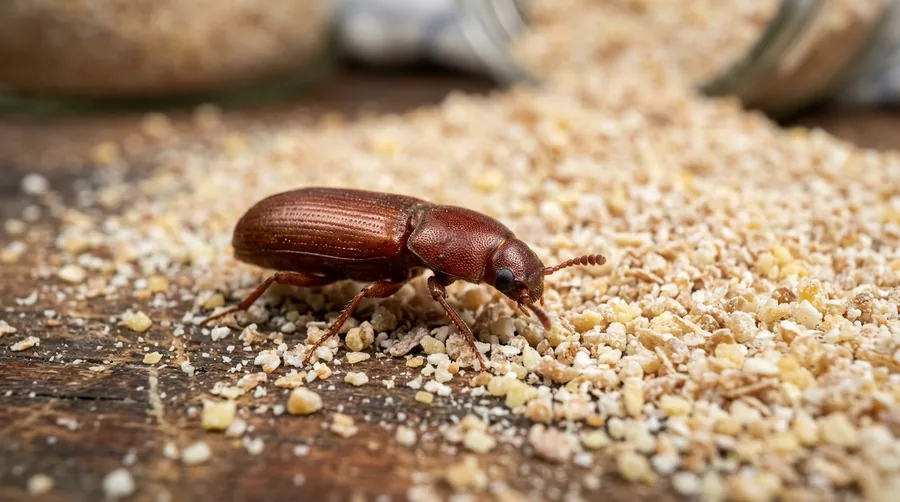
Small shiny reddish-brown red flour beetle on spilled flour
Recommended Products


What it does
Red flour beetles are among the most common pests of stored flour and grain products. They cannot break into sound whole kernels, so they feed on already broken, milled, or damaged grain and on flour, where large populations produce a sharp odor and can give flour a grayish or pinkish tinge. Adults can fly and are drawn to light.
Where it lives
They infest home pantries, grain stores, mills, groceries, and warehouses, living directly in flour, cereal, and milled grain products and in the spilled residue in cracks and cabinet corners. Widely distributed across the US, they favor warm conditions and thrive in heated buildings year-round.
How it breeds
Females lay eggs directly in flour and grain products, where the eggs stick to particles. The larvae feed within the food, then pupate, and adults emerge to continue the cycle. In warm conditions a generation completes in about a month, so populations can build rapidly through overlapping generations.
What it eats
They feed on milled and processed grain products, flour, cereal, meal, and broken grain, as well as dried goods such as beans, nuts, spices, and dry pet food; they cannot feed on undamaged whole kernels.
Identification
Adults are small, 3-4 mm, flattened, and shiny reddish-brown, nearly identical to the confused flour beetle. The red flour beetle's antennae end abruptly in a three-segmented club, and unlike the confused flour beetle it can fly. A hand lens is usually needed to tell the two apart reliably.
Signs of an infestation
- Small reddish-brown beetles in or near flour and grain products
- Flour with a sharp odor or a grayish or pinkish tint
- Beetles crawling in cabinets or flying toward lights
- Live insects sifted out when sieving stored flour or meal
Prevention tips
- Store flour, grain, and dried goods in airtight containers
- Rotate stock and use older dried products first
- Clean up spilled flour and crumbs in cabinet cracks and corners
- Inspect and, if unsure, freeze newly bought grain products before storing
Professional solutions
Control starts with finding and discarding infested products, then cleaning cracks and corners where flour collects and switching to sealed containers. Freezing or heating suspect items can kill hidden stages. Pheromone traps help monitor. A professional is worth calling for persistent infestations in pantries or commercial storage where the source keeps eluding you.
Health & safety
Red flour beetles do not bite, sting, or transmit disease. The concern is contamination and spoilage of stored foods, which develop an off odor and taste and should be discarded. Eating a few accidentally is not known to be harmful, though some people can be sensitive to heavily infested flour. They are a nuisance and economic pest.
Relevant Products


Frequently asked questions
Where do red flour beetles come from?
They usually arrive in an already-infested package of flour, cereal, or grain product brought home from the store, then spread to other dried goods in the pantry. Because they feed on milled and broken grain and flour, spilled residue in cabinet cracks can also sustain a population.
Are red flour beetles dangerous?
They do not bite, sting, or spread disease, so they are not a health hazard. The problem is contamination: infested flour develops an off odor and taste and should be discarded. Accidentally eating a few is not known to be harmful, but the food quality is ruined.
How do I get rid of flour beetles?
Find and throw out infested flour, cereal, and grain products, then clean cabinet cracks and corners where flour collects and store everything in airtight containers. Freezing or heating suspect items kills hidden eggs and larvae, and monitoring traps help confirm the infestation is gone.
Fact-checked by Morgan Vance, Editorial Director (editorial review, not a professional pest-control or medical sign-off). Last reviewed July 2, 2026. We correct anything a reader shows us is wrong — see our corrections policy.