
Drugstore Beetle
Stegobium paniceum · also called biscuit beetle, bread beetle
Quick answer
The drugstore beetle (Stegobium paniceum) is a tiny, reddish-brown, hump-backed beetle that eats an exceptionally wide range of dried goods, from flour, spices, and cereals to pet food and even pharmaceuticals. Its larvae feed and contaminate stored products, and can bore through packaging. It does not bite or spread disease.
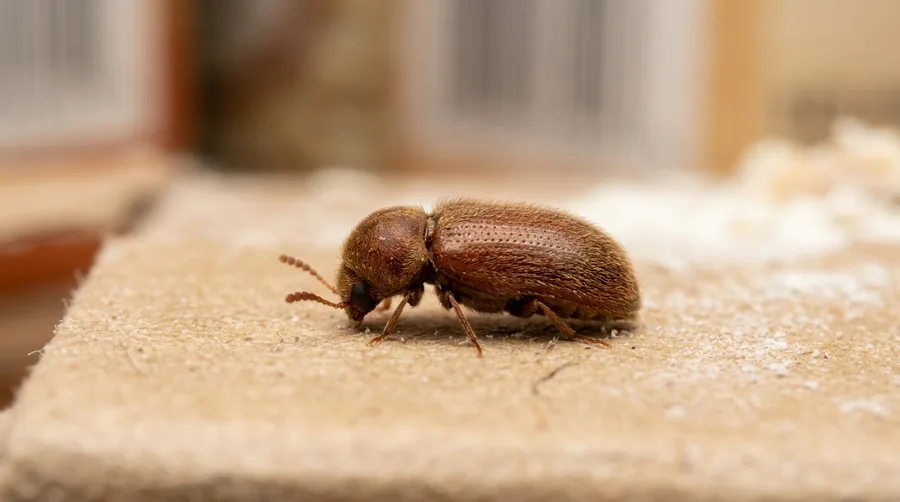
Tiny reddish-brown hump-backed drugstore beetle on grains of flour
Recommended Products


What it does
Drugstore beetles fly well, are attracted to light, and often play dead when disturbed. Adults do little feeding, but the larvae bore through a remarkably wide range of dried goods and can even chew through packaging, including foil and thin plastic, to reach or escape food. Warm storage areas let numbers build quickly.
Where it lives
They live wherever dry stored products are kept, homes, pantries, groceries, pharmacies, and warehouses. Larvae develop inside flour, cereals, spices, seeds, dry pet food, and even medicines and dried botanicals. Found nationwide, they are among the most common and least picky stored-product pests in kitchens and storage rooms.
How it breeds
Females lay eggs on or in stored food, and the small C-shaped larvae tunnel and feed inside the product before pupating in a cocoon. Under warm conditions the cycle completes in a couple of months, producing several generations a year, so a hidden source can spread quickly across a pantry.
What it eats
Larvae feed on an exceptionally broad range of dry materials, flour, bread, cereals, spices, seeds, nuts, dried fruit, dry pet food, and even pharmaceuticals and dried plant material, which gives the beetle its name.
Identification
Adults are 2-3.5 mm, cylindrical, and uniformly reddish-brown, with the same humped profile as the cigarette beetle. Two features separate them: the drugstore beetle's antennae end in a loose three-segmented club rather than being saw-toothed, and its wing covers have fine lengthwise grooves.
Signs of an infestation
- Small reddish-brown beetles near pantries, windows, or lights
- Tiny holes bored in packaging, including foil and plastic
- Larvae, tunneling, or powder inside dried goods
- Contaminated flour, spices, or pet food with a musty quality
Prevention tips
- Keep flour, cereals, spices, and pet food in airtight containers
- Rotate stored foods and discard old or expired items
- Wipe up spills and vacuum cracks in cabinets and shelves
- Check newly purchased dried goods for existing infestation
Professional solutions
As with other pantry beetles, the key is locating and discarding every infested item, then cleaning shelves and cracks and switching to sealed containers. Pheromone or monitoring traps help find hidden sources. Recurring infestations in stores or warehouses, where the source is elusive, are where a professional's inspection and treatment become worthwhile.
Health & safety
Drugstore beetles do not bite, sting, or transmit disease, and eating a few in infested food is not known to be harmful. Their impact is contamination and spoilage of a wide range of dried goods and even stored medicines, which should be discarded. They are an economic and nuisance pest, not a health threat.
Relevant Products


Frequently asked questions
How can I tell a drugstore beetle from a cigarette beetle?
They look nearly identical, both small, reddish-brown, and humped, but two details separate them: the drugstore beetle has antennae ending in a three-segmented club and wing covers with fine lengthwise grooves, while the cigarette beetle has saw-toothed antennae and smooth wing covers.
Can drugstore beetles get through packaging?
Yes. The larvae can bore through many types of packaging, including cardboard, paper, thin plastic, and even foil, to reach food or escape it. That is why sealed, hard-sided airtight containers protect pantry goods far better than the original packaging.
How do I get rid of drugstore beetles?
Find and discard every infested package of flour, spice, grain, pet food, or dried goods, then clean shelves and cracks and store the rest in airtight containers. Monitoring traps help you locate hidden sources and confirm the infestation is fully gone.
Fact-checked by Morgan Vance, Editorial Director (editorial review, not a professional pest-control or medical sign-off). Last reviewed July 7, 2026. We correct anything a reader shows us is wrong — see our corrections policy.