
Confused Flour Beetle
Tribolium confusum · also called flour beetle, confused flour beetles
Quick answer
The confused flour beetle (Tribolium confusum) is a tiny, shiny reddish-brown pantry pest nearly identical to the red flour beetle, and named for how easily the two are confused. It infests flour, cereals, and dried goods, feeding on processed grain. Unlike its cousin it cannot fly, and it does not bite or spread disease.
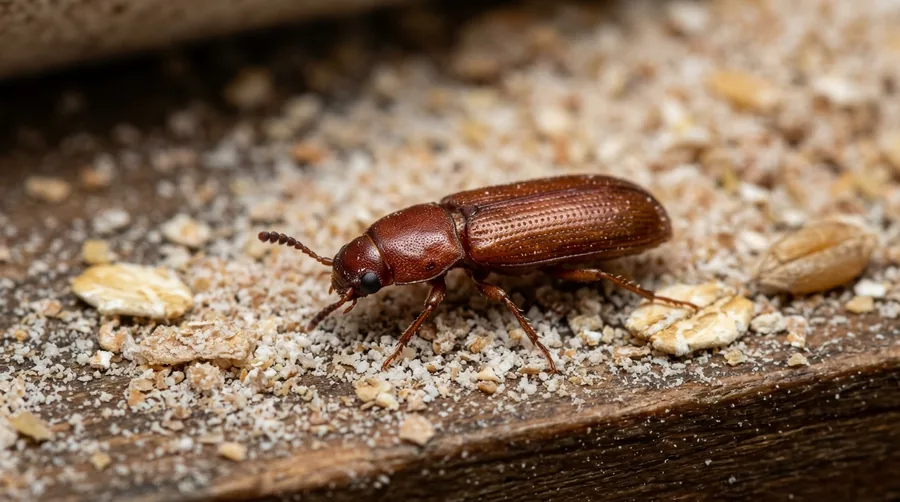
Small shiny reddish-brown confused flour beetle among grains of cereal
Recommended Products


What it does
The confused flour beetle behaves much like the red flour beetle, feeding on flour and milled grain that is already broken or processed rather than whole kernels. Large numbers give flour an unpleasant odor and can taint it. Unlike the red flour beetle it does not fly, so it spreads by crawling and through infested products.
Where it lives
It infests pantries, mills, groceries, and warehouses, living in flour, cereals, and milled grain and in spilled residue in cracks and corners. It tolerates cooler conditions better than the red flour beetle and is often the more common of the two in northern areas, but both occur across the US.
How it breeds
Females lay sticky eggs in flour and grain products, and the larvae feed within the food before pupating and emerging as adults. Warm conditions allow a generation in about a month, with overlapping generations building the population over time in a neglected food source.
What it eats
It feeds on milled and processed grain products, flour, cereal, and meal, and broken grain, plus dried goods such as beans, nuts, spices, and dry pet food; like its relative, it cannot attack sound whole kernels.
Identification
Adults are 3-4 mm, flattened, shiny reddish-brown, and nearly indistinguishable from the red flour beetle. The confused flour beetle's antennae enlarge gradually to a four-segmented club, and it cannot fly. Telling the two apart usually requires a hand lens to examine the antennae and the sides of the thorax.
Signs of an infestation
- Small reddish-brown beetles in or around flour and cereal
- Flour with an off odor or grayish tint from heavy infestation
- Beetles crawling, not flying, in pantry cabinets
- Insects sifted out when sieving stored grain products
Prevention tips
- Keep flour, cereal, and dried goods in airtight containers
- Rotate pantry stock and discard old or expired items
- Vacuum and clean spilled flour from cracks and corners
- Freeze or inspect newly purchased grain products before storing
Professional solutions
As with the red flour beetle, the fix is locating and discarding infested products, cleaning the cracks and corners where flour accumulates, and storing food in sealed containers. Freezing or heating suspect items kills hidden stages. For stubborn or commercial infestations where the source is hard to trace, a professional's inspection and monitoring can help.
Health & safety
Confused flour beetles do not bite, sting, or spread disease, so they pose no direct health threat. Their impact is contamination and spoilage of stored flour and grain products, which take on an off odor and should be discarded. Eating a few accidentally is not known to be harmful, though the food quality is lost.
Relevant Products


Frequently asked questions
Why is it called the confused flour beetle?
The name refers to how easily it is confused with the very similar red flour beetle, not to the insect's behavior. The two look almost identical; the confused flour beetle has antennae that widen gradually to a four-segmented club and cannot fly, while the red flour beetle has an abrupt club and can fly.
Are confused flour beetles harmful?
No. They do not bite, sting, or spread disease. The concern is that they contaminate and spoil stored flour, cereal, and grain, giving it an off odor. Infested food should be discarded, but accidentally eating a few beetles is not known to cause harm.
How do I prevent flour beetle infestations?
Store flour, cereal, and dried goods in airtight containers, rotate your stock, and promptly clean spilled flour from cabinet cracks and corners where beetles feed and breed. Inspecting or freezing newly purchased grain products before storing them helps stop an infestation before it starts.
Fact-checked by Morgan Vance, Editorial Director (editorial review, not a professional pest-control or medical sign-off). Last reviewed July 20, 2026. We correct anything a reader shows us is wrong — see our corrections policy.