
Nine-Banded Armadillo
Dasypus novemcinctus · also called armadillo, nine-banded armadillo, long-nosed armadillo
Quick answer
The nine-banded armadillo (Dasypus novemcinctus) is a cat-sized mammal covered in a bony, banded shell, with a long snout and strong digging claws. This nocturnal insect-eater roots up lawns, flower beds, and pastures searching for grubs and worms and digs burrows that undermine structures. It ranges across the southern US.
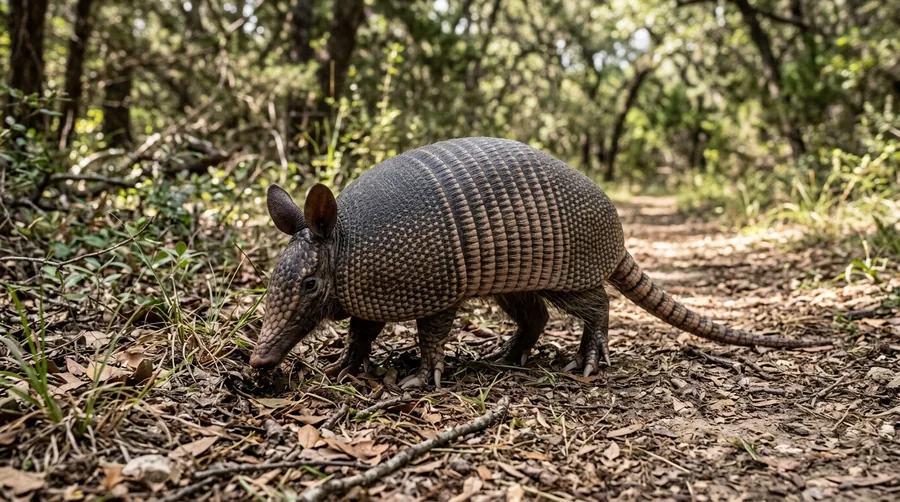
Armored nine-banded armadillo rooting in soil with its long snout in a southern lawn
Recommended Products



What it does
Armadillos are mostly nocturnal and nearly constantly digging, rooting through soil, mulch, and turf with their snout and claws in search of insects and grubs. This leaves lawns, gardens, and flower beds pocked with shallow cone-shaped holes and uprooted plants. They also excavate burrows that can undermine driveways, patios, and foundations.
Where it lives
Nine-banded armadillos live across the Southeast, Gulf states, and Texas and continue expanding northward. They prefer warm areas with loose, moist soil, favoring woods, brush, streamsides, pastures, and suburban yards, and dig multiple burrows within their range for shelter and raising young.
How it breeds
Armadillos breed in summer, and after delayed implantation the female produces a single litter, almost always four genetically identical young of the same sex, born the following spring. They reproduce slowly with just one litter a year, but each animal ranges widely and digs persistently.
What it eats
Armadillos are primarily insectivores. They eat beetles, grubs, ants, termites, worms, and other soil invertebrates, along with some small vertebrates, eggs, and fallen fruit, and their hunt for these underground foods drives nearly all of the lawn and garden damage.
Identification
Look for a distinctive gray-brown bony shell with about nine flexible bands across the midsection, a long tapering snout, large ears, and stout clawed feet. No other US mammal has this armored appearance, so identification is straightforward once one is seen.
Signs of an infestation
- Numerous shallow, cone-shaped holes in lawns and beds
- Uprooted plants, mulch, and disturbed flower beds
- Burrow openings 7-10 inches wide near cover or structures
- Rooted-up turf that lifts away from the soil
- An armored animal foraging after dark
Prevention tips
- Install fencing angled outward and buried at the base
- Treat lawns for grubs to reduce the food supply
- Remove brush piles, low cover, and debris
- Keep mulch beds tidy and reduce overwatering
- Fill inactive burrows and block gaps under structures
Professional solutions
Armadillos are hard to deter and dig persistently, so ongoing lawn destruction or burrows near a foundation often call for a wildlife professional. Pros rely mainly on humane trapping plus exclusion, since these animals ignore most repellents. Trapping and relocation are regulated by state wildlife law, and a licensed operator will follow local rules.
Health & safety
Armadillos rarely bite, but they are one of the few animals that naturally carry Mycobacterium leprae, the bacterium that causes leprosy (Hansen's disease). Transmission to people is uncommon and mostly linked to handling or eating armadillos in the southern US, so avoid direct contact, wear gloves during cleanup, and keep pets away. Overall risk is moderate, driven mainly by digging damage.
Relevant Products






Frequently asked questions
How do I stop armadillos from digging up my yard?
Because armadillos dig for grubs and insects, treating the lawn to reduce those foods, removing brush cover, and installing outward-angled buried fencing around key areas all help. They ignore most repellents, so persistent damage usually needs humane trapping, which is regulated by state wildlife law and often best handled by a pro.
Can you really get leprosy from an armadillo?
Nine-banded armadillos can carry the leprosy bacterium, and a small number of human cases in the southern US have been linked to handling or eating them. The overall risk is low, but it is real, so avoid touching live or dead armadillos and wear gloves during any cleanup near burrows.
Are armadillo burrows a threat to my house?
They can be. Armadillos dig several burrows within their range, and one dug beside a driveway, patio, deck, or foundation can undermine the soil and slab over time. Filling inactive burrows and blocking access under structures, along with fencing, helps protect your property.
Fact-checked by Morgan Vance, Editorial Director (editorial review, not a professional pest-control or medical sign-off). Last reviewed August 8, 2026. We correct anything a reader shows us is wrong — see our corrections policy.