
Meadow Vole
Microtus pennsylvanicus · also called meadow mouse, field mouse, vole
Quick answer
The meadow vole (Microtus pennsylvanicus) is a small, stout rodent with a blunt snout, tiny ears, and a short tail, often called a field mouse. It lives in grassy fields and yards, creating surface runways. Voles rarely enter homes but girdle trees and damage lawns, gardens, and plant roots.
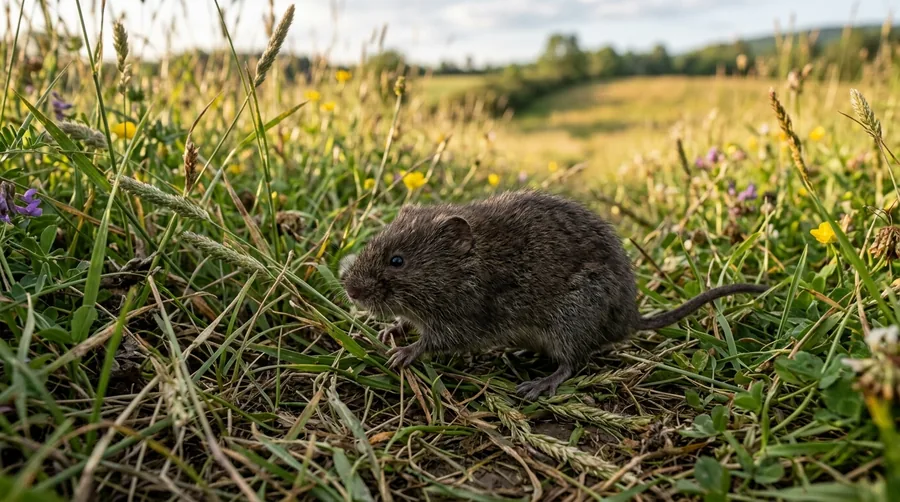
Stocky brown meadow vole with a blunt snout and short tail in grass
Recommended Products
See the full ranking →


What it does
Meadow voles are active day and night year-round, scurrying through a maze of surface runways they clip through grass. They rarely enter homes but are among the most prolific mammals, and their gnawing girdles young trees and shrubs and damages lawns, bulbs, and roots, especially under winter snow cover.
Where it lives
They live in grassy, weedy areas: meadows, fields, pastures, orchards, gardens, and unmowed yard edges across the northern and central US. They build shallow burrows and grass runways under vegetation and snow, and move into landscaped yards, tree rows, and gardens that border grassy cover.
How it breeds
Meadow voles are extraordinarily prolific, breeding through much of the year with a short three-week gestation and litters of about three to six young; a female can produce many litters annually. Populations cycle dramatically, sometimes irrupting to very high densities before crashing. Young mature in about a month.
What it eats
Voles are herbivores that eat grasses, sedges, seeds, roots, bulbs, and bark. In fall and winter they gnaw the bark of young trees and shrubs at the base, often under snow, girdling and sometimes killing them, and they damage garden bulbs, tubers, and root crops.
Identification
A meadow vole is a compact rodent about 3-1/2 to 5 inches in the body with a blunt, rounded snout, small eyes, short ears nearly hidden in fur, and a short tail, roughly the length of the hind foot. Its stocky build and short tail separate it from long-tailed mice.
Signs of an infestation
- Networks of surface runways clipped through grass
- Girdled, gnawed bark at the base of young trees and shrubs
- Golf-ball-sized burrow openings in lawns and gardens
- Damage to bulbs, roots, and low garden plants
- Runways and turf damage revealed after snow melts
Prevention tips
- Mow lawns and clear weeds and tall grass, especially near young trees
- Keep mulch pulled back a few inches from trunks and stems
- Protect young trees with hardware-cloth guards around the base
- Remove ground cover, brush, and debris that hide runways
- Maintain a vegetation-free zone around gardens and orchards
Professional solutions
Most vole problems are managed with habitat cleanup, tree guards, and mouse-style snap traps set in runways. For orchards, large gardens, or persistent outbreaks, a professional can advise on trapping and any EPA-registered baits used per label. Recurring landscape damage over several seasons is the usual reason to seek professional help.
Health & safety
Meadow voles pose little direct health risk to people; they seldom enter homes and are not major disease carriers, though like any wild rodent they can harbor parasites, so avoid handling them bare-handed. The real damage is to landscaping, lawns, gardens, and young trees, which they can harm significantly, especially in winter.
Relevant Products




Frequently asked questions
What is making winding trails in my lawn?
Meadow voles clip networks of surface runways through grass as they travel, and these winding, matted trails often appear in lawns and gardens, especially after snow melts. Small burrow openings along the runways are another clue that voles are present.
Do voles come into houses?
Rarely. Meadow voles live outdoors in grassy, weedy cover and seldom enter homes. Their impact is on the landscape, gnawing bark off young trees, damaging bulbs and roots, and creating lawn runways, rather than infesting living spaces like house mice do.
How do I protect young trees from voles?
Wrap the base of young trees and shrubs with hardware-cloth guards pushed slightly into the soil, keep mulch pulled back from the trunk, and mow or clear grass and weeds nearby. Removing the cover voles rely on is the most effective long-term protection.
Fact-checked by Morgan Vance, Editorial Director (editorial review, not a professional pest-control or medical sign-off). Last reviewed May 23, 2026. We correct anything a reader shows us is wrong — see our corrections policy.