
Eastern Mole
Scalopus aquaticus · also called common mole, garden mole, ground mole
Quick answer
The eastern mole (Scalopus aquaticus) is a small, burrowing insectivore, not a rodent, with velvety gray fur, huge paddle-like front feet, and tiny hidden eyes. It tunnels underground eating earthworms and grubs, raising ridges and volcano-shaped mounds. Moles damage lawns but do not eat plants or bite people.
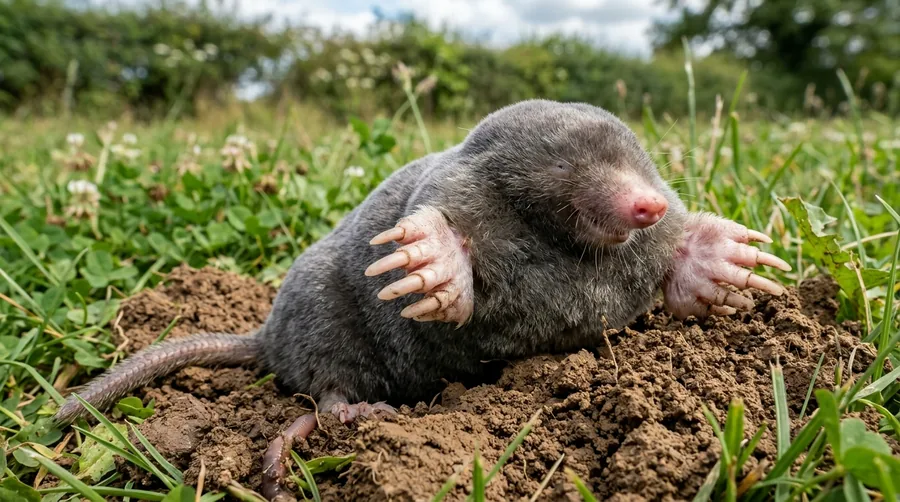
Gray eastern mole with large spade-like front feet and pointed snout on turned soil
Recommended Products



What it does
The eastern mole is a solitary, insect-eating burrower, not a rodent, that tunnels almost constantly in search of earthworms and grubs. Its shallow feeding tunnels raise the familiar ridges across lawns, while deeper runs and volcano-shaped mounds mark its permanent burrows. Moles rarely surface and do not eat plants, but their digging disrupts turf and roots.
Where it lives
Eastern moles live underground in lawns, gardens, fields, pastures, and woodland edges with moist, loose, well-drained soil across the eastern and central US. They dig two tunnel levels: shallow surface runs for feeding and deeper tunnels for nesting and travel. Rich, worm-filled soil in yards and parks is prime mole habitat.
How it breeds
Moles are largely solitary and breed once a year, mating in late winter or spring. After about a month, the female bears a single litter of roughly two to five young in an underground nest chamber. The young mature over the summer and disperse to establish their own burrow systems by fall.
What it eats
Eastern moles are insectivores that eat earthworms, white grubs, beetle larvae, and other soil invertebrates, consuming large amounts daily. They do not eat plant roots or bulbs; plant damage from mole tunnels is incidental, caused by soil heaving and disturbed roots rather than feeding, which is why grain baits fail.
Identification
The eastern mole is 4-1/2 to 6-1/2 inches long with velvety gray to brownish fur, a pointed, hairless snout, no visible eyes or external ears, and greatly enlarged, outward-facing front feet built for digging. Those broad, spade-like paws and hidden eyes clearly separate a mole from any rodent.
Signs of an infestation
- Raised surface ridges snaking across the lawn
- Round, volcano-shaped soil mounds with a central plug
- Spongy, loose turf that gives underfoot
- Disturbed or heaved plant roots and seedlings
- New ridges appearing after rain when soil is moist
Prevention tips
- Address white-grub problems that provide a food source
- Avoid overwatering, which drives worms and moles near the surface
- Use buried hardware-cloth barriers around key beds
- Roll or tamp surface ridges and monitor for renewed activity
- Keep expectations realistic, as healthy soil naturally attracts moles
Professional solutions
Because moles are insectivores, poison grain baits and repellents are largely ineffective, and trapping in active tunnels is the proven method. Moles can be tricky to trap and some states regulate methods, so a wildlife or pest professional is often the most reliable route, especially for persistent damage or large lawns. Confirm active runs before treating.
Health & safety
Eastern moles pose essentially no health risk to people or pets. They do not bite in normal circumstances, do not enter homes, and are not disease carriers of concern. The damage is cosmetic and structural to lawns and gardens, ridges, mounds, and heaved roots, rather than anything that threatens human health.
Relevant Products






Frequently asked questions
Are moles rodents?
No. Despite living underground like some rodents, moles are insectivores in a different group of mammals. They eat earthworms and grubs, not plants or seeds, which is why rodent grain baits do not work on them. Their spade-like front feet and hidden eyes set them apart.
Do moles eat my plants and bulbs?
Not directly. Eastern moles eat earthworms, grubs, and other soil insects, not roots or bulbs. Plant damage from moles is incidental, caused by tunneling that heaves soil and disturbs roots. Bulb and root damage is more often from voles or gophers using mole tunnels.
What is the best way to get rid of moles?
Trapping in active tunnels is the most effective method, since moles ignore grain baits and repellents give inconsistent results. Reducing grubs and avoiding overwatering can lower their food supply. Because trapping is tricky and sometimes regulated, many people hire a professional.
Fact-checked by Morgan Vance, Editorial Director (editorial review, not a professional pest-control or medical sign-off). Last reviewed July 4, 2026. We correct anything a reader shows us is wrong — see our corrections policy.