
Honey Bee
Apis mellifera · also called honey bees, honeybee, European honey bee
Quick answer
The honey bee (Apis mellifera) is a golden-brown, fuzzy pollinator that lives in large perennial colonies and is vital to agriculture. Honey bees sting only to defend the hive and die afterward. Because they are beneficial and often protected, swarms and colonies should be relocated by a beekeeper, not exterminated.
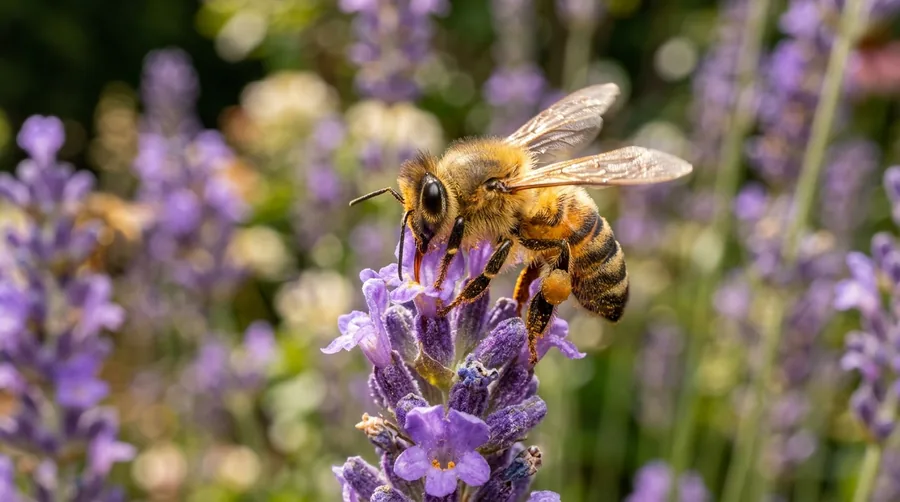
Golden-brown fuzzy honey bee with dark bands collecting pollen from a yellow flower
Recommended Products


What it does
Honey bees are highly social and generally gentle while foraging, focused on collecting nectar and pollen. They sting only to defend the hive, and because the stinger is barbed, a worker dies after stinging, so they do not sting casually. In spring, colonies reproduce by swarming, temporarily clustering on a branch while scouts seek a new home.
Where it lives
Managed colonies live in beekeepers' hives, while wild or feral colonies nest in cavities: hollow trees, wall voids, chimneys, attics, and utility boxes. A colony in a home is usually discovered by a steady stream of bees at a small exterior gap. Honey bees are found nationwide wherever flowers bloom.
How it breeds
A colony is a perennial superorganism with one queen, tens of thousands of workers, and seasonal males (drones). The queen lays eggs continuously in warm months; workers progress through in-hive and foraging roles. Colonies reproduce by swarming, in which the old queen leaves with part of the colony to establish a new nest elsewhere.
What it eats
Honey bees feed on nectar, which they convert to honey for energy storage, and pollen, their protein source. Foraging workers travel widely among flowers, making honey bees among the most important pollinators of crops and wild plants in the US.
Identification
Honey bees are about 1/2 inch, slender, golden-amber to brown with darker bands and a fuzzy thorax, smaller and less robust than bumblebees or carpenter bees. A large cluster of bees hanging on a branch is a swarm, and a constant flow of bees into a single wall or eave gap indicates an established colony inside.
Signs of an infestation
- A steady two-way stream of bees at a small gap in a wall or eave
- A hanging cluster (swarm) of bees on a branch or fence in spring
- Buzzing heard inside a wall, chimney, or ceiling
- Honey or wax staining bleeding through interior walls
- Many fuzzy amber bees foraging on nearby flowers
Prevention tips
- Seal potential cavity entrances like wall gaps, vents, and chimney openings
- Screen soffit, gable, and utility penetrations before swarm season
- Remove old honeycomb after any colony is professionally removed
- Report a spring swarm to a local beekeeper for free relocation
- Avoid sealing bees inside a wall, which traps honey and pests
Professional solutions
Honey bees should not be exterminated by DIY sprays. For a swarm, contact a local beekeeper, who will often relocate it for free. For an established colony inside a structure, a beekeeper or bee-removal specialist performs a live 'cut-out,' removing bees and comb and sealing the cavity. Killing bees in a wall leaves honeycomb that rots and attracts other pests.
Health & safety
Honey bees are not aggressive away from the hive and sting only defensively, losing their barbed stinger and dying afterward. A single sting is painful but harmless for most people. The real danger is to those allergic to bee venom, for whom a sting can be life-threatening. Anyone with breathing trouble, swelling, or dizziness after a sting needs emergency care.
Relevant Products




Frequently asked questions
Should I kill honey bees in my wall?
No. Honey bees are beneficial pollinators and should not be sprayed. Killing a colony in a wall leaves honeycomb behind that melts, rots, stains, and attracts other pests. Instead, call a beekeeper or bee-removal specialist to do a live removal (cut-out) and then seal the cavity properly.
What should I do about a honey bee swarm?
A swarm, a cluster of bees hanging on a branch or fence, is usually temporary and gentle while the bees look for a new home. Do not spray it. Contact a local beekeeper, who will often collect and relocate the swarm for free, frequently within a day or two.
Do honey bees die after stinging?
Worker honey bees have a barbed stinger that lodges in the skin, so they die after stinging a person. That is why they sting only to defend the hive and are calm while foraging. It also means a bee foraging on flowers in your yard has little reason to sting you.
Fact-checked by Morgan Vance, Editorial Director (editorial review, not a professional pest-control or medical sign-off). Last reviewed June 10, 2026. We correct anything a reader shows us is wrong — see our corrections policy.