
Bumblebee
Bombus spp. · also called bumblebees, bumble bee, humble bee
Quick answer
Bumblebees (Bombus species) are large, round, fuzzy black-and-yellow bees and important native pollinators. They nest in small colonies in ground cavities, old rodent burrows, or under sheds. Gentle by nature, they sting only when their nest is threatened, and because many species are declining, they are best left alone or relocated.
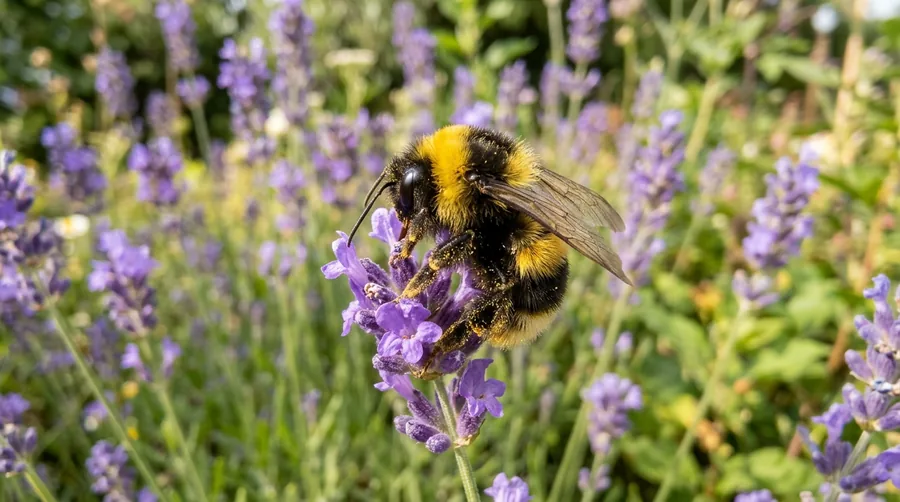
Large fuzzy black and yellow bumblebee gathering nectar from a purple flower
Recommended Products


What it does
Bumblebees are gentle, social pollinators that rarely sting unless their nest is directly threatened or they are handled. Unlike honey bees, they can sting more than once because their stinger is not barbed, but they seldom do. They are excellent pollinators, using 'buzz pollination' to shake pollen loose from flowers like tomatoes and blueberries.
Where it lives
They form small annual colonies, usually nesting at or below ground in abandoned rodent burrows, under sheds and decks, in compost piles, dense grass, or wall insulation. A colony is modest, often a few dozen to a few hundred bees. Bumblebees are found across the US, from gardens and meadows to mountains.
How it breeds
A single overwintered queen starts a nest in spring and rears the first workers. The colony grows through summer, then produces new queens and males in late summer. Only the newly mated queens survive winter, hibernating underground; the founding queen, workers, and males die at frost, and the nest is not reused.
What it eats
Bumblebees feed on nectar for energy and collect pollen to feed their larvae. Their long tongues and buzz-pollination let them pollinate many flowers other bees cannot, making them valuable to gardens and crops such as tomatoes, peppers, and berries.
Identification
Bumblebees are large, 3/4 to 1 inch, robust, and densely furry, with black and yellow (sometimes orange or white) bands over the whole body, including the abdomen. That all-over fuzziness separates them from the shiny-bellied carpenter bee. Their slow, bumbling flight and loud buzz are also distinctive.
Signs of an infestation
- Fuzzy black-and-yellow bees entering a hole in the ground or under a structure
- A low buzzing coming from beneath a shed, deck, or compost pile
- Bees visiting flowers with a slow, bumbling flight
- A small number of bees defending a hidden ground nest
- Bees active around insulation or a wall void gap
Prevention tips
- Seal gaps under sheds, decks, and into wall voids before spring
- Fill abandoned rodent burrows near high-traffic areas
- Keep compost piles and grass managed near patios and walkways
- Tolerate nests in out-of-the-way spots, since colonies die at frost
- Mark and route around a known ground nest rather than disturbing it
Professional solutions
Because bumblebees are beneficial and declining, the best approach is usually to leave a nest alone until it dies off naturally at frost. If a nest is in a high-traffic or hazardous spot, or someone in the home is allergic, a pest professional or a bee relocation service can move or treat it. Avoid DIY extermination of these valuable pollinators.
Health & safety
Bumblebees are gentle and sting only defensively, but because their stinger lacks a barb, a bumblebee can sting more than once if its nest is disturbed. For most people a sting is painful but not dangerous; for those allergic to bee venom it can be serious. Seek emergency care for breathing trouble, swelling, or dizziness after a sting.
Relevant Products




Frequently asked questions
Are bumblebees dangerous?
Bumblebees are among the gentlest stinging insects and rarely sting unless their nest is threatened or they are handled. Unlike honey bees they can sting more than once, but they seldom do. For most people they pose little danger, though those allergic to bee stings should still keep their distance from a nest.
Should I remove a bumblebee nest?
Usually it is best to leave it. Bumblebees are valuable, often declining pollinators, and their small annual colonies die off naturally at the first frost and never reuse the nest. Only consider removal or relocation if the nest is in a high-traffic area or someone nearby has a sting allergy.
How is a bumblebee different from a carpenter bee?
Bumblebees are fuzzy all over, including the abdomen, and nest in the ground or under structures. Carpenter bees have a shiny, hairless black abdomen and bore round holes into wood. If a large bee is drilling into your deck or fascia, it is a carpenter bee, not a bumblebee.
Fact-checked by Morgan Vance, Editorial Director (editorial review, not a professional pest-control or medical sign-off). Last reviewed July 31, 2026. We correct anything a reader shows us is wrong — see our corrections policy.