
Carpenter Bee
Xylocopa virginica · also called carpenter bees, wood bee, boring bee
Quick answer
Carpenter bees (Xylocopa species) are large, robust bees that look like bumblebees but have a shiny, hairless black abdomen. Females bore round, half-inch tunnels into wood eaves, decks, and railings to nest, causing cumulative damage. They are important pollinators, and males, though they hover aggressively, cannot sting.
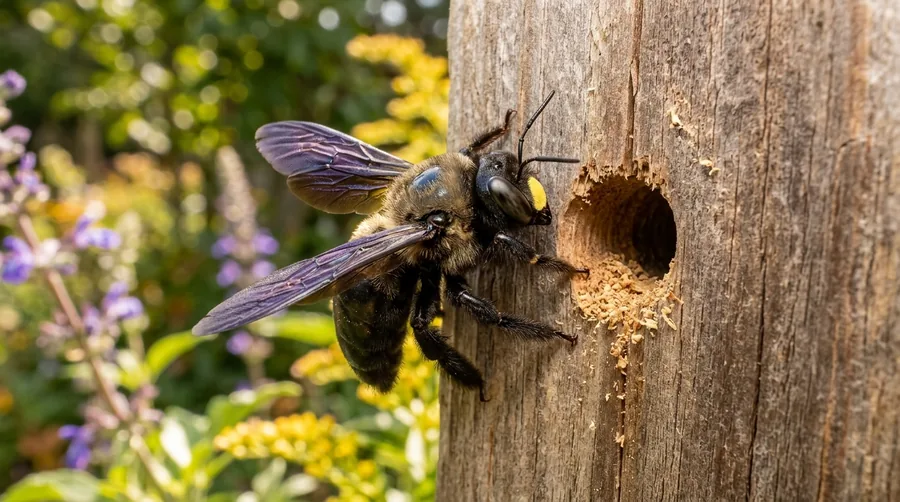
Large carpenter bee with a shiny black abdomen at a round hole bored into a wooden fascia board
Recommended Products


What it does
Carpenter bees are solitary nesters that bore into wood to raise young. Males hover near nest sites and dart at people and pets, which looks threatening, but males have no stinger and cannot harm you. Females can sting but are docile and rarely do. The bees are strong pollinators and are most conspicuous in spring.
Where it lives
They tunnel into bare, weathered, or unpainted softwoods: fascia boards, eaves, deck railings, fence posts, wooden siding, porch ceilings, and outdoor furniture. Females often reuse and extend old tunnels year after year. Carpenter bees occur across the US and are most active around wooden structures in spring.
How it breeds
A female bores a round entry hole, then tunnels along the grain, creating a series of cells she stocks with pollen and nectar and seals with one egg each. Larvae develop over summer and emerge as adults in late summer, overwintering in tunnels and mating the next spring. There is generally one generation a year.
What it eats
Adult carpenter bees feed on nectar and pollen and are valuable pollinators of many flowers and crops. They do not eat the wood they bore; they excavate it only to create nesting tunnels, pushing the sawdust-like frass out of the entry hole.
Identification
Carpenter bees are about an inch long and resemble bumblebees, but the key difference is the abdomen: carpenter bees have a shiny, black, hairless upper abdomen, while bumblebees are fuzzy all over. Males often have a pale spot on the face. Perfectly round, half-inch entry holes in wood are a telltale sign.
Signs of an infestation
- Round, clean half-inch holes bored into wood surfaces
- Coarse sawdust (frass) beneath entry holes
- Yellowish staining below holes from bee waste
- Large bees hovering and darting near eaves or railings
- Woodpecker damage widening existing bee tunnels
Prevention tips
- Paint or varnish exposed wood, which deters boring
- Fill and plug existing tunnels in fall after bees emerge
- Cover rough or weathered wood with hardware or trim
- Use hardwoods or non-wood materials for vulnerable trim
- Inspect eaves, railings, and fascia each spring for new holes
Professional solutions
For a few holes, homeowners can treat tunnels with an insecticidal dust in the opening, wait for the bees to move through it, then plug the holes and paint. Extensive galleries, damage over many years, or repeated woodpecker activity opening tunnels are worth a professional's evaluation to treat the bees and advise on wood repair and protection.
Health & safety
Carpenter bees are a low health risk. Males cannot sting despite their aggressive hovering, and females sting only if handled or provoked. The bigger concern is property: repeated tunneling weakens wood over years and attracts woodpeckers that enlarge the damage. Anyone allergic to bee stings should still avoid provoking the females.
Relevant Products




Frequently asked questions
How can I tell a carpenter bee from a bumblebee?
Look at the abdomen. A carpenter bee has a shiny, black, hairless upper abdomen, while a bumblebee is fuzzy all over, often with yellow hair on the abdomen. Carpenter bees are also the ones boring perfectly round holes in wood, which bumblebees never do.
Do carpenter bees sting?
Rarely. The males hover and dart aggressively near nests but have no stinger at all, so they cannot sting. Females can sting but are docile and do so only if handled or trapped. For most people carpenter bees are more of a property concern than a stinging threat.
How much damage do carpenter bees cause?
A single tunnel is minor, but females reuse and extend tunnels year after year, and repeated boring plus woodpeckers chasing the larvae can seriously weaken fascia, railings, and trim over time. Painting exposed wood and plugging old holes each fall is the best way to limit damage.
Fact-checked by Morgan Vance, Editorial Director (editorial review, not a professional pest-control or medical sign-off). Last reviewed May 30, 2026. We correct anything a reader shows us is wrong — see our corrections policy.