
Gulf Coast Tick
Amblyomma maculatum · also called gulf coast ticks, gotch ear tick
Quick answer
The Gulf Coast tick (Amblyomma maculatum) is a brown, silvery-marked tick of coastal prairies and the Southeast. Adults bite livestock, pets, and people, and can transmit Rickettsia parkeri, a milder spotted-fever illness that leaves a dark scab at the bite. Its range is steadily expanding northward beyond the Gulf.
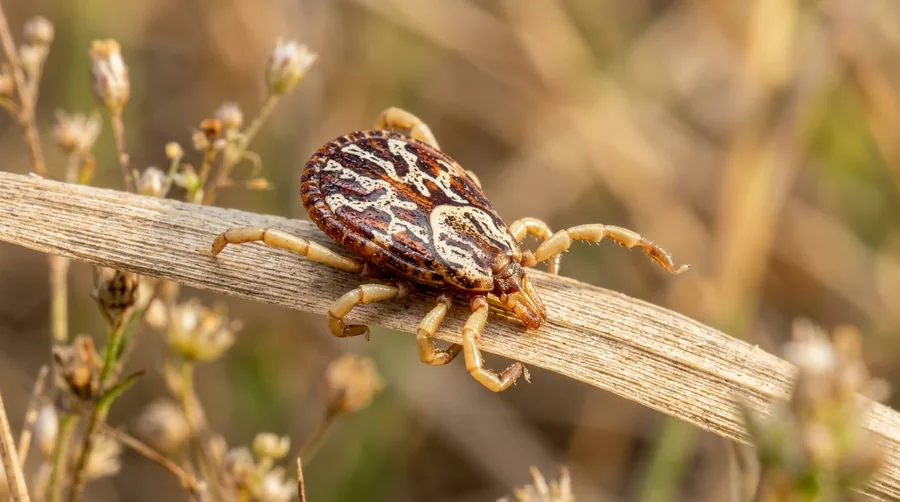
Brown Gulf Coast tick with silvery ornate markings on its shield resting on a blade of grass
Recommended Products
See the full ranking →

What it does
Gulf Coast ticks quest from the tips of tall grasses in open, sunny prairies and pastures, grabbing hosts that brush past. Adults favor large animals and often attach to the ears, where heavy feeding on cattle can cause wounds and deformity known as 'gotch ear.' They bite people readily when present.
Where it lives
They thrive in coastal uplands, prairies, grassy meadows, and pasture edges rather than deep forest, historically along the Gulf and Atlantic coasts. Their range has expanded well inland and northward in recent decades. Larvae and nymphs use small mammals and ground birds, while adults seek deer, livestock, dogs, and humans.
How it breeds
Like other hard ticks, the female feeds to full engorgement, drops off, lays a large single egg mass of several thousand eggs, and dies. The three-host cycle (larva, nymph, adult) generally spans about a year, with each stage requiring one blood meal and long periods of waiting between hosts.
What it eats
Gulf Coast ticks feed exclusively on blood. Immature stages take meals from birds and small mammals; adults feed on deer, cattle, horses, dogs, and people, anchoring with long mouthparts that make them harder to remove cleanly.
Identification
Adults are brown with striking silvery-white ornate markings across the scutum (shield), and have relatively long mouthparts. They resemble the American dog tick but the markings are more extensive and the mouthparts longer. Unfed adults are 4-6 mm; engorged females swell to well over a centimeter and turn grayish.
Signs of an infestation
- A tick attached in the hairline, ears, or skin folds after time outdoors
- Ticks found on the ears of cattle, horses, or dogs
- A dark scab (eschar) forming at a bite site
- Fever, headache, or rash days after a known bite
- Ticks questing on grass tips in open pasture or coastal fields
Prevention tips
- Use EPA-registered repellent and wear long pants tucked into socks in tall grass
- Treat clothing with permethrin before working in pastures or coastal fields
- Check yourself, children, and pets for ticks after being outdoors
- Mow tall grass and clear brushy field edges near the home
- Keep livestock and pets on veterinarian-approved tick control
Professional solutions
For homes and farms bordering grassland, professionals reduce tick pressure with acaricide treatment of transitional zones and vegetation management, plus livestock treatment programs. Because adults favor open grassy habitat, controlling the pasture-lawn edge matters most. Remove any attached tick promptly with fine tweezers rather than waiting.
Health & safety
The Gulf Coast tick transmits Rickettsia parkeri, a spotted-fever rickettsiosis that is generally milder than Rocky Mountain spotted fever and often produces a dark scab (eschar) at the bite along with fever and rash. Remove attached ticks quickly and contact a doctor, or Poison Control at 1-800-222-1222, if symptoms develop.
Relevant Products



Frequently asked questions
Is the Gulf Coast tick dangerous to people?
It can transmit Rickettsia parkeri, a spotted-fever illness that is usually milder than Rocky Mountain spotted fever but still causes fever, rash, and a dark scab at the bite. The illness is treatable, so remove attached ticks promptly and see a doctor if you develop symptoms after a bite.
Where are Gulf Coast ticks found?
They favor open, grassy habitats like coastal prairies, meadows, and pasture edges, historically along the Gulf and southeastern Atlantic coasts. Their range has expanded well inland and northward, so they now turn up in areas where they were once uncommon.
What is 'gotch ear' in cattle?
Gotch ear is a wound and deformity of the ear caused by heavy Gulf Coast tick feeding, since adults often attach in large numbers inside the ears of cattle and horses. It is a livestock concern, which is why pasture tick control matters on farms.
Fact-checked by Morgan Vance, Editorial Director (editorial review, not a professional pest-control or medical sign-off). Last reviewed May 10, 2026. We correct anything a reader shows us is wrong — see our corrections policy.