
Feral Pigeon
Columba livia · also called rock pigeon, rock dove, city pigeon
Quick answer
The feral pigeon (Columba livia) is the common gray city pigeon, with an iridescent green-purple neck and two dark wing bars. Nesting on ledges, signs, and rooftops, it fouls buildings with acidic droppings that corrode surfaces and clog gutters. Its droppings and nests can carry disease and attract other pests.
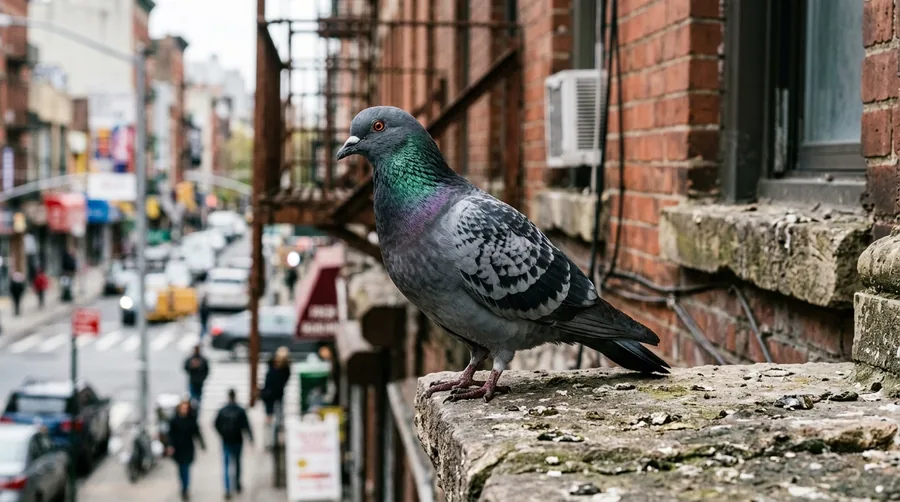
Gray feral pigeon with an iridescent neck perched on a building ledge streaked with droppings
Recommended Products



What it does
Feral pigeons are social birds that gather in flocks on ledges, rooftops, signs, bridges, and building faces. They roost and nest on the same sites repeatedly, building up thick layers of droppings and nesting debris. The acidic droppings deface and corrode masonry, metal, and paint, and nests clog gutters, drains, and rooftop equipment.
Where it lives
Descended from wild rock doves that nested on cliffs, feral pigeons now thrive in cities, suburbs, farms, and industrial sites nationwide. They favor building ledges, window sills, rafters, signs, bridge girders, and warehouse beams, which mimic their natural cliff ledges, especially near a reliable food source.
How it breeds
Pigeons breed year-round where food and shelter allow, laying one or two eggs per clutch and raising several broods a year. Both parents feed the young 'crop milk,' and chicks fledge in about a month. This rapid, repeated breeding lets a small group grow into a large colony quickly.
What it eats
Pigeons are ground-feeding seed and grain eaters that also scavenge human food scraps, spilled birdseed, and garbage. In urban areas, intentional feeding and dropped food are what sustain large flocks near buildings.
Identification
Look for a plump, 12-14 inch blue-gray bird with an iridescent green-and-purple neck sheen, red feet, an orange eye, and two dark bars across each wing. Plumage varies from typical gray to white, brown, or mottled birds within the same flock.
Signs of an infestation
- Heavy droppings streaking ledges, walls, and sidewalks
- Flocks roosting on ledges, signs, or rooftops
- Nests and debris in gutters, vents, and rooftop equipment
- Feathers and matted nesting material on ledges
- Cooing and constant flapping around a building face
Prevention tips
- Install anti-roosting spikes, wire, or sloped ledge covers
- Screen or net off rafters, vents, and openings
- Stop all intentional feeding and clean up spilled seed
- Secure trash and remove accessible food sources
- Clear existing nests and droppings, then block the site
Professional solutions
Large or persistent pigeon colonies on commercial or multi-story buildings usually need a bird-control professional. Pros install exclusion such as netting, spikes, and electrified track, and safely clean and decontaminate droppings, which is a health hazard in bulk. As a non-native species, feral pigeons are not federally protected, but methods still follow local ordinances.
Health & safety
Pigeon droppings can carry fungi and bacteria that cause histoplasmosis, cryptococcosis, and psittacosis, with the main risk coming from inhaling dust while cleaning large accumulations. Their nests also harbor mites, ticks, and beetles that can enter buildings. Pigeons rarely contact people directly. Wear protection during cleanup or hire a pro. Overall risk is moderate.
Relevant Products





Frequently asked questions
How do I keep pigeons off my building or balcony?
Physical exclusion works best: anti-roosting spikes, tensioned wire, sloped ledge covers, and netting over rafters and openings. Remove existing nests and droppings first, then block the site. Cutting off food, no intentional feeding, secured trash, and cleaned-up seed, is essential, since food is what holds a flock in place.
Are pigeon droppings dangerous?
In large accumulations they can be. Dried droppings can carry fungi and bacteria linked to histoplasmosis, cryptococcosis, and psittacosis, mainly a risk from inhaling dust during cleanup. Nests also harbor mites and other pests. Wear a respirator and gloves for small cleanups, and hire a professional for heavy soiling.
Why do pigeons keep coming back to the same spot?
Pigeons are strongly loyal to established roosting and nesting sites and return year after year, especially where food is nearby. Simply chasing them off or removing nests is temporary; lasting control requires physical exclusion of the ledge or opening plus eliminating the food source that draws them.
Fact-checked by Morgan Vance, Editorial Director (editorial review, not a professional pest-control or medical sign-off). Last reviewed May 28, 2026. We correct anything a reader shows us is wrong — see our corrections policy.