
Elm Leaf Beetle
Xanthogaleruca luteola · also called elm beetle, elm leaf beetles
Quick answer
The elm leaf beetle (Xanthogaleruca luteola) is a small yellow-green beetle with a black stripe along each wing cover. Adults and larvae skeletonize elm leaves, stressing and defoliating trees. In fall the adults gather on and enter homes to overwinter, a harmless nuisance. It does not bite people or spread disease.
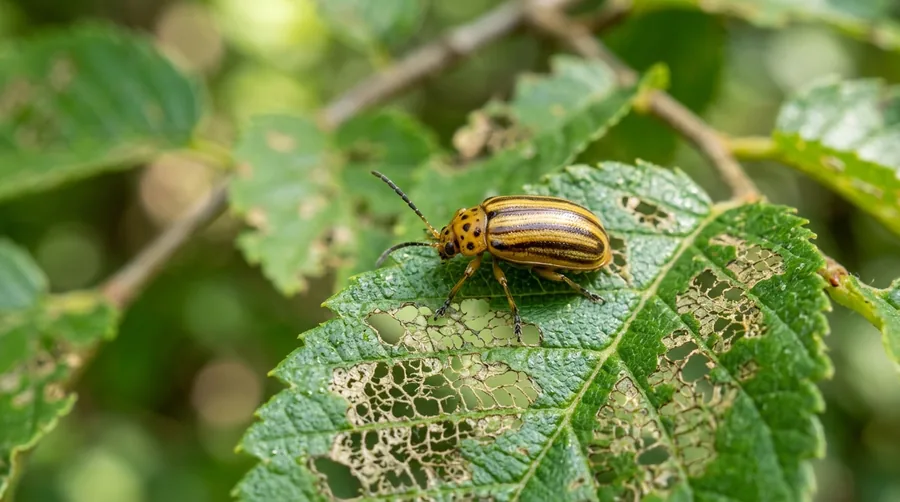
Yellow-green elm leaf beetle with black side stripes on a skeletonized elm leaf
Recommended Products
See the full ranking →


What it does
Both the adults and larvae feed on elm leaves: larvae skeletonize the undersides, leaving a lacy network of veins, while adults chew small holes through the leaf. Heavy feeding browns and thins the canopy and stresses trees. In fall, adults leave the trees and gather on and inside buildings to overwinter, becoming a household nuisance.
Where it lives
They live on elm trees throughout the season, feeding and breeding on the foliage. As cold weather nears, adults migrate to sheltered sites, entering homes through gaps around windows, doors, and the roofline and clustering in wall voids and attics. They occur wherever elms are grown across much of the US.
How it breeds
Overwintered adults emerge in spring to feed and lay clusters of yellow eggs on the undersides of elm leaves. The larvae feed and skeletonize leaves, then pupate at the base of the tree, and new adults emerge. There are often two to three generations per year, building numbers by late summer.
What it eats
Adults and larvae feed exclusively on the leaves of elm trees, with larvae skeletonizing the leaf underside and adults chewing shot-holes through the foliage.
Identification
Adults are about 6 mm, yellowish to olive-green, with a black stripe running along the outer edge of each wing cover and dark marks behind the head. The larvae are yellowish with rows of dark spots or stripes and are found on elm leaves. Fall home invaders are the adults.
Signs of an infestation
- Elm leaves that are skeletonized, lacy, or browning by late summer
- Small yellow-green beetles clustering on walls in fall
- Beetles indoors at windows and in attics over winter
- Yellow egg clusters and spotted larvae on elm leaf undersides
Prevention tips
- Seal cracks and gaps around windows, doors, and the roofline before fall
- Repair screens and add door sweeps and weatherstripping
- Vacuum up indoor beetles rather than crushing them
- Keep elm trees healthy and consider resistant species when planting
Professional solutions
Indoors, the beetles are a harmless nuisance best handled by exclusion and vacuuming. For valued elm trees suffering heavy defoliation, an arborist or pest professional can time treatments to the larval stage to protect the canopy, and can apply an exterior perimeter treatment to reduce the fall invasion of adults into the home.
Health & safety
Elm leaf beetles do not bite, sting, or spread disease, and they do not damage the structure or contents of a home, so the health risk is none. They are a nuisance when they overwinter indoors in numbers. Their actual damage is to elm trees, where repeated heavy defoliation can weaken the tree.
Relevant Products




Frequently asked questions
Why are elm leaf beetles in my house?
In fall, adult elm leaf beetles leave the trees to find sheltered places to overwinter and slip into homes through gaps around windows, doors, and the roofline, much like Asian lady beetles. They do not breed or feed indoors and are simply looking for a place to wait out winter.
Are elm leaf beetles harmful?
Not to people or homes. They do not bite, sting, spread disease, or damage the house or its contents; indoors they are just a nuisance. Their damage is to elm trees, where larvae skeletonize leaves and adults chew holes, thinning and browning the canopy.
How do I keep elm leaf beetles out?
Seal cracks and gaps around windows, doors, and the roofline, repair screens, and add door sweeps before fall. Vacuum up any that get inside. If a nearby elm produces overwhelming numbers, a professional can treat the tree's larvae and apply an exterior perimeter barrier.
Fact-checked by Morgan Vance, Editorial Director (editorial review, not a professional pest-control or medical sign-off). Last reviewed June 3, 2026. We correct anything a reader shows us is wrong — see our corrections policy.