
European Earwig
Forficula auricularia · also called earwig, earwigs, pincher bug
Quick answer
The European earwig (Forficula auricularia) is a slender, reddish-brown insect easily recognized by the pincer-like forceps at its rear. Nocturnal and moisture-loving, it hides in damp cracks by day and feeds on plants and small insects. Despite the old myth, it does not crawl into ears, and its pinch is harmless.
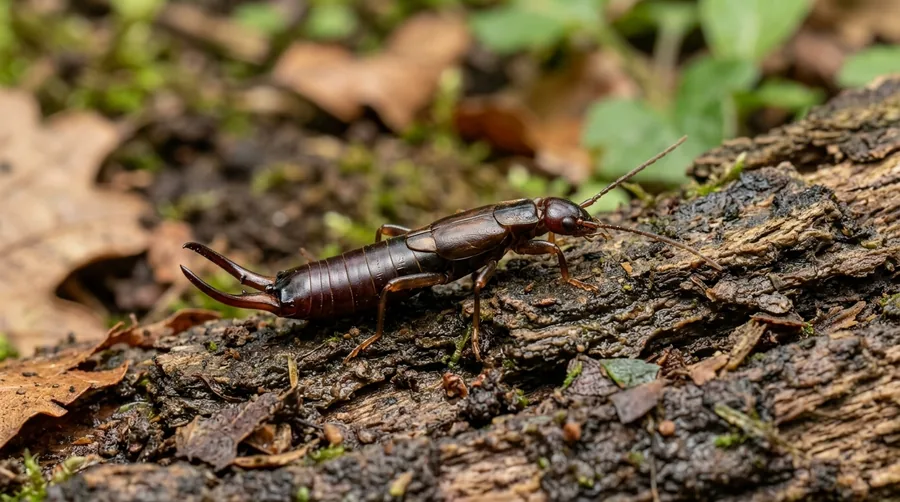
Reddish-brown European earwig with prominent rear pincers on a damp garden leaf
Recommended Products
See the full ranking →


What it does
Earwigs are nocturnal and hide by day in dark, damp, tight spaces, emerging at night to feed. When disturbed they may raise their rear pincers defensively; the pinch is harmless and rarely breaks skin. They are strong runners, are drawn to lights, and often wander indoors accidentally rather than establishing lasting indoor populations.
Where it lives
Outdoors they shelter under mulch, leaf litter, stones, flowerpots, boards, and in garden debris where it is moist. Indoors they turn up in damp bathrooms, basements, and around door and window thresholds, usually after wandering in from outside. They are established across the US and are especially common in cool, damp regions.
How it breeds
Earwigs are unusual insects in that the female shows maternal care, guarding her eggs and newly hatched young in an underground nest. She lays a batch of a few dozen eggs, often overwintering, and there are typically one to two generations a year. The nymphs resemble small adults and molt several times before maturing.
What it eats
Earwigs are omnivorous, feeding on decaying plant matter, algae, and other small insects, but also chewing living plants. In gardens they can damage seedlings, soft fruit, and the leaves and petals of flowers, giving them a mixed reputation as both a minor garden pest and a predator of aphids and other insects.
Identification
Earwigs are 1/2 to nearly 3/4 inch, elongated, flattened, and reddish-brown to dark brown, with a pair of prominent pincer-like forceps (cerci) at the rear, curved in males and straighter in females. Short wing covers may be visible. The rear pincers are the unmistakable identifying feature.
Signs of an infestation
- Brown insects with rear pincers found in damp indoor corners
- Earwigs under flowerpots, mulch, boards, or door mats
- Ragged holes chewed in seedlings, flowers, or soft fruit
- Insects gathering around exterior lights at night
- Clusters hiding in moist cracks near thresholds after rain
Prevention tips
- Reduce moisture and remove mulch, leaves, and debris near the foundation
- Fix leaks and improve drainage and ventilation in damp rooms
- Seal gaps around doors, windows, and the foundation
- Move firewood, boards, and flowerpots away from the house
- Reduce or redirect outdoor lighting that attracts them at night
Professional solutions
Earwigs rarely need professional treatment, since indoor sightings are usually strays and control centers on moisture and exclusion. For repeated invasions, a perimeter treatment around the foundation and reducing outdoor harborage usually solves it. A pest professional can apply a targeted barrier treatment if large numbers keep entering despite these steps.
Health & safety
Earwigs are essentially harmless to people. They do not sting, do not spread disease, and the rear pincers, though they look menacing, can at most deliver a weak pinch that rarely breaks skin and carries no venom. The centuries-old belief that they crawl into people's ears to burrow into the brain is a myth.
Relevant Products




Frequently asked questions
Do earwigs really crawl into your ears?
No. This is a persistent myth with no basis in fact. Earwigs do not seek out or burrow into human ears, and they certainly do not lay eggs in the brain. Like many insects they might occasionally wander into a warm crevice, but they have no special attraction to ears.
Do earwig pincers hurt?
Not much. An earwig can use its rear pincers to deliver a light pinch if handled, but it rarely breaks the skin and carries no venom or sting. They are essentially harmless, and the pincers are used mainly for defense and to grasp prey and mates, not to attack people.
Why do I keep finding earwigs in my house?
Earwigs love moisture, so they wander indoors from damp mulch, leaf litter, and debris near the foundation, especially after rain or in dry spells. Reducing moisture, clearing debris and mulch away from the walls, sealing gaps, and dimming outdoor lights usually cuts down indoor sightings quickly.
Fact-checked by Morgan Vance, Editorial Director (editorial review, not a professional pest-control or medical sign-off). Last reviewed May 8, 2026. We correct anything a reader shows us is wrong — see our corrections policy.