
Codling Moth
Cydia pomonella · also called codling moths, apple worm, the worm in the apple
Quick answer
The codling moth (Cydia pomonella) is a small gray moth with a coppery patch at each wingtip and the classic 'worm in the apple.' Its pinkish larvae tunnel into apples and pears to the core, ruining the fruit. It is the most serious pest of pome fruit in North America and is managed mainly in orchards and home fruit trees.
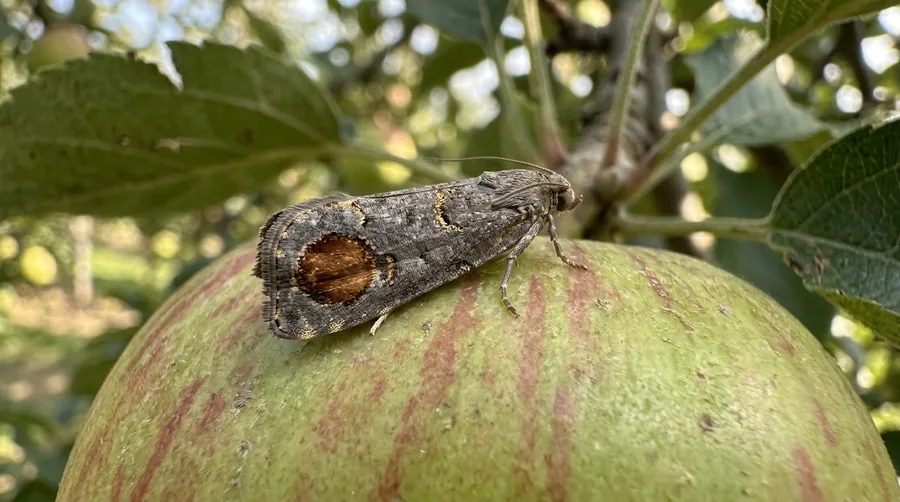
Gray codling moth with coppery wingtip patches beside an apple with a larval tunnel
Recommended Products


What it does
Adults are active at dusk in warm spring and summer evenings, when females lay eggs on or near developing fruit and leaves. Newly hatched larvae bore into the fruit, tunnel to the core to feed on the seeds, then exit to pupate. This tunneling, plus the entry hole packed with brown frass, is what ruins the fruit.
Where it lives
The codling moth lives wherever apples and pears grow, in commercial orchards, backyard fruit trees, and abandoned trees, across the US and especially the major apple regions of the West and Pacific Northwest. Larvae overwinter in cocoons under loose bark or in ground debris and litter near host trees.
How it breeds
Overwintered larvae pupate in spring, and adults emerge to lay eggs as fruit develops. Larvae feed inside fruit for several weeks, then leave to pupate, producing two to three generations a year depending on climate. The final generation overwinters as mature larvae, restarting the cycle the following spring.
What it eats
Larvae feed inside the fruit of apple, pear, and related pome fruits, and sometimes walnuts and quince, tunneling to consume the core and seeds. Adults do not damage fruit. The larval feeding is entirely inside the fruit, which is why infested fruit often looks fine outside until cut open.
Identification
Adults are about 3/4-inch wingspan, mottled gray, with a distinctive coppery-bronze patch bordered by darker lines at each wingtip. Larvae are pinkish-white caterpillars with a dark head, up to about 1/2 inch. A frass-packed entry hole and a tunnel to the core are the clearest signs in fruit.
Signs of an infestation
- Apples or pears with a frass-filled entry hole
- Brown tunnels leading to the fruit core
- Pinkish caterpillars inside cut fruit
- Premature fruit drop from infested trees
- Gray, copper-tipped moths near fruit trees at dusk
Prevention tips
- Remove and destroy dropped and infested fruit promptly
- Scrape loose bark and remove debris where larvae overwinter
- Use pheromone traps to monitor moth flights and timing
- Apply fruit bags or protective barriers on backyard trees
- Follow research-based orchard spray timing where used
Professional solutions
Codling moth control is notoriously demanding and timing-dependent. Commercial orchards rely on integrated programs of pheromone monitoring, mating disruption, and precisely timed treatments guided by extension services and agricultural advisors. Home growers often work with local cooperative extension for research-based, region-specific guidance.
Health & safety
Codling moths do not bite, sting, or transmit disease to people, so there is no direct health risk. The damage is economic and agricultural: larvae render apples and pears wormy and unsalable. Any pesticide use in orchards or home gardens must follow the product label and local guidance.
Relevant Products


Frequently asked questions
What causes the worm inside my apples?
The classic 'worm in the apple' is the larva of the codling moth. After hatching from eggs laid near developing fruit, the caterpillar bores in and tunnels to the core, leaving a frass-packed entry hole. It is the most common cause of wormy apples and pears in North America.
How can I reduce codling moths on my backyard fruit tree?
Promptly remove dropped and infested fruit, scrape loose bark and clear debris where larvae overwinter, and use pheromone traps to time any treatments. Bagging individual fruit can protect a small tree. Local cooperative extension offices provide research-based, region-specific control guidance.
Are codling moth larvae harmful to eat?
Codling moths do not carry disease, so accidentally eating part of an infested apple is not considered dangerous, though understandably unpleasant. The real impact is agricultural: the larvae tunnel through and spoil the fruit, making infested apples and pears unmarketable.
Fact-checked by Morgan Vance, Editorial Director (editorial review, not a professional pest-control or medical sign-off). Last reviewed August 4, 2026. We correct anything a reader shows us is wrong — see our corrections policy.