
Spongy Moth
Lymantria dispar · also called spongy moths, gypsy moth, LDD moth
Quick answer
The spongy moth (Lymantria dispar), formerly called the gypsy moth, is an invasive tree pest of the eastern United States. Its hairy caterpillars defoliate oaks and other hardwoods during outbreaks, and the fuzzy tan egg masses spread on outdoor items. The caterpillars, not the moths, cause the damage and can irritate skin.
Hairy spongy moth caterpillar with blue and red spots on an oak leaf beside a tan egg mass
Recommended Products


What it does
The damaging stage is the caterpillar, which feeds heavily on tree leaves in late spring and early summer. During outbreaks, huge numbers can defoliate whole stands of oaks and other hardwoods, stressing and sometimes killing trees. Young caterpillars can balloon on silk threads in the wind, spreading to new trees over short distances.
Where it lives
It is established in the northeastern US and parts of the Midwest and Southeast, in forests, woodlots, parks, and yards with oaks and other hardwoods. Egg masses are laid on tree bark and any sheltered outdoor surface, including firewood, vehicles, and outdoor gear, which is how the pest spreads to new areas.
How it breeds
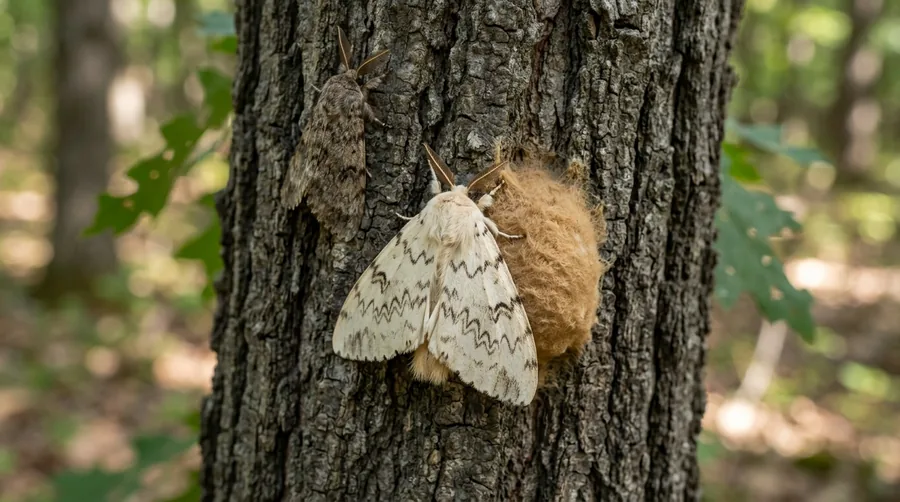
There is one generation a year. Fuzzy tan egg masses laid in summer overwinter and hatch the next spring into caterpillars that feed and grow, then pupate. Adults emerge in mid to late summer to mate and lay eggs; in the established European lineage the females do not fly, so egg masses on moved items drive spread.
What it eats
Caterpillars feed on the leaves of many trees, strongly preferring oaks but also eating aspen, birch, willow, apple, and hundreds of other hardwoods and some conifers. This broad appetite is what makes outbreaks so destructive to forests and landscape trees.
Identification
Mature caterpillars are dark and hairy, up to about 2.5 inches, with a distinctive row of five pairs of blue spots followed by six pairs of red spots along the back. Adult females are near-white and heavy-bodied; males are brown and fly. Egg masses are buff, felt-like, and spongy, the source of the current name.
Signs of an infestation
- Trees stripped of leaves in late spring or early summer
- Large hairy caterpillars with blue and red spots
- Fuzzy tan, spongy egg masses on bark and surfaces
- Frass (droppings) raining down beneath infested trees
- Clusters of caterpillars on trunks and outdoor structures
Prevention tips
- Inspect and scrape egg masses from bark and surfaces in winter
- Check vehicles, firewood, and outdoor gear before moving them
- Do not transport firewood long distances
- Follow local quarantine rules for moving outdoor items
- Report suspected new infestations to state agriculture officials
Professional solutions
Managing spongy moth on landscape trees, or during regional outbreaks, often involves professionals and government programs using pheromone monitoring, targeted biological or growth-regulator treatments, and area-wide suppression. Arborists can help protect high-value yard trees, and state agencies coordinate broader control and quarantine efforts.
Health & safety
Spongy moths do not bite or sting, but the caterpillars' hairs can cause an itchy skin rash in some people who handle them or brush against them. The larger concern is ecological and property-related: repeated defoliation stresses and can kill valuable trees, and the pest is regulated to limit its spread.
Relevant Products


Frequently asked questions
Why is the gypsy moth now called the spongy moth?
The insect Lymantria dispar was renamed 'spongy moth' as its accepted common name, referring to its fuzzy, spongy egg masses. The species and its behavior are unchanged; only the common name was updated, so older sources calling it the gypsy moth refer to the same pest.
Can spongy moth caterpillars hurt you?
They do not bite or sting, but their hairs can cause an itchy skin rash in some people who touch them or brush against infested surfaces. Wearing gloves and long sleeves when removing caterpillars or egg masses helps avoid irritation.
How does the spongy moth spread to new areas?
Because females of the established lineage do not fly, the pest spreads mainly when egg masses are carried on moved items, such as firewood, vehicles, and outdoor gear. Inspecting and removing egg masses and not moving firewood long distances are key to slowing its spread.
Fact-checked by Morgan Vance, Editorial Director (editorial review, not a professional pest-control or medical sign-off). Last reviewed June 23, 2026. We correct anything a reader shows us is wrong — see our corrections policy.