
Carrot Rust Fly
Chamaepsila rosae · also called carrot fly, carrot root fly, carrot rust fly
Quick answer
The carrot rust fly (Chamaepsila rosae) is a small, shiny black fly whose creamy maggots tunnel into carrots and related roots. The rust-colored tunnels and rot make crops unusable, often discovered only at harvest. Adults are weak, low-flying insects. It is harmless to people but a major pest of carrots, parsnips, celery, and parsley.
Carrot cut open to show rusty-brown tunnels left by carrot rust fly maggots
Recommended Products


What it does
The damage comes from the larvae, not the adult. The small black fly stays low, flying near the soil, and lays eggs at the base of carrots and related plants. The maggots burrow into the roots and mine rust-colored tunnels just under the skin, which promote rot. Infested carrots may show reddish leaf tips, stunting, and forked or scarred roots.
Where it lives
This pest attacks members of the carrot family: carrots, parsnips, celery, celeriac, parsley, and fennel, in home gardens and commercial fields. Introduced from Europe, it is most troublesome in cool, moist regions, including the Pacific Northwest, the Northeast, and northern states. Adults rest in shady, sheltered vegetation near host crops.
How it breeds
There are usually two to three generations a year. Adults emerge in spring and lay eggs in the soil beside host plants. Maggots hatch, tunnel into the roots, and feed for several weeks before pupating in the soil. Later generations attack maturing roots through summer and fall, and the pest overwinters as pupae or larvae in the soil or in roots left in the ground.
What it eats
The larvae feed inside the roots of carrot-family plants, mining tunnels through carrots, parsnips, celery root, and parsley roots. Adult flies feed on nectar and other fluids and do no root damage. It is the tunneling larvae that ruin the crop.
Identification
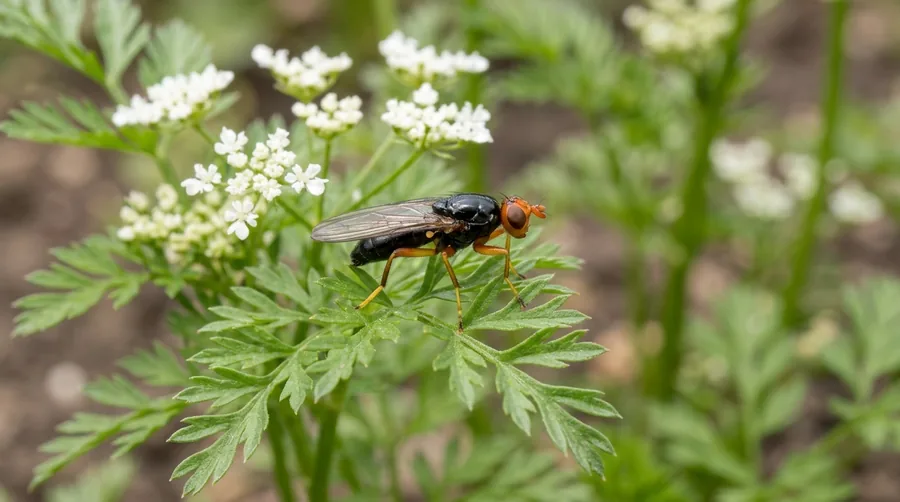
The adult is a small, slender, shiny black fly about a quarter inch with a reddish-brown head and yellowish legs, easy to overlook. The real evidence is in the roots: creamy-yellow maggots up to a third of an inch and rust-colored tunnels and scarring just beneath the skin, often with secondary rot.
Signs of an infestation
- Rust-colored tunnels and scarring just under the carrot skin
- Creamy maggots inside carrots, parsnips, or celery roots
- Reddish or bronze tint to the carrot-top foliage
- Stunted, forked, or rotting roots at harvest
- Small shiny black flies low over the carrot bed
Prevention tips
- Cover the crop with floating row covers or fine insect netting from sowing
- Delay sowing past the first spring generation where advised
- Rotate carrot-family crops to a distant bed each year
- Harvest promptly and avoid leaving roots in the ground over winter
- Thin carrots in the evening and firm the soil to reduce the scent that attracts flies
Professional solutions
In gardens, exclusion with row covers or fine netting is the most reliable control, since the adult flies are weak and low-flying. Crop rotation and timing help further. For commercial carrot production, an advisor or licensed applicator can recommend labeled soil or foliar insecticides and monitoring to time treatments against the egg-laying flies.
Health & safety
The carrot rust fly poses no health risk to people or pets; it does not bite, sting, or spread human disease. The harm is entirely to the crop: tunneled, rusty, rot-prone roots that are unmarketable and unpleasant to eat. Lightly damaged carrots can often be salvaged by cutting away the affected tunnels.
Relevant Products


Frequently asked questions
What causes rusty tunnels in my carrots?
Those tunnels are the work of carrot rust fly maggots, which burrow just under the skin and leave rust-colored trails that often rot. You may not see the small black adult flies, but the root damage and a bronze tint to the foliage are the giveaways at or before harvest.
How do I prevent carrot rust fly?
The most reliable method is covering the bed with floating row cover or fine insect netting from sowing, since the low-flying adults cannot reach the plants to lay eggs. Rotating crops, harvesting promptly, and not leaving roots in the ground over winter all reduce the problem.
Can I still eat carrots damaged by carrot rust fly?
Lightly affected carrots are usually fine once you cut away the rusty tunnels and any rotten parts. Heavily tunneled or rotting roots are best discarded. The maggots themselves are not a health hazard, but the secondary rot they cause makes badly infested carrots unpalatable.
Fact-checked by Morgan Vance, Editorial Director (editorial review, not a professional pest-control or medical sign-off). Last reviewed July 18, 2026. We correct anything a reader shows us is wrong — see our corrections policy.