Brown Garden Snail
Cornu aspersum · also called garden snail, common garden snail, European brown snail
Quick answer
The brown garden snail (Cornu aspersum) is a round-shelled land snail that feeds at night on leaves, seedlings, and fruit, leaving ragged holes and slime trails. A major garden pest in California and the South, it can damage a wide range of plants. Rarely, snails can carry a parasite that infects people via unwashed produce.
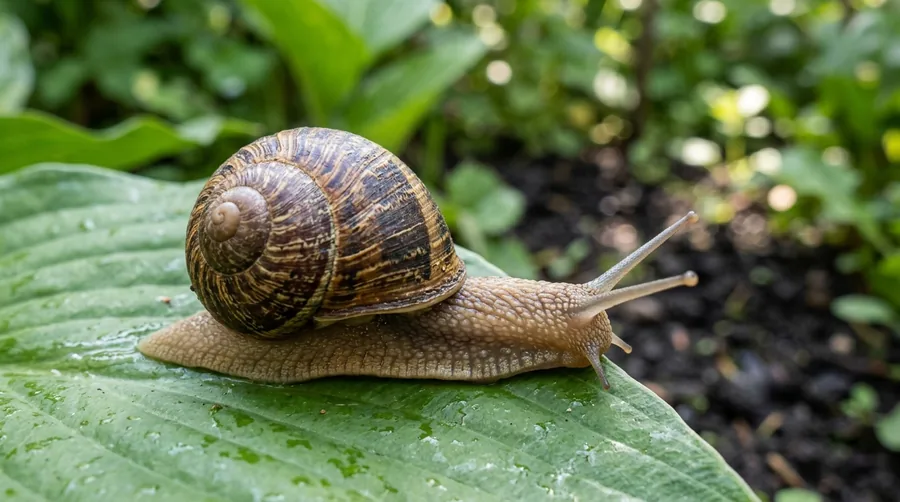
Brown garden snail with a banded round shell on a chewed green leaf
Recommended Products


What it does
The brown garden snail feeds at night and on damp, overcast days, gliding on a slimy foot and rasping holes in leaves, seedlings, flowers, and fruit. By day, and in dry or hot weather, it withdraws into its shell and seals itself to shaded walls, pots, or debris, then resumes feeding when conditions turn cool and moist.
Where it lives
Introduced from Europe, the brown garden snail is now a major pest in California, the Pacific coast, and the South. It shelters by day under boards, pots, dense groundcover, and garden debris, and on shaded walls and fences. Irrigated gardens, citrus, and landscapes in mild, moist climates support the largest numbers.
How it breeds
Brown garden snails are hermaphrodites; each mates and lays eggs. A snail can lay clusters of about 80 spherical white eggs in a soil nest, several times a year. Eggs hatch in a couple of weeks, and young snails mature over one to two years. They are longest-lived and most active in cool, moist seasons.
What it eats
The snail eats a broad range of plants, including seedlings, leafy vegetables, herbs, flowers, and ripening fruit, and it feeds on citrus leaves and rind. It also grazes on algae and decaying matter, but its damage to living garden and orchard plants is what makes it a serious pest.
Identification
The brown garden snail has a round, brownish shell about 1 to 1.25 inches across, with wavy yellow and dark-brown bands and a wrinkled surface. The soft body is gray-brown with two pairs of tentacles. Its shell separates it from slugs, and its silvery slime trails and smooth-edged leaf holes point away from insects.
Signs of an infestation
- Silvery, dried slime trails on plants, walls, and soil
- Ragged, smooth-edged holes in leaves, fruit, and flowers
- Seedlings and low foliage stripped overnight
- Snails clustered under pots, boards, and on shaded walls by day
- Chewed rind and leaves on citrus and other fruit
Prevention tips
- Remove daytime hiding places like boards, debris, and dense groundcover
- Hand-pick snails in the evening or after watering
- Install copper bands around trunks, beds, and planters
- Water in the morning so surfaces dry by night
- Encourage predators such as birds, ground beetles, and ducks
Professional solutions
Brown garden snails are generally a DIY pest. Iron phosphate baits work well and are lower-risk around pets and wildlife than metaldehyde; follow the EPA label. Combine baiting with hand-picking, copper barriers, and sanitation. In California citrus, predatory decollate snails have been used as biological control; check local rules, and consult extension for orchard-scale problems.
Health & safety
Brown garden snails do not bite or sting, but like slugs they can carry the rat lungworm parasite, which can rarely infect people who swallow a snail or eat contaminated raw produce. Cases are uncommon and concentrated in warm regions. Wash produce thoroughly and wash your hands after handling snails or garden debris.
Relevant Products


Frequently asked questions
How do I tell snail damage from insect damage?
Snails leave dried, silvery slime trails and rasp ragged holes with smooth edges in leaves and fruit, often overnight. Chewing insects leave no slime and usually different edge patterns. Finding snails clustered under pots, boards, or on shaded walls by day confirms them.
Are brown garden snails harmful to people?
They do not bite or sting, but they can rarely carry the rat lungworm parasite, which can infect people who accidentally swallow a snail or eat contaminated, unwashed produce. Cases are uncommon; wash produce well and wash your hands after handling snails.
What is the best way to control brown garden snails?
Combine methods: remove daytime hiding spots, hand-pick in the evening, and ring beds or trunks with copper barriers. Iron phosphate baits are effective and lower-risk around pets and wildlife than metaldehyde baits when used according to the label.
Fact-checked by Morgan Vance, Editorial Director (editorial review, not a professional pest-control or medical sign-off). Last reviewed July 30, 2026. We correct anything a reader shows us is wrong — see our corrections policy.