
Ground Beetle
Family Carabidae · also called ground beetles, carabid beetle
Quick answer
Ground beetles (family Carabidae) are fast-running, dark, often shiny beetles with ridged wing covers that hide under rocks and logs by day. They are beneficial predators of insects, slugs, and weed seeds, and only wander indoors by accident near lights. They cause no damage and do not bite or spread disease.
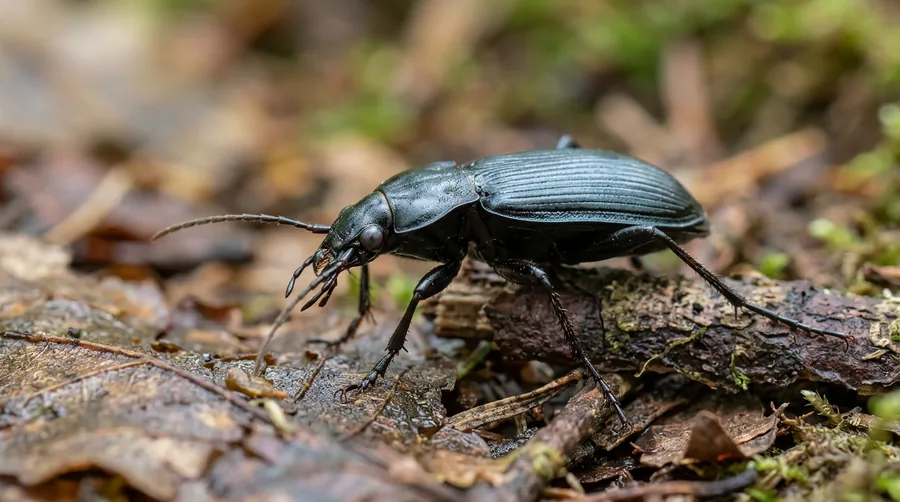
Shiny black ground beetle with ridged wing covers on soil
Recommended Products


What it does
Ground beetles are fast-running, mostly nocturnal hunters that hide by day under rocks, logs, mulch, and debris and come out at night to eat other insects. They are beneficial predators, not pests, and only enter homes by accident, usually drawn to lights. Indoors they cannot feed or breed and simply wander until removed.
Where it lives
They live outdoors in gardens, lawns, fields, and woodlands, sheltering under stones, bark, leaf litter, and boards. A few species stray indoors near ground level, especially where outdoor lighting or moisture draws them, but they are outdoor insects that do not establish inside homes.
How it breeds
Females lay eggs in the soil or leaf litter, and the larvae are also predatory, living in the ground and feeding on other small creatures. They pupate in the soil and emerge as adults. Most complete one generation per year, and adults of some species live for more than a year.
What it eats
Both adults and larvae are mainly predators, feeding on insects, caterpillars, slugs, snails, and other small invertebrates; some ground beetles also eat weed seeds, making them useful in gardens.
Identification
Ground beetles vary widely, from about 2 to 25 mm or more, but most are dark, shiny black or brown, sometimes with a metallic sheen, with ridged or grooved wing covers, long legs built for running, and prominent forward-pointing jaws. Their quick, ground-level scurrying is characteristic.
Signs of an infestation
- Fast-running dark beetles found on floors near doors at night
- Occasional beetles indoors after being drawn to outdoor lights
- Beetles sheltering under mulch, stones, or logs outdoors
- No feeding damage indoors, since they do not infest anything
Prevention tips
- Seal gaps under doors and around windows and the foundation
- Reduce outdoor lighting or switch to less attractive bulbs
- Move mulch, leaf litter, and woodpiles away from the foundation
- Vacuum or sweep up any that wander inside
Professional solutions
Ground beetles are beneficial and do not warrant chemical treatment. Since they are accidental invaders, exclusion, sealing entry points and reducing attractants, and simply removing the occasional beetle are all that is needed. A professional is essentially never required; the goal is to keep the outdoor predators outdoors, not to eliminate them.
Health & safety
Ground beetles do not spread disease and cause no damage to homes or belongings, so they pose no meaningful health risk. Most do not bite, though a few large species can deliver a harmless pinch or release a defensive secretion if handled. They are beneficial predators best left alone outdoors.
Relevant Products




Frequently asked questions
Are ground beetles harmful?
No. Ground beetles are beneficial predators that eat other insects, slugs, and snails, and even some weed seeds. They do not damage your home, food, or belongings, and they cannot breed indoors. The ones you see inside are accidental visitors that wandered in, usually toward light.
Do ground beetles bite?
Most ground beetles do not bite people, though a few of the larger species can give a harmless pinch with their jaws or release a smelly defensive fluid if you pick them up. They are not aggressive and pose no real risk; it is best to simply leave or remove them.
How do I stop ground beetles coming inside?
Since they are drawn in by light and moisture, reduce outdoor lighting, seal gaps under doors and around the foundation, and move mulch and leaf litter away from the walls. Vacuum or sweep up any that get in; no insecticide is needed for these harmless, beneficial insects.
Fact-checked by Morgan Vance, Editorial Director (editorial review, not a professional pest-control or medical sign-off). Last reviewed June 7, 2026. We correct anything a reader shows us is wrong — see our corrections policy.