
Blister Beetle
Epicauta spp. · also called blister beetles, striped blister beetle, black blister beetle
Quick answer
Blister beetles (Epicauta species) are elongated, soft-bodied beetles with a narrow 'neck' that feed in groups on garden and field plants. They contain cantharidin, a chemical that can blister skin on contact and is dangerous to horses if beetles are baled into hay. Their larvae, however, are beneficial and eat grasshopper eggs.
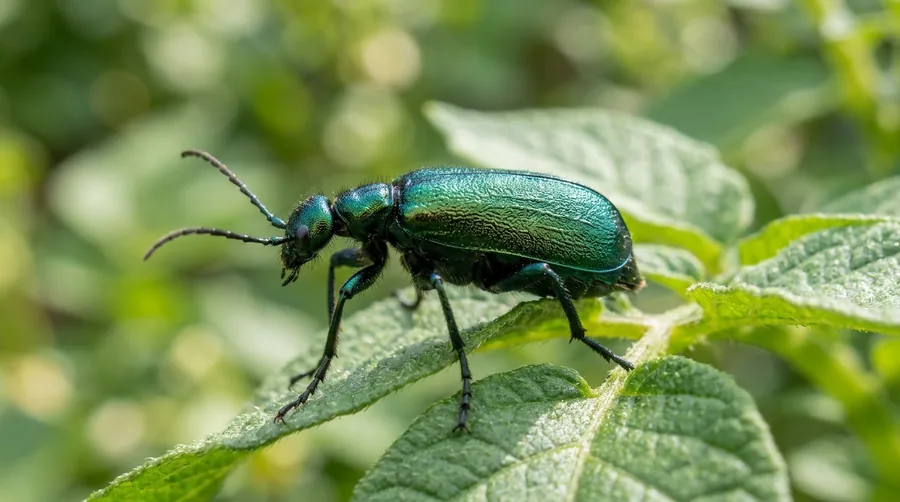
Elongated soft-bodied blister beetle with a narrow neck feeding on a garden plant leaf
Recommended Products


What it does
Adult blister beetles often feed in large, mobile swarms, stripping leaves, flowers, and pods before moving on. When handled or crushed, they exude cantharidin, a caustic defensive chemical that raises blisters on skin. Despite the adult damage, the larvae are predators that consume grasshopper egg pods in the soil.
Where it lives
Adults are found in vegetable gardens, alfalfa and hay fields, and on flowering weeds across the US, often most numerous in years following heavy grasshopper populations. They favor warm, sunny conditions and gather on legumes, tomatoes, potatoes, and amaranth.
How it breeds
Blister beetles undergo complex development called hypermetamorphosis. Females lay egg clusters in soil, and the active first-stage larva hunts down grasshopper egg pods, then molts through several less-mobile grub-like stages before pupating. There is generally one generation per year, with adults emerging in summer.
What it eats
Adults chew foliage, blossoms, and developing pods of many plants, especially legumes (alfalfa, beans), tomatoes, potatoes, eggplant, and amaranth. Larvae are beneficial predators that feed on grasshopper eggs in the soil.
Identification
Adults are 10-25 mm long, narrow and soft-bodied, with a distinctly narrow segment behind the head that gives a 'neck' look. Species vary from solid black or gray to boldly striped yellow-and-black. The soft, cylindrical body and long legs distinguish them from hard-shelled leaf beetles.
Signs of an infestation
- Clusters of long-necked beetles stripping foliage and blossoms
- Sudden, patchy defoliation of legumes, tomatoes, or potatoes
- Chewed flowers and developing pods
- Groups of beetles that move together from plant to plant
- Skin blistering after crushing a beetle against the skin
Prevention tips
- Wear gloves and handpick beetles into soapy water rather than crushing them
- Use row covers on vulnerable vegetables during peak beetle season
- Control broadleaf weeds that draw feeding swarms
- Scout hay and alfalfa carefully, since beetles baled into hay endanger horses
- Tolerate low numbers, since larvae help suppress grasshoppers
Professional solutions
Handpicking with gloves and row covers manage most garden situations. If swarms repeatedly damage vegetables, insecticidal options exist, but read the label and avoid crushing beetles onto skin. Horse owners and hay producers should contact their Cooperative Extension office, because cantharidin-contaminated hay is a serious veterinary hazard.
Health & safety
Blister beetles do not bite or sting, but their body fluid contains cantharidin, which can raise painful blisters on skin and irritate the eyes if a beetle is crushed against you. The greater danger is to livestock: horses can be poisoned, sometimes fatally, by eating beetles accidentally baled into alfalfa hay.
Relevant Products


Frequently asked questions
Can a blister beetle hurt you?
Blister beetles do not bite or sting, but if one is crushed against your skin it releases cantharidin, a chemical that can raise a blister or welt. Brush beetles off gently rather than swatting them, and wash the area if you feel irritation.
Are blister beetles dangerous to horses?
Yes. Cantharidin in blister beetles is highly toxic to horses, and beetles accidentally baled into alfalfa hay have caused serious and sometimes fatal poisoning. Horse owners should inspect hay sources and consult a veterinarian or Cooperative Extension office if exposure is suspected.
Should I kill blister beetles in my garden?
Handpicking adults with gloves protects your vegetables, but it is worth knowing the larvae are beneficial and eat grasshopper eggs in the soil. For a few beetles, gentle removal is enough; reserve stronger control for damaging swarms.
Fact-checked by Morgan Vance, Editorial Director (editorial review, not a professional pest-control or medical sign-off). Last reviewed July 9, 2026. We correct anything a reader shows us is wrong — see our corrections policy.