
Rose Chafer
Macrodactylus subspinosus · also called rose chafer, rose bug
Quick answer
The rose chafer (Macrodactylus subspinosus) is a slender tan beetle with long, spiny reddish legs that swarms roses, grapes, and other plants in early summer, chewing flowers and skeletonizing leaves. It favors sandy-soil areas, where its grubs feed on grass roots. The beetle contains a toxin that can be fatal to birds such as poultry if eaten.
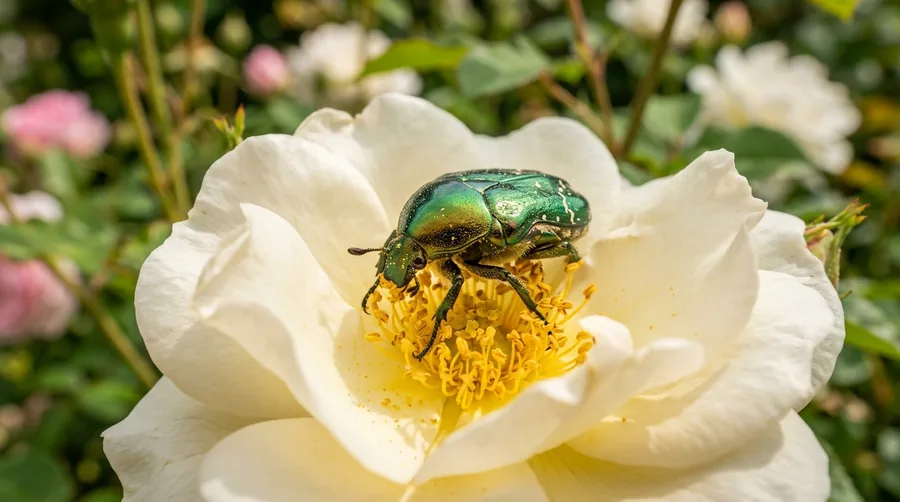
Slender tan rose chafer beetle with long spiny legs on a white rose blossom
Recommended Products


What it does
Adults emerge in early summer and often appear suddenly in numbers, feeding on flowers, foliage, and fruit. They chew the petals of roses and peonies and skeletonize the leaves of grapes and many other plants, feeding for a concentrated four-to-six-week period. Grubs live in the soil and feed on the roots of grasses and other plants.
Where it lives
Rose chafers are especially common in the Northeast, Midwest, and northern states in areas with light, sandy soils, which favor grub development. Adults are found in gardens, vineyards, orchards, and landscapes on roses, grapes, and a wide variety of trees, shrubs, and flowers.
How it breeds
There is one generation per year. After the early-summer feeding period, females lay eggs in sandy soil. The grubs feed on plant and grass roots through late summer and fall, then overwinter in the soil and pupate the following spring, emerging as adults in early summer to repeat the cycle.
What it eats
Adults feed on the blossoms, foliage, and fruit of many plants, especially roses, peonies, grapes, and various trees and shrubs. The soil-dwelling grubs feed on the roots of grasses and other plants.
Identification
Adults are slender, about 10-12 mm, tan to fawn-colored with a reddish-brown thread-like body and conspicuously long, spiny reddish legs. They are less rounded than Japanese beetles and lack that beetle's metallic green sheen. The long-legged, straw-colored look and swarming on roses and grapes are distinctive.
Signs of an infestation
- Chewed, ragged rose and peony blossoms in early summer
- Skeletonized leaves on grapes, roses, and shrubs
- Slender tan long-legged beetles clustered on flowers
- Sudden swarms appearing over a few weeks then vanishing
- Feeding concentrated in sandy-soil neighborhoods
Prevention tips
- Handpick beetles into soapy water during their short season
- Cover valued plants with fine netting during the flight period
- Keep poultry away from areas where beetles are numerous
- Tolerate feeding on established plants, which usually recover
- Avoid pheromone traps that can draw in more beetles
Professional solutions
Because rose chafers are present only a few weeks and established plants recover, most gardeners rely on handpicking and netting. Labeled insecticides can protect high-value roses or grapes during heavy flights. Your Cooperative Extension office can advise on timing and product choices and confirm rose chafer versus Japanese beetle if you are unsure.
Health & safety
Rose chafers do not bite or sting people and carry no human disease, so they pose no direct risk to gardeners. One notable caution: the beetles contain a toxin that can sicken or kill birds, including chickens and other poultry, if the birds eat them, so keep flocks away from areas where the beetles swarm.
Relevant Products


Frequently asked questions
What is the tan long-legged beetle eating my roses and grapes?
A slender, straw-tan beetle with long spiny reddish legs swarming roses, peonies, and grapes in early summer is the rose chafer. It chews blossoms and skeletonizes leaves for about four to six weeks, then disappears. It lacks the metallic green sheen of a Japanese beetle.
Are rose chafers dangerous to chickens?
Yes, to birds. Rose chafers contain a toxin that can sicken or kill poultry and other birds that eat them in quantity, so keep chickens away from areas where the beetles are swarming. The beetles are not harmful to people, who they neither bite nor sting.
How do I control rose chafers without traps?
Handpick beetles into soapy water and cover valued plants with fine netting during their short flight period. Avoid pheromone traps, which can attract even more beetles to your yard. Established roses and grapes usually recover, so tolerance is often the simplest approach.
Fact-checked by Morgan Vance, Editorial Director (editorial review, not a professional pest-control or medical sign-off). Last reviewed July 17, 2026. We correct anything a reader shows us is wrong — see our corrections policy.