
Japanese Beetle
Popillia japonica · also called japanese beetles
Quick answer
The Japanese beetle (Popillia japonica) is a metallic green-and-copper beetle that swarms and skeletonizes the leaves of roses, grapes, and hundreds of other plants in summer. Its white grubs feed on lawn roots, killing turf in patches. An invasive pest of the eastern US, it is harmless to people but damaging to gardens and lawns.
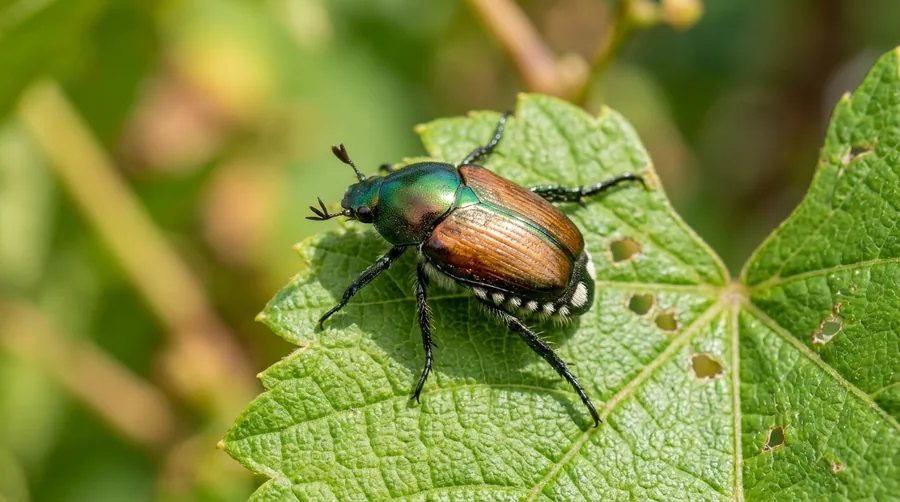
Metallic green and copper Japanese beetle on a skeletonized rose leaf
Recommended Products


What it does
Adults feed in groups on warm, sunny days, chewing leaf tissue between the veins and leaving a lacy, skeletonized look, and also feeding on flowers and fruit. Feeding beetles release odors that attract still more beetles, so damage snowballs. Below ground, the white grubs chew grass roots, producing dead, spongy lawn patches.
Where it lives
An invasive species first found in New Jersey in 1916, it is now established across the eastern US and parts of the Midwest and is spreading westward. Adults feed on over 300 plant species in gardens, orchards, and landscapes, while the grubs live in the soil of lawns, pastures, and turf.
How it breeds
Adults emerge in early to midsummer, feed, mate, and lay eggs in the soil of lawns. The grubs hatch and feed on grass roots through late summer and fall, overwinter deep in the soil, then feed again briefly in spring before pupating. There is one generation a year.
What it eats
Adults eat the leaves, flowers, and fruit of hundreds of plants (roses, grapes, lindens, fruit trees, and more); the grubs feed on the roots of turfgrass and other plants.
Identification
Adults are about 1/2 inch, shiny metallic green on the head and thorax with copper-bronze wing covers, and, uniquely, five small tufts of white hairs along each side plus two on the tip of the abdomen. Grubs are white, C-shaped, with a brown head, found in lawn soil.
Signs of an infestation
- Metallic green-and-copper beetles clustered on plants
- Leaves skeletonized to a lacy network of veins
- Chewed flowers and fruit in mid-summer
- Brown, dead patches of lawn that lift up easily
- White C-shaped grubs in the soil under damaged turf
Prevention tips
- Handpick beetles into soapy water in the early morning
- Avoid pheromone traps near plants, they can attract more beetles
- Keep lawns healthy; treat grubs only where they are damaging turf
- Protect prized plants with fine netting during peak flights
- Choose plants Japanese beetles tend to avoid for new plantings
Professional solutions
Home gardeners manage adults with hand-picking and netting, and lawns can be treated for grubs when counts are high. For persistent turf damage, a local extension office or lawn-care professional can advise on properly timed grub control, including milky spore or beneficial nematodes, and on labeled insecticides applied to protect pollinators.
Health & safety
Japanese beetles do not bite, sting, or carry any disease that affects people or pets, so they are harmless to handle. The impact is on plants and lawns, skeletonized foliage on ornamentals and crops, plus dead turf patches from root-feeding grubs, which can be extensive in a bad year.
Relevant Products


Frequently asked questions
Do Japanese beetle traps help or hurt?
Pheromone traps attract more beetles than they catch, often drawing them into your yard and onto nearby plants. Most experts advise against placing traps near gardens; hand-picking beetles into soapy water is more effective for protecting specific plants.
Are the grubs in my lawn Japanese beetles?
Possibly. Japanese beetle grubs are one of several white grubs that feed on grass roots and cause brown patches that lift like carpet. Confirming the species and grub count helps decide whether and when lawn treatment is worthwhile.
Fact-checked by Morgan Vance, Editorial Director (editorial review, not a professional pest-control or medical sign-off). Last reviewed May 14, 2026. We correct anything a reader shows us is wrong — see our corrections policy.