
Billbug
Sphenophorus spp. · also called billbugs, bluegrass billbug, turf weevil
Quick answer
Billbugs are small weevils with a long snout whose white, legless grubs feed inside grass stems and on roots. Damaged turf yellows and dies in irregular patches that pull up easily, often mistaken for drought. Common billbugs attack lawns and grasses across the US and pose no risk to people or pets.
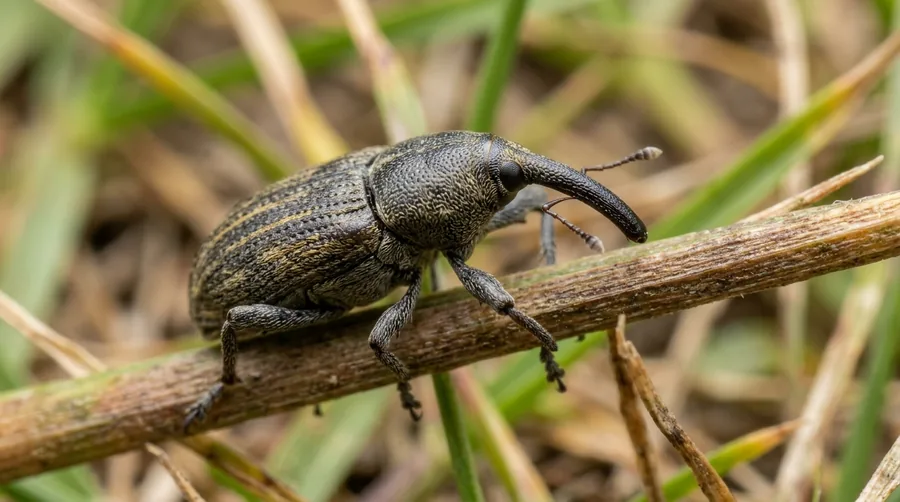
Dark gray billbug weevil with a long snout on a concrete surface beside grass
Recommended Products


What it does
Billbugs damage turf mainly as grubs. Adult weevils chew small holes in grass stems, then the white, legless larvae tunnel inside stems and feed on the crowns and roots. This severs the plant, so affected turf yellows, browns, and dies in patches that lift away easily, leaving fine, sawdust-like frass behind.
Where it lives
Billbugs live in lawns, pastures, and grass fields across the US, with several species common in home turf. Larvae feed inside stems and among roots at the soil surface; adults are found walking on driveways, sidewalks, and turf. Warm-season and cool-season grasses can both be attacked, depending on species.
How it breeds
Most common billbugs have one generation a year. Adults overwinter in soil and debris, become active in spring, and lay eggs inside grass stems. Larvae feed inside stems, then move to the crown and roots as they grow, pupate in the soil, and emerge as new adults in late summer. Some southern species have more generations.
What it eats
Billbug larvae feed inside grass stems and on the crowns and roots of turf grasses such as bluegrass, ryegrass, fescue, and zoysia. Adults chew on grass stems and blades. They are pests of lawns and grasses, not of people's food.
Identification
Adults are small, hard-bodied weevils about 1/4 to 3/8 inch, gray to black, with a long downward-curving snout. Larvae are small, white, legless grubs with a tan head, found inside stems or in the soil, and are easily confused with white grubs. Fine, sawdust-like frass in damaged stems is a key clue.
Signs of an infestation
- Irregular yellow-to-brown patches of dying turf
- Grass stems that break off easily and pull up with little effort
- Fine, sawdust-like frass at the base of damaged stems
- Snouted weevils walking on sidewalks and driveways in spring
- White, legless grubs inside stems or in the soil
Prevention tips
- Keep turf healthy and adequately watered to tolerate feeding
- Reduce thatch that shelters larvae and adults
- Plant endophyte-enhanced grass varieties where appropriate
- Monitor for adult weevils on pavement in spring
- Overseed and maintain dense turf to resist damage
Professional solutions
Because billbug larvae feed inside stems and roots, damage is often mistaken for drought and noticed late. Healthy turf and endophytic grasses help. A lawn-care professional can time an EPA-registered insecticide to adult activity in spring, or use beneficial nematodes against larvae, all applied per the label. Confirming billbugs first avoids treating the wrong problem.
Health & safety
Billbugs do not bite, sting, or spread disease to people or pets, so they present no health risk. They are strictly a turf pest: larvae killing grass stems and roots produce dead patches in lawns, which is a lawn-health and cosmetic concern rather than any threat to people, animals, or buildings.
Relevant Products


Frequently asked questions
How can I tell billbug damage from drought?
Billbug-damaged grass pulls up very easily, breaking at the crown, and you will often find fine, sawdust-like frass inside the stems and white, legless grubs nearby. Drought-stressed turf stays anchored by its roots. A simple tug test on browning patches helps tell them apart.
Are billbugs harmful to people or pets?
No. Billbugs do not bite, sting, or carry disease. They damage only lawns and grasses, so the concern is turf health and appearance, not any risk to people or animals.
How do I control billbugs in my lawn?
Maintain dense, healthy turf and consider endophyte-enhanced grasses, which resist billbugs. For active infestations, a lawn professional can time an EPA-registered insecticide to spring adult activity or apply beneficial nematodes against larvae, following the product label.
Fact-checked by Morgan Vance, Editorial Director (editorial review, not a professional pest-control or medical sign-off). Last reviewed May 14, 2026. We correct anything a reader shows us is wrong — see our corrections policy.