
Balsam Woolly Adelgid
Adelges piceae · also called BWA, balsam woolly aphid
Quick answer
The balsam woolly adelgid (Adelges piceae) is a tiny invasive sap-feeding insect that attacks true firs like balsam and Fraser fir. Hidden under white woolly wax, it feeds on bark, causing swollen nodes (gouting), stunted growth, crown dieback, and tree death. It is a major pest of fir forests and the Fraser fir Christmas-tree industry.
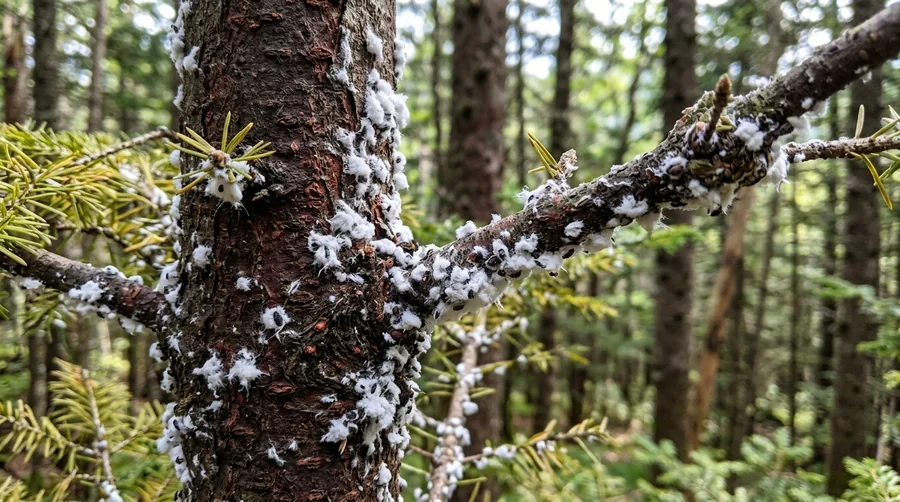
White woolly wax masses of balsam woolly adelgid coating the bark and nodes of a fir branch
Recommended Products


What it does
This adelgid feeds by inserting its mouthparts into the bark of true firs and injecting saliva as it sucks sap. The saliva disrupts the tree's growth, causing abnormal swellings (gouting) at buds and branch nodes, dense abnormal wood, and blocked movement of water and nutrients. Over several years, feeding stunts growth, kills the crown from the top down or the branches inward, and can kill the tree.
Where it lives
The balsam woolly adelgid attacks true firs (Abies), including balsam fir in the Northeast and Fraser fir in the southern Appalachians, plus western firs in the Pacific Northwest. It infests forest trees, Christmas-tree plantations, and landscape firs. A European native, it was introduced to North America over a century ago and has devastated high-elevation Fraser fir forests in the southern Appalachians.
How it breeds
In North America the adelgid reproduces without males, and all individuals are egg-laying females, allowing rapid population growth over two or more generations a year. Eggs hatch into tiny mobile 'crawlers' that settle on the bark, insert their mouthparts, and feed while secreting protective white wax. They overwinter as immatures on the bark and resume feeding and reproducing as conditions warm.
What it eats
The insect feeds only on the sap of true fir trees, drawing fluids from the bark of the trunk, branches, and nodes. It does not feed on other plants, people, or animals. Its saliva, injected during feeding, is what triggers the abnormal growth and decline in the host fir.
Identification
The adelgid itself is under a millimeter and rarely seen; what you notice is the white, woolly wax it secretes, appearing as tiny cottony specks or a white coating on the bark of the trunk and branches. Other clues are gouting, the swelling of buds and nodes into knobby lumps, plus stunted new growth, thinning, and reddish-brown dieback in the crown of affected firs.
Signs of an infestation
- White woolly wax specks or coating on fir bark and nodes
- Swollen, knobby buds and branch nodes (gouting)
- Stunted, distorted new growth
- Crown thinning and reddish-brown dieback
- Reduced needle retention and a gradually declining fir
- Death of the tree over several years in heavy infestations
Prevention tips
- Inspect firs for white woolly bark specks, especially on the trunk and nodes
- Avoid moving infested nursery stock or cut greenery to clean areas
- Keep landscape firs healthy and appropriately sited
- Report suspected infestations to your extension or forestry agency
- Choose adelgid-resistant species where firs repeatedly fail
Professional solutions
Landscape and Christmas-tree firs can be protected with properly timed insecticide treatments, but coverage is difficult because the insects hide under wax and on the trunk, so this is best handled by a certified arborist or licensed applicator. In forests, control relies on natural enemies and resistance rather than spraying. Because heavily infested firs decline over years, early detection and treatment give the best results.
Health & safety
The balsam woolly adelgid poses no risk to people or pets; it does not bite, sting, or spread disease to humans. Its impact is ecological and economic: it kills true firs, has reshaped southern Appalachian fir forests, and threatens the Fraser fir Christmas-tree industry, so its significance is to tree health, forests, and property rather than human safety.
Relevant Products




Frequently asked questions
What are the white woolly specks on my fir tree?
White, cottony specks or a woolly coating on the bark of a true fir often mean balsam woolly adelgid, a tiny sap-feeding insect hidden under the wax. Look also for swollen, knobby nodes (gouting) and crown dieback. Because it can kill firs over several years, early detection matters.
Can a fir infested with balsam woolly adelgid be saved?
Landscape and Christmas-tree firs can sometimes be protected with properly timed insecticide treatments applied by a professional, especially if caught early. Coverage is hard because the insects hide under wax on the bark. Heavily infested trees that are already declining often cannot be saved.
Is the balsam woolly adelgid the same as the hemlock woolly adelgid?
No. They are related sap-feeding adelgids that both make white wool, but the balsam woolly adelgid attacks true firs like balsam and Fraser fir, while the hemlock woolly adelgid attacks hemlocks. Correct identification matters because host trees and management differ.
Fact-checked by Morgan Vance, Editorial Director (editorial review, not a professional pest-control or medical sign-off). Last reviewed May 21, 2026. We correct anything a reader shows us is wrong — see our corrections policy.