
Hemlock Woolly Adelgid
Adelges tsugae · also called HWA, hemlock adelgid, woolly adelgid
Quick answer
The hemlock woolly adelgid (Adelges tsugae) is a tiny aphid-like insect that attacks eastern and Carolina hemlock trees. Native to Asia, it is spotted by the white, woolly egg sacs it leaves at the base of needles. It sucks sap, causing needle loss and, over years, tree death. It does not harm people or pets.
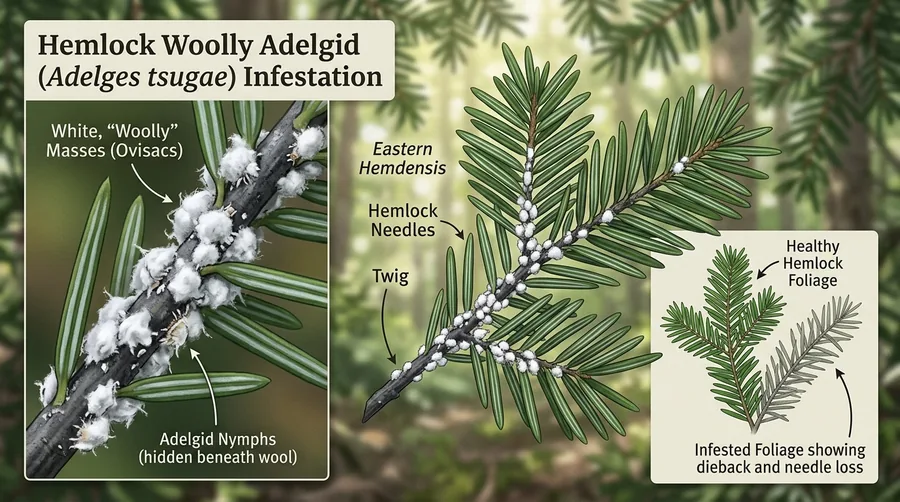
White woolly egg sacs of hemlock woolly adelgid lined along the underside of hemlock needles
Recommended Products


What it does
Hemlock woolly adelgids are sap-feeders that settle at the base of hemlock needles and stay put, covered by protective white wool they secrete. Feeding at the needle base cuts off nutrients, causing needles to gray, dry, and drop. Repeated infestation thins the canopy from the bottom up and can kill a tree over several years.
Where it lives
This pest lives only on hemlock trees, mainly eastern and Carolina hemlock in the eastern US. It is spread by wind, birds, deer, and people moving infested nursery stock or branches. It has become established from the Southern Appalachians through New England and continues to expand its range.
How it breeds
In North America the adelgid reproduces asexually, with two generations a year and no males needed, so populations build fast. Each female lays dozens of eggs in the white woolly mass. Crawlers hatch, settle on new growth, and feed through fall, winter, and spring, going dormant in the heat of summer.
What it eats
Hemlock woolly adelgids feed exclusively on the stored starches and sap at the base of hemlock needles, using piercing-sucking mouthparts. They feed on no other plant and eat nothing in or around the home.
Identification
The insect itself is under 2 mm and rarely seen. The giveaway is rows of white, woolly, cotton-ball-like sacs on the underside of branches where the needles meet the twig, most visible fall through spring. Do not confuse them with harmless white spittle or the normal pale bases of the needles.
Signs of an infestation
- White woolly sacs at the base of needles on branch undersides
- Graying, thinning needles and premature needle drop
- Dieback starting on lower and inner branches
- Loss of new-growth tips on hemlocks
- Overall decline of a hemlock over several seasons
Prevention tips
- Inspect hemlocks each winter for white woolly sacs
- Avoid moving hemlock branches, logs, or nursery stock from infested areas
- Do not place bird feeders in hemlocks, since birds spread the crawlers
- Keep trees healthy with proper water and mulch to improve resilience
- Report infestations to help track spread in newly affected areas
Professional solutions
Small landscape hemlocks can be treated by homeowners with horticultural oil or insecticidal soap applied to thoroughly coat the undersides of the branches. Large or high-value trees are best handled by a certified arborist using systemic insecticides such as soil-applied imidacloprid or dinotefuran. Early treatment greatly improves the odds of saving a tree.
Health & safety
Hemlock woolly adelgids pose no risk to human or pet health; they do not bite, sting, or carry disease and feed only on hemlock. The danger is to the trees and forests: infestations can kill mature hemlocks over several years, a real property and ecological loss in affected regions.
Relevant Products




Frequently asked questions
How do I know if my hemlock has woolly adelgid?
Look on the underside of the branches, where the needles attach to the twig, for rows of small white, woolly, cotton-like sacs. They are most obvious from fall through spring. Graying needles, thinning lower branches, and premature needle drop are supporting signs of an infestation.
Can I save a hemlock infested with woolly adelgid?
Often yes, if you act early. Small trees can be treated with horticultural oil or insecticidal soap that coats the branch undersides. Large or valued trees usually need a certified arborist to apply a systemic insecticide. The sooner treatment begins, the better the tree's chances.
Is the hemlock woolly adelgid harmful to people?
No. It feeds only on hemlock sap and cannot bite, sting, or spread disease to people or pets. The white wool is simply a protective coating over the insect and its eggs. The threat is entirely to hemlock trees, not to human health.
Fact-checked by Morgan Vance, Editorial Director (editorial review, not a professional pest-control or medical sign-off). Last reviewed June 3, 2026. We correct anything a reader shows us is wrong — see our corrections policy.