
Spotted Lanternfly
Lycorma delicatula · also called SLF, spotted lantern fly, lanternfly
Quick answer
The spotted lanternfly (Lycorma delicatula) is an invasive planthopper with gray black-spotted forewings and scarlet underwings. Native to Asia, it sucks sap from grapes, hardwoods, and its favorite tree-of-heaven, then coats plants and decks in sticky honeydew that grows sooty mold. It does not bite people but threatens crops and landscapes.
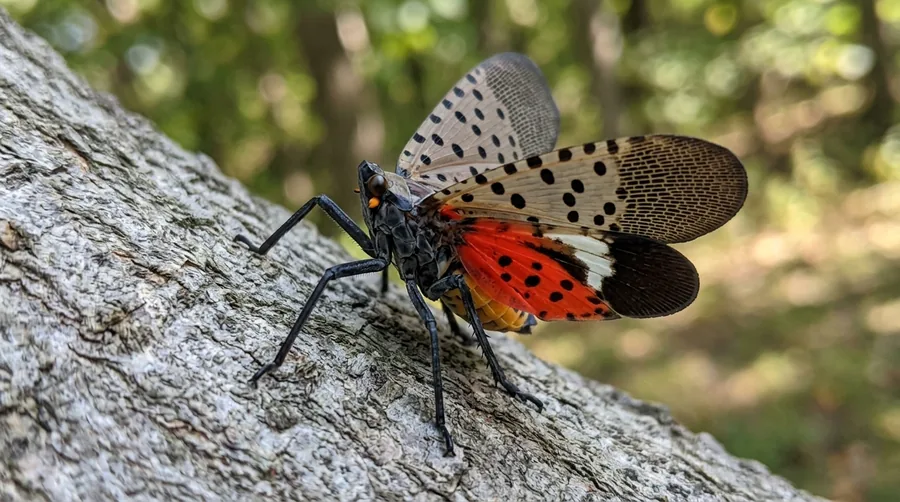
Spotted lanternfly with gray black-spotted forewings and bright red underwings on tree bark
Recommended Products


What it does
Spotted lanternflies are sap-sucking planthoppers that gather in large numbers on trunks and stems. They hop strongly rather than fly far. As they feed they excrete sugary honeydew that coats leaves, decks, and cars, encouraging black sooty mold and drawing wasps. Heavy feeding weakens grapevines and young trees.
Where it lives
This invasive favors tree-of-heaven (Ailanthus altissima) but feeds on more than 70 plants, including grape, maple, walnut, and fruit trees. It lays eggs on almost any flat surface: bark, stone, vehicles, and outdoor furniture. It is established across the Northeast and is spreading into the Midwest and Southeast.
How it breeds
There is one generation a year. Females lay gray, mud-like egg masses of 30-50 eggs in fall that overwinter. Eggs hatch in spring into black-and-white then red-and-black nymphs (four instars), maturing into winged adults by mid-summer. Adults die off after the first hard frosts.
What it eats
Both nymphs and adults feed only on plant sap, drawn from stems, trunks, and leaves with piercing mouthparts. They do not chew leaves or eat household food.
Identification
Adults are about an inch long at rest, with gray forewings marked by black spots and a brick pattern; the hidden hindwings flash red, white, and black. Nymphs are wingless: early stages are black with white spots, and the last stage is bright red with black and white markings.
Signs of an infestation
- Sticky honeydew and black sooty mold under trees
- Gray, putty-like egg masses on bark and flat surfaces
- Weeping sap and wasps or ants gathering on trunks
- Clusters of spotted insects hopping on stems
- Red-and-black spotted nymphs on garden plants
Prevention tips
- Scrape egg masses into a bag of alcohol or hand sanitizer in fall and winter
- Remove tree-of-heaven where possible, its preferred host
- Check vehicles, trailers, and firewood before moving them
- Wrap trunks with sticky or circle traps during nymph season
- Report new sightings to your state agriculture department
Professional solutions
Spotted lanternfly is hard to eradicate once established. Arborists and licensed applicators use targeted systemic or contact insecticides on high-value or repeatedly infested trees, and manage tree-of-heaven with herbicide. Because it is a regulated invasive, report sightings and follow any local quarantine before moving plants or outdoor items.
Health & safety
Spotted lanternflies do not bite, sting, or spread disease to people or pets, so the direct health risk is low. The problems are agricultural and nuisance: crop and landscape damage, plus sticky honeydew and sooty mold that foul decks, cars, and play areas. Their real threat is to vineyards, orchards, and forests.
Relevant Products


Frequently asked questions
Do spotted lanternflies bite or hurt people?
No. Spotted lanternflies have no biting or stinging mouthparts and are harmless to people and pets. They only pierce plants to feed on sap. The concern is the damage they do to grapes, trees, and crops, plus the sticky honeydew and sooty mold they leave on outdoor surfaces.
What should I do if I see a spotted lanternfly?
In areas where it is invasive, kill it and report the sighting to your state agriculture department, since tracking its spread matters. Scrape and destroy any egg masses you find on bark or flat surfaces in fall and winter, and check your vehicle and firewood before traveling.
Why are spotted lanternflies a big deal if they don't bite?
They are a serious agricultural pest. Heavy feeding stresses grapevines, fruit trees, and hardwoods, and their honeydew fuels sooty mold that blocks light and coats property. Because they hitchhike on cars and firewood, they spread fast, which is why states quarantine and track them.
Fact-checked by Morgan Vance, Editorial Director (editorial review, not a professional pest-control or medical sign-off). Last reviewed June 1, 2026. We correct anything a reader shows us is wrong — see our corrections policy.