
Periodical Cicada
Magicicada spp. · also called 17-year cicada, 13-year cicada, periodical cicadas
Quick answer
Periodical cicadas (Magicicada species) are black, red-eyed insects that emerge in massive synchronized broods every 13 or 17 years across the eastern US. Males sing loud daytime choruses to attract mates. They do not bite, sting, or spread disease, and adults live only a few weeks. Egg-laying can flag twigs on young trees.
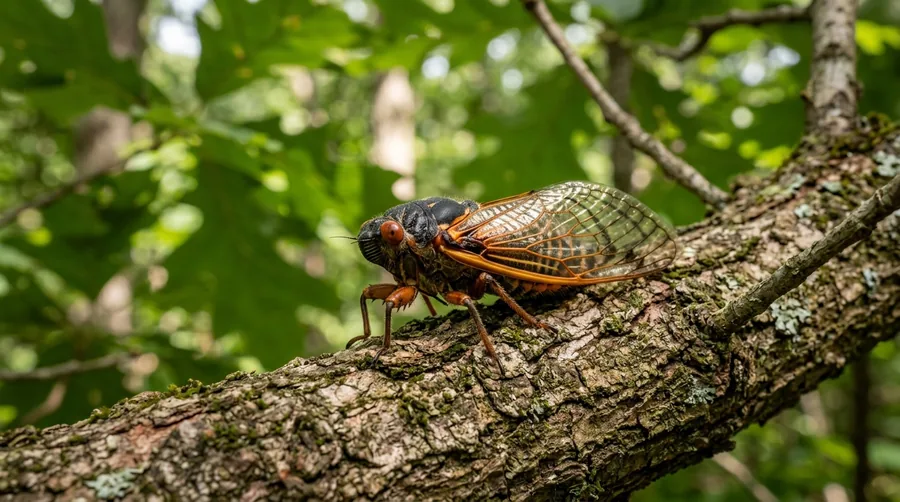
Black periodical cicada with bright red eyes and orange wing veins clinging to a twig
Recommended Products


What it does
Periodical cicadas spend most of their lives underground as nymphs, then emerge together in enormous numbers over a few weeks. Males form deafening daytime choruses using drum-like organs to attract females. Adults are clumsy fliers that cling to trees. They harm no one but can overwhelm a yard with sheer numbers and noise.
Where it lives
Nymphs live underground feeding on tree-root sap, then climb trunks, shrubs, and fences to molt. Adults gather in deciduous trees. Periodical broods are mapped across the eastern and central US; a given brood emerges in specific states on its 13- or 17-year schedule.
How it breeds
After 13 or 17 years underground, nymphs surface, molt into winged adults, mate, and die within four to six weeks. Females cut slits in pencil-thin twigs and lay eggs there. Eggs hatch in six to ten weeks; the tiny nymphs drop to the soil and burrow down to begin the long cycle again.
What it eats
Both nymphs and adults feed on plant fluids. Underground nymphs draw sap from tree roots; short-lived adults feed little, taking small amounts of sap from twigs. They do not chew leaves or eat household food.
Identification
Adults are 1 to 1.5 inches with a black body, striking red eyes, and clear wings with orange veins. This separates them from the larger green-and-black annual (dog-day) cicadas. Look for split brown nymphal shells left on tree trunks and fences after they molt.
Signs of an infestation
- Loud, pulsing daytime chorus from the trees
- Empty brown nymphal shells on trunks and fences
- Pencil-sized emergence holes in soil under trees
- Browning, flagged twig tips on young trees
- Sudden mass appearance of red-eyed insects
Prevention tips
- Delay planting young or bare-root trees in an emergence year
- Cover small trees and shrubs with fine netting during the emergence
- Avoid pesticides, which do little against such huge numbers
- Leave established trees alone; they tolerate the damage
- Simply wait it out, since adults are gone within weeks
Professional solutions
Periodical cicadas almost never need professional control; their emergence is brief and self-limiting. Insecticides are ineffective against such numbers and can harm pollinators. The only real concern is twig damage to newly planted trees, best handled by netting. An arborist can advise on protecting young or high-value plantings.
Health & safety
Periodical cicadas do not bite, sting, or carry diseases, and they are not venomous or poisonous, so they pose essentially no risk to people or pets. A dog that eats a few is usually fine, though gorging on many can cause temporary stomach upset. The main downsides are noise and volume, not danger.
Relevant Products




Frequently asked questions
Are periodical cicadas dangerous or do they bite?
No. Periodical cicadas cannot bite or sting and carry no disease. They are harmless to people and pets. Very rarely a cicada may probe skin with its feeding tube if held, but it does not draw blood or inject venom. They are loud but not a health threat.
Why do cicadas come out every 13 or 17 years?
Periodical cicadas spend those years underground as nymphs feeding on root sap, then emerge together on a synchronized clock. Scientists think these long prime-numbered cycles help them overwhelm predators by sheer numbers and avoid syncing with predator populations. Different broods emerge in different regions and years.
Will cicadas damage my trees?
Mature trees shrug off cicadas. The only real harm is to young or newly planted trees, whose thin twigs females slit to lay eggs, causing tips to brown and flag. Cover small trees with fine netting during the emergence rather than spraying, which does little against their numbers.
Fact-checked by Morgan Vance, Editorial Director (editorial review, not a professional pest-control or medical sign-off). Last reviewed May 15, 2026. We correct anything a reader shows us is wrong — see our corrections policy.